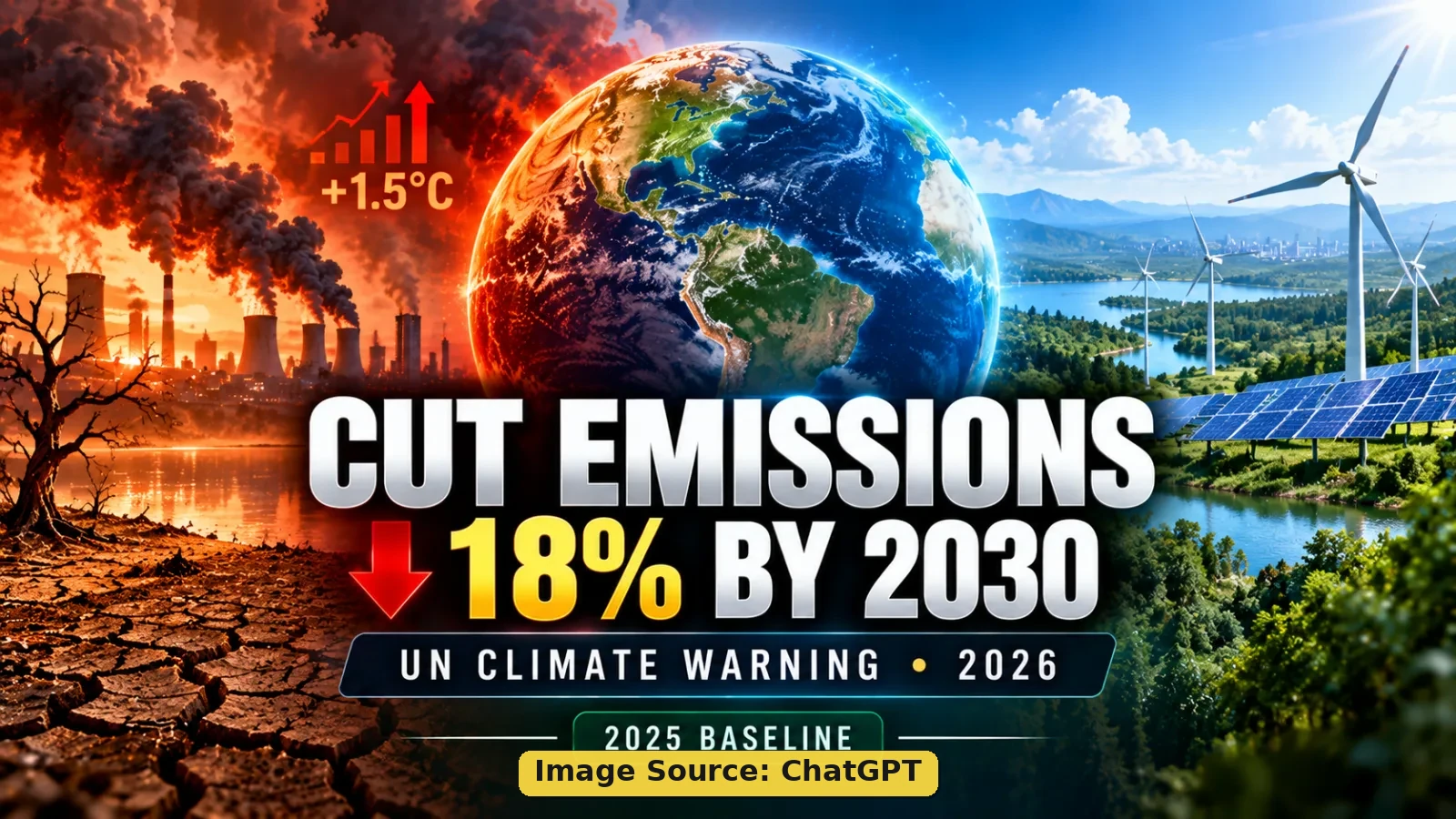
The world has less than four years to deliver a major reduction in greenhouse gas emissions if it wants to prevent global warming from reaching even more dangerous levels, according to a new United Nations climate assessment.
The United Nations Environment Programme (UNEP) has warned that global greenhouse gas emissions must fall by 18% by 2030, 45% by 2035 and 69% by 2040, compared with 2025 levels.
The findings are presented in the Emissions Gap Report 2026: The Point of Return, released on October 21.
The report delivers a troubling conclusion: the opportunity to prevent a temporary breach of the Paris Agreement's 1.5°C warming threshold has effectively disappeared.
However, scientists say humanity can still limit how far temperatures rise beyond that threshold and potentially bring warming back to 1.5°C by the end of the century.
Achieving that outcome would require substantial changes in global energy systems, faster reductions in fossil fuel use, stronger climate policies and carefully managed carbon dioxide removal.
The next four years will be particularly important because continued delays would make future reductions considerably more difficult.
UN Climate Report 2026: Why the 18% Emissions Target Matters
The central warning in the latest UNEP assessment is that climate commitments are not translating into emissions reductions quickly enough.
Countries have announced numerous plans to expand renewable energy, improve efficiency and reduce dependence on fossil fuels.
Yet global greenhouse gas emissions remain close to historically high levels.
UNEP estimates that the world released approximately 58.4 billion tonnes of carbon dioxide equivalent in 2025.
That figure was broadly comparable to 2024 levels, although the available estimates contain uncertainties.
A relatively stable year does not establish that global emissions have begun a sustained decline.
The distinction is essential.
To limit future warming, the world must do more than stop emissions from increasing. It must begin reducing them rapidly and maintain that decline for decades.
UNEP's proposed pathway requires the following global reductions:
| Target year | Reduction from 2025 levels |
|---|---|
| 2030 | 18% |
| 2035 | 45% |
| 2040 | 69% |
These targets describe collective global emissions reductions, not identical mandatory percentage cuts for every individual country.
Different countries have different emissions histories, economic circumstances and responsibilities under international climate agreements.
The challenge is developing national policies that collectively deliver the reductions required.
What Does the UN Mean by Returning to 1.5°C?
The Paris Agreement, adopted in 2015, established an international objective of keeping global warming well below 2°C while pursuing efforts to limit it to 1.5°C above pre-industrial temperatures.
The 1.5°C threshold matters because climate risks become more serious as global average temperatures increase.
Higher temperatures can intensify heatwaves, increase the likelihood of certain extreme rainfall events, worsen drought conditions in vulnerable regions and contribute to rising sea levels.
The latest UNEP report concludes that exceeding 1.5°C for a period is now effectively unavoidable.
Scientists describe this temporary exceedance as a temperature overshoot.
An overshoot does not necessarily mean that temperatures must remain permanently above the threshold.
If humanity rapidly reduces emissions and subsequently removes sufficient carbon dioxide from the atmosphere, global temperatures could eventually decline.
Under UNEP's lowest-overshoot scenario, warming would peak at approximately 1.7°C to 1.8°C around the middle of the century.
Temperatures could then return to 1.5°C or below by 2100, with an estimated probability of approximately 50%.
That outcome is not guaranteed.
It depends on ambitious emissions reductions, extensive international cooperation and the successful development of reliable carbon-removal methods.
Current Climate Policies Could Lead to 2.8°C of Global Warming
Perhaps the most concerning finding is the difference between the emissions reductions required and the policies governments have already implemented.
According to UNEP, existing climate policies could lead to approximately 2.8°C of warming during this century, with temperatures potentially continuing to rise afterward.
Even if countries fully implement their existing national climate commitments, projected warming would still reach around 2.6°C.
The report also considers a more optimistic scenario in which countries fulfill both their nationally determined contributions and additional net-zero commitments.
Even that outcome would limit projected warming to approximately 2.1°C.
These figures reveal a substantial gap between international ambition and expected results.
The Paris Agreement encourages countries to submit increasingly ambitious emissions-reduction plans, formally known as nationally determined contributions, or NDCs.
However, promises alone cannot reduce atmospheric greenhouse gas concentrations.
The necessary changes must occur through electricity generation, industrial production, transportation, land use and other economic activities.
UNEP estimates that full implementation of current NDCs would reduce emissions by only 5% to 8% by 2030 compared with 2025.
That falls considerably short of the 18% reduction required under its lowest-overshoot pathway.
Why Scientists Say Delaying Climate Action Is Becoming More Dangerous
Climate change presents a particular challenge because carbon dioxide remains in the climate system for a long time.
Every additional year of substantial emissions adds to the cumulative amount of carbon dioxide affecting global temperatures.
Reducing future emissions can limit further warming, but it does not immediately reverse the consequences of past emissions.
UNEP estimates that another five years of carbon dioxide emissions at current levels would add approximately 0.1°C to peak global warming.
That may appear to be a small temperature difference.
However, changes in global average temperature influence conditions across the planet.
Even relatively small increases can affect heat extremes, water availability, ecosystems and agricultural production.
Repeated delays also increase the scale of future economic adjustments.
For example, postponing investment in clean electricity infrastructure may require countries to replace a larger amount of fossil fuel capacity over a shorter period later.
Similarly, delaying improvements in transport systems can extend dependence on vehicles and infrastructure that produce substantial emissions.
The longer action is postponed, the more difficult it becomes to achieve the same climate outcome.
Renewable Energy Expansion Offers a Major Opportunity
Despite its warnings, the UN report identifies significant reasons for optimism.
Renewable electricity technologies have expanded considerably faster than many earlier projections anticipated.
Since the Paris Agreement was adopted, global renewable electricity capacity has grown at approximately three times the previously anticipated pace.
Solar photovoltaic deployment has expanded around seven times faster than earlier expectations.
These developments are important because electricity generation is central to the global energy transition.
Renewable sources such as solar and wind can produce electricity without the direct carbon dioxide emissions associated with burning coal or natural gas.
When combined with reliable electricity networks, storage technologies and flexible energy systems, they can help countries reduce dependence on fossil fuels.
The challenge is increasing deployment fast enough to meet rising electricity demand while replacing existing high-emission generation.
International climate commitments already include a goal to triple renewable energy capacity by 2030.
UNEP suggests that continued growth, supported by stronger policies, could make this objective achievable.
However, constructing additional renewable power plants is only part of the solution.
Governments must also invest in transmission networks, electricity storage and the systems required to maintain reliable energy supplies.
Coal, Oil and Gas Must Play a Smaller Role in Global Energy
Reducing dependence on fossil fuels remains essential to limiting future warming.
Coal, oil and natural gas have supported economic development for generations, but their combustion releases carbon dioxide into the atmosphere.
UNEP's latest report sets out sector-specific benchmarks for a pathway that minimizes the overshoot of 1.5°C.
One of the most demanding recommendations concerns coal-fired electricity generation.
Under the proposed pathway, global coal power generation would need to decline by at least 75% by 2035 compared with 2025 levels.
Coal-fired generation would then need to be effectively phased out worldwide by 2040.
The report also identifies substantial reductions in the share of fossil fuels within the global energy supply.
Such changes would require new investment in electricity infrastructure, industrial technology, transportation and energy efficiency.
Countries heavily dependent on fossil fuel production may face additional economic challenges.
Workers and communities connected to coal mining, petroleum production and related industries could require assistance as energy systems change.
A successful transition therefore needs policies that address employment, affordability and regional economic development alongside emissions reduction.
Cutting Methane Could Deliver Faster Climate Benefits
Carbon dioxide receives much of the attention in climate policy, but it is not the only greenhouse gas contributing to global warming.
Methane is another major concern.
It is released from activities including oil and gas production, agriculture, waste management and coal mining.
Methane is particularly important because it has a powerful warming effect over shorter periods.
Unlike carbon dioxide, which can influence the climate for centuries, atmospheric methane has a substantially shorter average lifetime.
That means sustained reductions in methane emissions can help slow the rate of warming within the coming decades.
UNEP's proposed pathway calls for global methane emissions to fall by at least 25% by 2035 and 40% by 2040 compared with 2025 levels.
Practical measures include identifying leaks from oil and gas infrastructure, improving waste management and adopting appropriate agricultural practices.
Some methane reductions can also offer economic benefits.
Capturing gas that would otherwise escape into the atmosphere may allow energy companies to recover a commercially useful resource.
However, methane reductions cannot replace the need for major carbon dioxide cuts.
Both are necessary to achieve durable climate progress.
Carbon Removal May Be Needed to Reverse Temperature Overshoot
An important aspect of the new UN assessment is its conclusion that emissions reductions alone may no longer be sufficient to return global warming to 1.5°C after a temporary overshoot.
Additional carbon dioxide removal would be required.
Carbon removal refers to processes that take carbon dioxide out of the atmosphere and store it for extended periods.
Examples include restoring certain natural carbon sinks and developing technologies that capture carbon dioxide directly from the air.
UNEP estimates that its lowest-overshoot scenario would require removing and permanently storing approximately 320 billion tonnes of carbon dioxide over the course of this century.
That is an enormous undertaking.
Current carbon-removal approaches face challenges involving cost, energy consumption, land use, measurement and long-term storage reliability.
Some technologies remain expensive or have not been demonstrated at the scale required.
Natural carbon sinks can also be vulnerable to wildfires, drought and changes in land management.
For these reasons, carbon removal should be viewed as a complementary strategy rather than a substitute for reducing emissions.
Preventing carbon dioxide from entering the atmosphere is generally preferable to depending on uncertain future efforts to remove it.
How Climate Change Could Affect Food, Water and Human Health
The consequences of inadequate climate action extend well beyond environmental statistics.
Global warming can influence the systems that support daily life.
Agriculture is particularly vulnerable to extreme weather.
Prolonged heat can reduce crop productivity, while droughts and intense rainfall can damage farmland and disrupt food production.
Water resources may also come under greater pressure as rainfall patterns change and evaporation increases.
In some regions, communities already experience serious difficulties obtaining reliable water supplies during unusually hot or dry conditions.
Human health is another major concern.
Extreme heat can increase the risk of heat-related illness, particularly among older adults, outdoor workers and people with underlying medical conditions.
Floods and storms can damage healthcare infrastructure, interrupt essential services and force people to leave their homes.
Climate-related disruptions can also affect transportation, electricity networks and household finances.
These risks are not distributed equally.
Communities with fewer financial resources may have less capacity to adapt, even when their historical contribution to global greenhouse gas emissions has been relatively small.
That inequality is one reason international climate discussions place substantial emphasis on adaptation finance and assistance for vulnerable countries.
Developing Countries Need More Support for the Energy Transition
Meeting global climate targets will require participation from both developed and developing economies.
However, countries face different financial and technological conditions.
Wealthier nations may have greater access to affordable financing, advanced infrastructure and specialized technical expertise.
Lower-income countries can struggle to secure funding for renewable energy projects, resilient infrastructure and clean transportation.
High borrowing costs can make renewable energy investment more difficult, even when projects could deliver long-term economic savings.
Climate finance can help address these barriers by supporting technology deployment, adaptation and institutional capacity.
International cooperation is especially important where energy demand is growing rapidly.
Developing economies need reliable and affordable electricity to improve living standards, expand healthcare services and support industrial development.
The challenge is finding ways to meet these legitimate needs while limiting additional emissions.
Greater access to clean technology, improved financial arrangements and investment in electricity networks could help countries pursue economic growth with a lower environmental impact.
What Governments Can Do Before 2030
The UN report emphasizes that effective climate policies already exist.
Its assessment identifies numerous examples of government measures that have helped reduce emissions in different countries and sectors.
More than 220 policy evaluations demonstrate that interventions involving electricity generation, carbon pricing and related measures can produce measurable results.
The difficulty is expanding successful approaches to a scale consistent with global climate objectives.
Several priorities stand out.
Accelerating clean electricity: Governments can simplify appropriate project approvals, strengthen power grids and encourage investment in reliable low-emission energy.
Improving energy efficiency: Better building standards, efficient industrial equipment and modern electrical systems can reduce energy demand without requiring equivalent reductions in economic activity.
Reducing methane leakage: Stronger monitoring and improved management practices can help limit emissions from energy production and other major sources.
Protecting forests: Preventing unnecessary deforestation preserves ecosystems and supports natural carbon storage.
Supporting low-emission transportation: Public transport, efficient vehicle technologies and appropriate charging infrastructure can reduce dependence on petroleum-based fuels.
These measures are most effective when supported by clear long-term policies and credible implementation plans.
Why COP31 Could Be Important for Global Climate Action
The upcoming COP31 UN climate conference in November 2026 will provide another opportunity for governments to respond to the widening gap between climate commitments and actual emissions trends.
International climate negotiations can help establish shared priorities and encourage countries to strengthen national policies.
However, agreements reached during conferences must be followed by domestic action.
The next formal global stocktake under the Paris Agreement is scheduled for 2028.
That process is intended to assess collective progress toward international climate goals and inform future national commitments.
UNEP's latest report underscores the importance of using these milestones to support immediate action rather than postponing decisions.
The 2030 deadline is now close enough that new infrastructure, legislation and investment decisions could strongly influence whether the targets remain achievable.
Can the World Still Avoid the Worst Climate Outcomes?
The latest assessment does not suggest that all climate efforts have failed.
Instead, it shows that the range of achievable outcomes is becoming narrower.
Holding warming below 1.5°C without a meaningful overshoot is no longer considered realistic.
But the difference between 1.8°C, 2.1°C and 2.8°C of warming remains extremely significant.
Every reduction in future temperature rise can help limit additional risks to people, ecosystems and infrastructure.
Renewable energy deployment has accelerated, climate policies have produced measurable benefits, and technological improvements are creating more options for reducing emissions.
The remaining challenge is deploying these solutions at sufficient speed.
The report's findings suggest that the main obstacles are not exclusively scientific or technological.
They also involve investment, political decisions, infrastructure development and international cooperation.
Whether the world can achieve a credible return pathway will depend on how governments and businesses respond over the next several years.
Final Outlook: The Next Four Years Will Help Determine the Climate Future
The United Nations' latest emissions assessment delivers a warning that is difficult to ignore.
Global greenhouse gas emissions must fall by 18% by 2030 and 45% by 2035 from 2025 levels to keep the lowest possible overshoot pathway within reach.
Current national commitments remain insufficient, while existing policies could lead to approximately 2.8°C of warming during this century.
Yet the report also demonstrates that progress is possible.
Renewable energy is expanding rapidly, proven climate policies are available, and reductions in methane and fossil fuel emissions could produce substantial benefits.
The challenge is no longer simply identifying solutions.
It is implementing them quickly enough to make a measurable difference.
The world may no longer be able to avoid temporarily exceeding 1.5°C of warming, but it can still influence how high temperatures rise, how long they remain elevated and how severely future generations are affected.
The choices made between now and 2030 will play a major role in determining whether humanity moves toward a more stable climate or faces increasingly difficult consequences from delayed action.