The world's governments have reached a new agreement to accelerate the protection of nature, but difficult questions surrounding money, industrial subsidies, and responsibility for environmental damage remain unresolved.
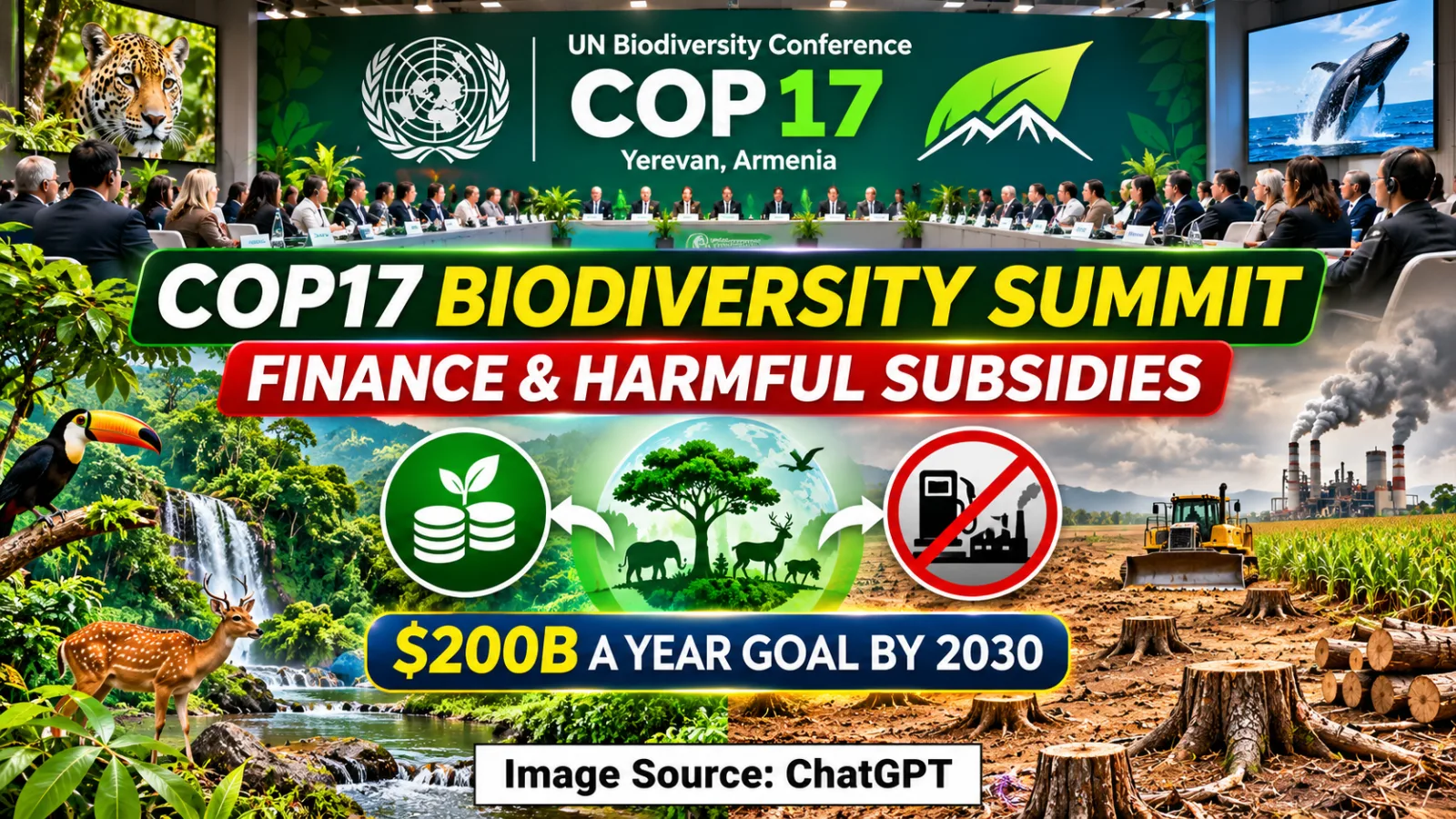
The United Nations COP17 biodiversity conference concluded in Yerevan, Armenia, on October 31, 2026, after negotiations extended beyond the scheduled closing date.
Delegates adopted the Yerevan Pathway, a plan intended to improve implementation of the Kunming–Montreal Global Biodiversity Framework, which established ambitious environmental targets for 2030.
The agreement marks diplomatic progress, yet the conference exposed a troubling contradiction. Governments are promising to protect forests, wildlife, oceans, and freshwater ecosystems while public financial incentives continue supporting some activities that damage those same natural resources.
New conservation-finance announcements exceeded $1.8 billion, according to conference organizers. However, that amount remains small compared with the international commitment to mobilize at least $200 billion annually for biodiversity by 2030.
For ordinary people, these negotiations are not simply about environmental diplomacy. Their outcomes can influence food security, drinking water, farming livelihoods, employment, and the cost of maintaining healthy ecosystems.
The central question is whether governments can turn international promises into measurable improvements before the decade ends.
1. What Happened at the COP17 Biodiversity Conference?
COP17 was the seventeenth meeting of parties to the United Nations Convention on Biological Diversity.
The main negotiations took place in Yerevan from October 19, with the final discussions continuing into October 31.
Representatives from governments, scientific institutions, environmental organizations, businesses, and Indigenous communities gathered to evaluate global conservation commitments.
Unlike climate conferences primarily associated with greenhouse gas emissions, biodiversity negotiations address the living systems that support the planet.
These include forests, wetlands, grasslands, freshwater ecosystems, oceans, wild species, and the genetic diversity within them.
A major responsibility of COP17 was conducting the first collective global review of the Kunming–Montreal framework, adopted in 2022.
The findings were concerning.
Although countries had made progress in creating national biodiversity targets, implementation remained insufficient across nearly all major commitments.
Delegates ultimately agreed that existing measures needed substantial acceleration.
2. COP17 Key Results and Financial Commitments
The conference produced several important outcomes, but not every announcement represented new money already delivered to conservation projects.
| Key Measure | COP17 Position or Commitment |
|---|---|
| Host city | Yerevan, Armenia |
| Conference conclusion | October 31, 2026 |
| Main agreement | Yerevan Pathway |
| Global biodiversity finance goal | At least $200 billion annually by 2030 |
| Harmful incentives reform goal | Reduce by at least $500 billion annually by 2030 |
| Conservation target | 30% of land and waters by 2030 |
| Ecosystem restoration target | 30% of degraded ecosystems by 2030 |
| Conference finance announcements | More than $1.8 billion |
| Long-term funding mechanism | Institutional details deferred |
| Next biodiversity summit | COP18, Quito, Ecuador, 2028 |
The figures describe different types of commitments.
The $1.8 billion represents reported finance announcements associated with the conference, while $200 billion is an annual international mobilization target.
The $500 billion figure concerns reducing or reforming environmentally damaging incentives, rather than creating a new conservation fund of that amount.
Understanding these differences is essential when evaluating whether global environmental finance is actually improving.
3. Why Biodiversity Funding Became the Biggest Disagreement
Protecting biodiversity requires more than creating national parks or introducing environmental legislation.
Governments must finance habitat restoration, wildlife monitoring, sustainable agriculture, pollution reduction, and enforcement against illegal environmental activities.
Many developing countries contain extraordinary biological diversity but face limitations in government budgets and conservation infrastructure.
They argue that wealthier nations should provide more predictable financial support, particularly given their historical contribution to environmental degradation.
Developed countries, meanwhile, have increasingly argued that today's international economy is different from the arrangements used to determine traditional donor responsibilities.
Some believe emerging economies with substantial financial capacity should contribute more.
At COP17, these disagreements became central to negotiations.
The resulting compromise allowed countries to express voluntary interest in taking on additional donor responsibilities.
However, it did not impose a sweeping new funding obligation on emerging economies or immediately create a fully operational replacement financing institution.
4. Why the $200 Billion Annual Goal Matters
The Kunming–Montreal framework established a target of mobilizing at least $200 billion each year from public and private sources for biodiversity by 2030.
This funding is intended to support conservation, ecosystem restoration, and sustainable management across countries.
The agreement also includes a specific commitment to increase international financial flows to developing countries.
Developed countries were expected to mobilize at least $20 billion annually by 2025 and at least $30 billion annually by 2030.
The first milestone was not achieved, according to the global review discussed at COP17.
That shortfall matters because environmental restoration projects often require years of stable financing.
A community cannot reliably maintain forest protection, wildlife monitoring, or watershed restoration when funding arrives unpredictably.
Conservation authorities also need long-term resources for salaries, equipment, scientific research, and local partnerships.
Without adequate and dependable finance, international targets risk becoming ambitions that lack practical implementation.
5. What Are Harmful Subsidies, and Why Are They Controversial?
A government subsidy is financial support intended to encourage particular activities, industries, or economic outcomes.
Subsidies can serve legitimate public purposes, including affordable food, energy access, employment, and rural development.
However, poorly designed incentives can encourage practices that damage ecosystems.
For example, certain agricultural subsidies may encourage excessive fertilizer use or expansion into ecologically sensitive land.
Some fishing subsidies can contribute to overcapacity and pressure on marine populations.
Financial incentives supporting environmentally damaging extraction or fossil-fuel consumption can also create negative environmental consequences.
Not every subsidy within these sectors is automatically harmful.
The environmental effect depends on its design, conditions, beneficiaries, and implementation.
This complexity makes reform politically sensitive.
Governments must consider both ecological protection and the economic circumstances of people who rely on supported activities.
COP17 highlighted the need to distinguish useful public assistance from incentives that unintentionally reward environmental destruction.
6. The $500 Billion Subsidy Reform Target
Target 18 of the Global Biodiversity Framework calls for governments to identify and progressively eliminate, phase out, or reform incentives harmful to biodiversity.
The agreed objective is to reduce harmful incentives by at least $500 billion annually by 2030.
Countries were also expected to identify harmful incentives by 2025, but progress toward that earlier milestone was inadequate.
At COP17, delegates agreed to encourage faster implementation while recognizing different national circumstances.
The language was less forceful than some conservation advocates had requested.
Nevertheless, a new political initiative known as the Friends of Target 18 emerged, co-chaired by Colombia and Finland.
The initiative aims to strengthen cooperation, exchange practical experience, and encourage governments to develop workable subsidy reforms.
Its effectiveness will depend on whether countries translate voluntary cooperation into budgetary and regulatory changes.
7. Why Governments Cannot Simply Eliminate Every Subsidy
Removing environmentally damaging support may sound straightforward, but sudden policy changes can produce unintended consequences.
Consider a small farmer who depends on subsidized agricultural inputs.
If government support disappears without suitable alternatives, production costs may increase immediately.
The farmer might reduce cultivation, accumulate debt, or raise selling prices.
Likewise, abrupt changes to energy support can affect household electricity costs and transportation expenses.
Successful reform therefore requires careful policy design.
Governments can redirect support toward sustainable production methods, efficient irrigation, improved soil management, and cleaner technologies.
Targeted assistance may be necessary to protect low-income households and vulnerable businesses during transitions.
The objective should be improving environmental outcomes without imposing disproportionate costs on people least able to absorb them.
That balance is essential for obtaining durable political and public support.
8. COP17's New Funding Announcements: Progress With Limitations
Several financing initiatives attracted attention during the conference.
One significant announcement involved a $500 million commitment from the Netherlands to the Tropical Forest Forever Facility.
The facility is designed to provide financial rewards to tropical forest countries for maintaining forest cover and reducing deforestation.
Other announcements involved environmental financing institutions, philanthropic organizations, and private investors.
The Global Environment Facility also reported substantial financing mobilization and resources for biodiversity-related programs.
These developments demonstrated that conservation investment continues attracting interest.
However, there is an important difference between announcing a commitment and delivering measurable results.
Funding may be pledged, approved, invested, or disbursed at different times.
Projects also need effective monitoring to demonstrate whether the money produces genuine environmental benefits.
A large financial announcement should therefore be evaluated according to its conditions, implementation schedule, additionality, and verified conservation outcomes.
9. What the Yerevan Pathway Actually Changes
The Yerevan Pathway is intended to accelerate action during the remaining years before the 2030 biodiversity deadline.
Its importance lies in acknowledging that progress is insufficient and identifying areas requiring stronger implementation.
These include reducing harmful incentives, increasing biodiversity finance, aligning public spending with conservation goals, and improving national action.
The conference also advanced discussions about the future structure of international biodiversity financing.
Countries agreed on criteria for a permanent financial mechanism after 2030, but the decision about whether to establish a new entity or rely on existing arrangements was left for further consideration.
That means the Pathway is not a complete financial solution.
It provides renewed direction and political agreement while leaving substantial implementation responsibilities to national governments.
Its success will depend on what countries actually do after returning from Yerevan.
10. Why Indigenous Communities Matter to Biodiversity Protection
Indigenous Peoples and local communities are closely connected to many of the world's biologically important landscapes.
Their knowledge and sustainable management practices can contribute to forest protection, wildlife conservation, and ecosystem resilience.
However, conservation policies can become unjust when communities are excluded from decisions affecting their traditional territories.
COP17 advanced institutional arrangements supporting Indigenous participation and traditional knowledge within the biodiversity convention.
Negotiators also addressed the Cali Fund, a mechanism intended to receive contributions from companies benefiting from digital sequence information associated with genetic resources.
The framework provides for 50% of its funding allocations to support the identified needs of Indigenous Peoples and local communities.
The challenge is making these arrangements accessible, accountable, and useful in practice.
Recognition at international conferences should translate into meaningful participation, secure rights, and benefits reaching communities directly.
11. How Biodiversity Loss Affects Ordinary Consumers
Environmental damage can influence household finances even when consumers live far from forests or protected areas.
Healthy ecosystems support agriculture through pollination, soil fertility, water regulation, and natural pest management.
When these services weaken, farmers may need more expensive inputs or encounter lower crop yields.
Those production challenges can eventually contribute to changes in food prices.
Watershed degradation can increase the cost of maintaining clean drinking water.
Damage to coastal habitats may also expose infrastructure and communities to greater environmental risks.
The relationship is not automatic in every location, and prices depend on many economic factors.
Nevertheless, biodiversity is part of the physical foundation of economic activity.
Protecting ecosystems is therefore relevant not only to conservation organizations but also to families, businesses, and public-service providers.
12. A 60-Day Citizen and Consumer Experience Matrix
The following is an illustrative 60-day monitoring framework, covering November 1 to December 30, 2026.
It demonstrates how different groups can assess whether the commitments made at COP17 are beginning to produce meaningful public information or policy action.
These are hypothetical scenarios, not completed customer interviews, measured experiences, or predictions of guaranteed results.
| Time Period | Illustrative User Experience | Action to Consider | Key Monitoring Indicator |
|---|---|---|---|
| Days 1–7 | Citizens review the conference outcome | Identify national biodiversity commitments | Publication of official decisions |
| Days 8–14 | Farmers examine possible subsidy implications | Review existing agricultural support | Announced policy changes |
| Days 15–21 | Consumers assess environmental claims | Compare credible sustainability information | Independent evidence |
| Days 22–30 | Local businesses examine biodiversity exposure | Identify resource and supply-chain dependencies | Water, land, and sourcing risks |
| Days 31–45 | Community groups assess conservation finance | Review available project and grant announcements | Funding eligibility and transparency |
| Days 46–60 | Residents and organizations evaluate follow-through | Track national implementation measures | Concrete plans, budgets, and accountability |
Key Highlights From the 60-Day Framework
First two weeks: Understanding what governments agreed is more important than assuming immediate financial or environmental changes.
First month: Farmers and businesses can examine whether national authorities have announced specific reforms affecting their sectors.
Second month: Community organizations can begin assessing opportunities for participation in conservation programs and monitoring government transparency.
The framework does not imply that global ecosystem conditions can be measurably transformed within 60 days.
Biodiversity recovery generally requires sustained action over much longer periods.
13. How Businesses and Investors May Be Affected
Biodiversity protection is becoming an important consideration in business risk management.
Companies in agriculture, food production, forestry, mining, construction, tourism, and finance can depend directly or indirectly on natural resources.
An agricultural business may rely on healthy soils and dependable water supplies.
A tourism operator may depend on wildlife, landscapes, or coastal ecosystems remaining attractive and ecologically functional.
Investors may increasingly examine whether companies face material risks related to environmental degradation or changing regulations.
However, environmental disclosures must be supported by reliable information.
A business should not describe an investment as environmentally beneficial merely because its marketing uses conservation language.
Credible assessments require relevant evidence about resource use, environmental impacts, governance, and actual performance.
14. Why the Cali Fund Remains an Important Test
The Cali Fund was designed to share benefits associated with commercial use of digital sequence information from genetic resources.
Such information can support research and product development in fields including pharmaceuticals, biotechnology, and agriculture.
The international challenge is ensuring that benefits from genetic information are shared fairly.
The fund relies on contributions under an internationally agreed framework, but mobilizing significant revenue remains difficult.
At COP17, governments reaffirmed indicative voluntary contribution rates and advanced arrangements for distributing funds.
The initiative has not yet generated revenue on the scale its supporters envision.
Its future effectiveness will depend on broader participation, predictable contributions, and transparent benefit-sharing procedures.
The fund illustrates a wider problem in biodiversity negotiations: designing a financial mechanism is easier than ensuring that it attracts sustained resources.
15. Is the World on Track to Protect 30% of Nature by 2030?
The framework's widely discussed 30-by-30 commitment aims to conserve at least 30% of terrestrial and inland-water areas and at least 30% of marine and coastal areas by 2030.
Another target seeks effective restoration of at least 30% of degraded ecosystems.
These objectives require more than drawing protected-area boundaries on maps.
Conservation areas must be effectively managed, ecologically representative, connected where appropriate, and governed equitably.
A protected forest may still face illegal extraction, fragmentation, or inadequate management.
Marine protected areas also need monitoring and enforcement.
The global review presented at COP17 found that current progress is inadequate to deliver nearly all of the framework's targets on schedule.
The remaining years will require considerably faster implementation, stronger financing, and credible national reporting.
16. What Should Governments Do After COP17?
Countries now face the challenge of translating international commitments into domestic policies.
A practical starting point is identifying the activities most responsible for biodiversity loss within their territories.
Governments can then examine whether existing spending policies unintentionally encourage those activities.
Conservation planning should be connected to agricultural, water, infrastructure, energy, and financial decision-making.
Authorities also need transparent systems for measuring environmental improvements.
Protecting a large area on paper is not sufficient if the habitat continues deteriorating.
National progress reports should distinguish between pledged finance, actual expenditure, and ecological outcomes.
Public participation matters because conservation policies affect livelihoods and local economies.
Successful implementation should combine scientific evidence with the knowledge and needs of affected communities.
17. What COP17 Means for Developing Countries
For many developing nations, financial capacity remains a major obstacle to biodiversity protection.
These countries may possess globally significant forests, freshwater systems, and wildlife habitats while also facing pressing development priorities.
Government budgets must address healthcare, education, infrastructure, employment, and debt obligations.
Conservation projects compete for limited resources.
International assistance can help governments protect ecosystems without placing an excessive burden on already stretched public finances.
However, financing must be predictable and accessible.
Complex applications, delayed approvals, or restrictive requirements can reduce the effectiveness of conservation funding.
The negotiations in Yerevan demonstrated that meaningful progress depends on balancing international responsibility with practical national capabilities.
This remains one of the central challenges for COP18.
18. Frequently Asked Questions
What is COP17?
COP17 is the seventeenth Conference of the Parties to the United Nations Convention on Biological Diversity, where governments negotiate measures to conserve nature and use biological resources sustainably.
Where and when was COP17 held?
The main conference took place in Yerevan, Armenia, from October 19, 2026, with final negotiations continuing into October 31.
What was the most important outcome?
Governments adopted the Yerevan Pathway, agreeing to accelerate implementation of international biodiversity goals after reviewing inadequate global progress.
How much funding does biodiversity protection need?
The Kunming–Montreal Global Biodiversity Framework establishes a goal of mobilizing at least $200 billion annually from all sources by 2030.
What is the harmful subsidy target?
Countries agreed to reduce incentives harmful to biodiversity by at least $500 billion annually by 2030 through elimination, phase-out, or reform.
Did COP17 fully resolve biodiversity financing?
No. Governments reached compromises and announced additional financial commitments, but major funding gaps and questions about long-term financing structures remain.
When will the next biodiversity conference take place?
COP18 is scheduled to take place in Quito, Ecuador, in 2028.
Conclusion: COP17 Reached an Agreement, but the Real Test Begins Now
COP17 demonstrated that governments can still reach international agreements on difficult environmental issues.
The Yerevan Pathway provides renewed political direction, while new initiatives on biodiversity finance and harmful subsidies offer opportunities for practical cooperation.
However, the financial gap remains substantial, and several difficult institutional decisions have been postponed.
The success of the conference cannot be judged solely by declarations or the amount of money announced.
It must ultimately be measured by whether ecosystems are restored, damaging incentives are reformed, communities receive meaningful support, and conservation spending produces verified results.
For governments, companies, and ordinary citizens, biodiversity protection is inseparable from economic resilience and long-term well-being.
The challenge between now and 2030 is converting diplomatic commitments into durable changes that protect the natural systems on which people depend.