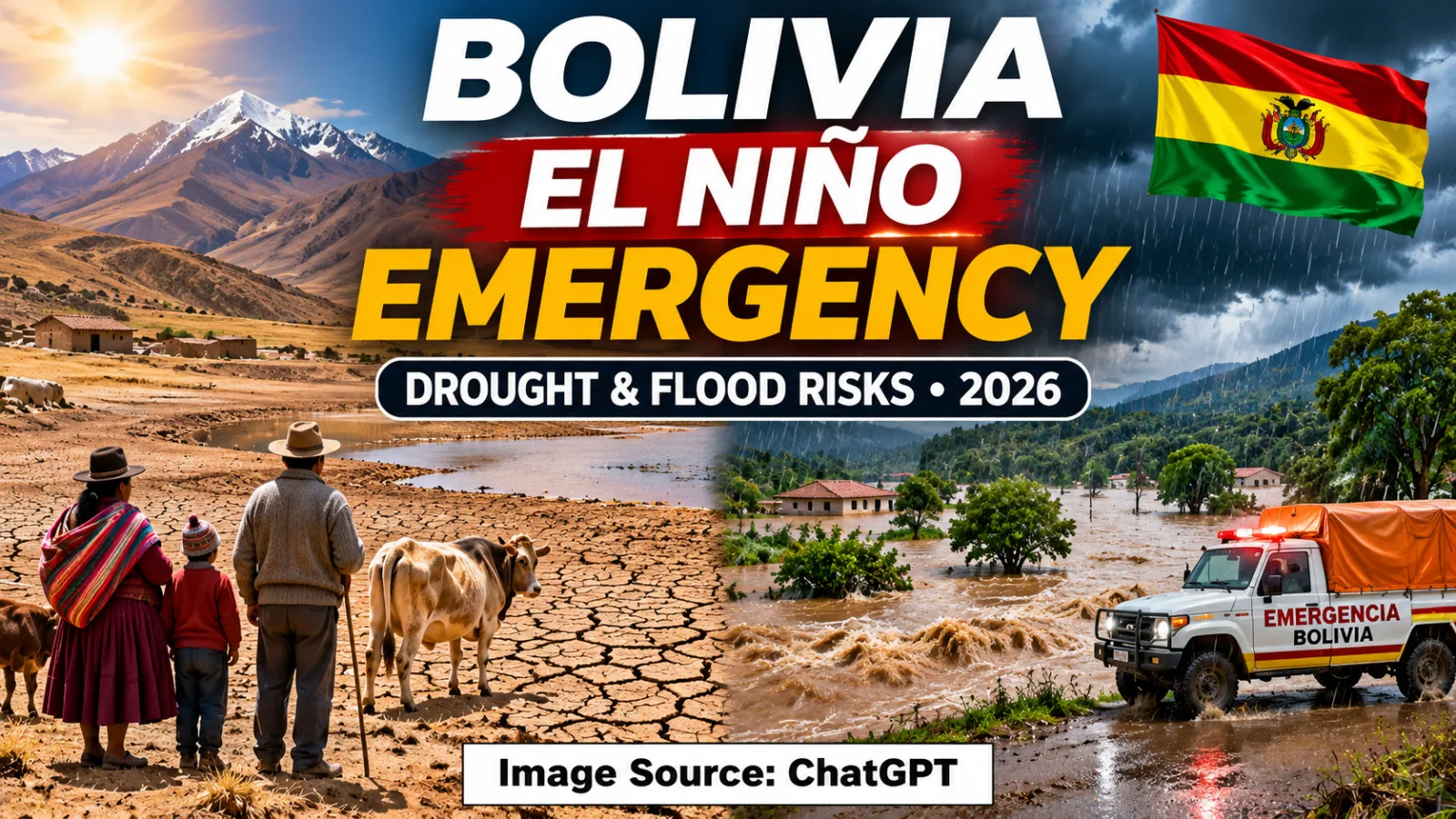
Bolivia is facing a growing climate emergency as severe drought, worsening water shortages, and the threat of destructive flooding put thousands of communities under pressure. On October 31, 2026, President Rodrigo Paz Pereira declared a nationwide emergency in response to the developing El Niño weather phenomenon.
The decision comes at a difficult moment for rural families, farmers, livestock owners, and communities already struggling with insufficient rainfall. Government figures released in late October show that 78,217 families have been affected by drought across six of Bolivia's nine departments, while more than 75,000 cattle have been lost.
The declaration is not simply a warning about future weather. It acknowledges an ongoing humanitarian and economic challenge while preparing the country for additional emergencies during the approaching rainy season.
Authorities are now working to mobilize financial resources, emergency personnel, and international cooperation.
For ordinary families, the concern is immediate: Will drinking water remain available? Can livestock survive? Will crops recover? And what happens if prolonged drought is followed by dangerous flooding?
1. Why Bolivia Declared a National Emergency
President Rodrigo Paz signed Supreme Decree No. 5759 on October 31, establishing a national emergency associated with El Niño conditions expected to continue into 2027.
The decree recognizes existing drought conditions alongside the risk of floods, river overflows, forest fires, hailstorms, and freezing weather.
Declaring an emergency allows the government to coordinate its response more effectively and mobilize resources for affected communities.
National authorities have called for cooperation among municipal governments, regional administrations, the military, police, emergency services, and international partners.
This approach reflects Bolivia's complicated geography. Some regions are experiencing prolonged water shortages, while others face the possibility of heavy rainfall and overflowing rivers.
A response designed only for drought would leave flood-prone communities exposed. Likewise, preparing exclusively for flooding would do little to help farmers whose animals are already suffering from a lack of water and pasture.
The government is attempting to address both threats.
2. Bolivia El Niño Emergency: Key Figures
The scale of the situation becomes clearer when the available government data is considered together.
| Emergency Indicator | Reported Situation |
|---|---|
| Emergency declaration | October 31, 2026 |
| Presidential decree | Supreme Decree No. 5759 |
| Families affected by drought | 78,217 |
| Departments significantly affected | 6 of 9 |
| Cattle reported lost | More than 75,000 |
| Additional livestock affected | Approximately 917,447 |
| Most severely affected drought region | Oruro |
| Main upcoming concern | Drought and seasonal flooding |
| El Niño outlook | Expected to persist into early 2027 |
Figures reflect government reports issued around October 28–31, 2026, and may change as damage assessments continue.
These statistics represent far more than economic losses.
A livestock death can mean the disappearance of household income, food production, breeding capacity, and years of investment. A failed harvest can reduce food availability long after rainfall returns.
For communities dependent on agriculture, recovering financially may take several planting seasons.
3. What Is El Niño, and Why Does It Matter?
El Niño is a recurring climate pattern associated with unusually warm surface waters across parts of the central and eastern equatorial Pacific Ocean.
These temperature changes influence atmospheric circulation, affecting winds, pressure systems, and rainfall patterns across large areas of the world.
The effects are not identical everywhere.
One location may experience unusually dry conditions, while another receives intense rainfall. Temperature patterns may also change, creating additional stress on agriculture, ecosystems, and infrastructure.
El Niño typically develops irregularly, with episodes occurring roughly every two to seven years.
It is a natural climate phenomenon, but its consequences can interact with other environmental pressures, including rising temperatures, land degradation, and poor water management.
For Bolivia, understanding El Niño requires looking beyond a single national rainfall forecast.
The country's high-altitude plateau, mountain valleys, agricultural districts, and tropical lowlands respond differently to changing weather conditions.
This variation explains why drought and flooding can threaten the same country at almost the same time.
4. Which Areas of Bolivia Are Most Affected?
According to Bolivia's Civil Defense authorities, significant drought impacts have been reported in Oruro, La Paz, Chuquisaca, Cochabamba, Santa Cruz, and Potosí.
Oruro has experienced particularly severe conditions.
In many high-altitude communities, water scarcity affects both household consumption and the pastures needed to sustain livestock.
Livestock producers face difficult decisions when available water is insufficient for their animals.
Cochabamba and Chuquisaca contain agricultural communities vulnerable to interruptions in rainfall during important planting and growing periods.
Potosí and parts of La Paz also face water-management challenges, especially in areas where natural supply is limited.
Meanwhile, authorities are monitoring Santa Cruz, parts of Beni, and Cochabamba for possible flooding during the rainy season.
The danger varies substantially from one municipality to another.
Residents should therefore rely on local meteorological and civil protection warnings rather than assuming conditions throughout a department are identical.
5. Water Shortages Are Becoming a Household Emergency
Water scarcity is often the first visible sign of a drought, but its consequences extend well beyond an empty household tank.
Families may need to travel farther to collect water or spend additional money purchasing it.
Schools, medical facilities, restaurants, and small businesses can also struggle when reliable supply becomes unavailable.
For households already living with limited financial resources, these additional expenses create pressure on food, transport, and healthcare budgets.
Water shortages can also undermine basic hygiene.
When households lack sufficient safe water, handwashing, sanitation, food preparation, and cleaning become harder.
The risks are especially serious for young children, older adults, and people with existing health vulnerabilities.
Emergency water distribution can provide temporary relief, but sustainable solutions require safe storage, reliable supply systems, and protection of local water sources.
In affected communities, public authorities may need to prioritize drinking water before less essential uses.
Clear communication about delivery schedules and water quality is just as important as the deliveries themselves.
6. Livestock Losses Reveal the Economic Damage
The reported loss of more than 75,000 cattle is among the most troubling indicators of Bolivia's drought.
Another approximately 917,447 livestock animals have been reported as affected.
Livestock need dependable access to drinking water and adequate feed. When prolonged dry conditions reduce pasture growth, farmers may need to purchase supplemental feed at higher prices.
That creates a financial challenge even before animals become seriously weakened.
Small producers are particularly vulnerable because they may lack savings, irrigation infrastructure, or alternative grazing land.
Losing breeding animals can weaken production for several years.
The impact also reaches households that depend on milk, meat, animal sales, and agricultural transport for their livelihoods.
Emergency fodder distribution, veterinary assistance, and access to water can help reduce additional losses.
However, effective support requires accurate identification of affected farms and transparent distribution systems.
The real measure of success will be how many surviving animals and farming livelihoods can be protected.
7. Agriculture and Food Prices Could Face Further Pressure
Drought can disrupt agriculture at several stages.
Seeds may fail to germinate when soil moisture is insufficient. Plants already growing may produce smaller harvests, while farmers may delay planting because rainfall is uncertain.
Some producers may spend more on irrigation or transport water to their fields.
These costs can influence agricultural supply and household income.
If production losses become widespread, local food markets may experience price pressures, although the actual impact will depend on harvest volumes, transport conditions, imports, and other market factors.
Consumers can be affected even when they do not live in drought-stricken areas.
A farmer's lost income may reduce spending on equipment, education, and local services. Transport operators and agricultural suppliers can also experience reduced business activity.
The economic consequences can therefore spread across entire rural communities.
Monitoring crop conditions and identifying the most vulnerable producers will be essential in limiting these effects.
8. Why Flooding Is Also a Major Concern
A serious drought does not eliminate the possibility of dangerous flooding.
Bolivia's rainy season generally extends from around November into March, although timing and intensity vary by region.
After a prolonged dry period, intense rainfall can create additional problems.
Hard or degraded ground, damaged vegetation, unstable slopes, and blocked drainage systems can increase localized runoff.
In some places, rivers may rise rapidly as heavy rain falls upstream.
Floodwaters can damage bridges, roads, homes, water systems, and agricultural fields.
Communities near riverbanks or low-lying areas may face evacuation risks even while other parts of Bolivia continue experiencing water shortages.
Authorities have identified Santa Cruz, parts of Beni, and Cochabamba as areas requiring particular attention.
However, these are risk assessments, not guarantees that flooding will occur in every identified location.
Early warnings and local preparedness remain essential.
9. How the Emergency Declaration Changes the Government's Response
The national emergency establishes a framework for coordinated action under Bolivia's disaster-risk management legislation.
Local governments remain important because they are often the first institutions to receive reports of damaged crops, water shortages, or threatened households.
Regional authorities can coordinate assistance between municipalities, while national agencies can provide additional resources when local capacity becomes insufficient.
Practical interventions may include water tankers, storage tanks, pipelines, emergency equipment, road repairs, and rescue operations.
Flood preparation may require drainage maintenance, river monitoring, evacuation planning, and temporary shelter arrangements.
The government has also emphasized cooperation with international organizations.
This can help connect national priorities with technical expertise and potential financial assistance.
However, a declaration alone cannot solve the emergency.
The effectiveness of the response will depend on how quickly assistance reaches households and whether resources match the actual conditions in each community.
10. How Strong Could El Niño Become in 2026–2027?
The World Meteorological Organization warned in September 2026 that the developing El Niño event was expected to become very strong.
Its forecasts indicated a near-100% likelihood that El Niño conditions would persist through February 2027.
Such forecasts do not mean every location will experience unprecedented disasters.
They describe the expected persistence and intensity of a large-scale climate pattern, while local outcomes depend on geography and regional weather systems.
The WMO has encouraged national meteorological services to strengthen early warning and preparedness activities.
For Bolivia, this means planning for an extended period of climate uncertainty rather than expecting an immediate return to normal conditions.
Communities may need to prepare for several different emergencies during the same season.
The most reliable guidance will come from updated national and regional forecasts as conditions evolve.
11. A 60-Day Household Experience and Preparedness Matrix
The following matrix is an illustrative 60-day household experience framework, covering November 1 through December 30, 2026.
It is intended for families, farmers, community organizations, and local service providers. It does not represent interviews, completed observations, or guaranteed future outcomes.
| Period | Illustrative Household Experience | Recommended Response | Key Indicator |
|---|---|---|---|
| Days 1–7 | Family reviews available drinking water and nearby assistance | Establish safe storage and obtain local emergency contacts | Reliable access to safe water |
| Days 8–14 | Household evaluates food, livestock, and transport needs | Identify essential supplies and animal feed requirements | Remaining supplies and access |
| Days 15–21 | Residents monitor changing rainfall forecasts | Review evacuation routes and local alerts | Warning reception and route safety |
| Days 22–30 | Farmers assess crop and livestock conditions | Document losses and seek available assistance | Agricultural damage records |
| Days 31–45 | Community evaluates continuing drought or flood threats | Update plans and coordinate with local authorities | Service continuity and hazard exposure |
| Days 46–60 | Families reassess longer-term financial and household needs | Review recovery support and future preparedness | Water security, income, and safe housing |
Key Highlights of the 60-Day Framework
The first two weeks should emphasize immediate safety, drinking water, essential supplies, and access to reliable information.
During the following two weeks, households can focus on changing weather conditions, agricultural losses, and practical emergency planning.
The second month should involve reassessing livelihoods, household finances, and the reliability of local infrastructure.
Actual experiences will differ significantly.
Some communities may remain affected primarily by drought, while others could experience increased rainfall or flooding.
The matrix should therefore be updated according to local conditions rather than followed as a fixed prediction.
12. Practical Steps Families Can Take During the Emergency
Households do not need expensive technology to improve basic preparedness.
A useful first step is identifying reliable local sources of weather warnings and emergency information.
Families should keep important documents, essential medication, drinking water, and basic supplies accessible.
Where possible, documents can be protected in waterproof packaging.
Water storage containers should be clean and covered to reduce contamination.
If a water source becomes unsafe after flooding, residents should follow public health instructions before using it for drinking or cooking.
Boiling can address many biological contaminants, but it does not remove every chemical hazard.
Families in flood-prone locations should identify safer routes and avoid crossing flooded roads or fast-moving water.
Those caring for children, older adults, or people with limited mobility may need additional assistance with transport and evacuation.
Preparedness should remain practical and adapted to the household's resources.
13. What Farmers and Livestock Owners Can Do
Farmers face particularly difficult choices during prolonged weather emergencies.
Protecting livestock drinking water and maintaining access to suitable feed are immediate priorities.
Producers may benefit from working with local agricultural authorities or cooperatives to identify available assistance.
Keeping records of livestock losses, damaged crops, and emergency expenses can also support applications for relief where documentation is required.
Farmers should monitor official rainfall forecasts before making costly planting decisions.
Where practical, soil moisture conservation, maintenance of irrigation equipment, and protection of available water supplies may reduce damage.
Livestock owners should consult veterinary professionals when animals show signs of severe dehydration, illness, or nutritional stress.
Emergency measures need to account for local crop types, water availability, and farming conditions.
A solution suitable for one agricultural district may be ineffective elsewhere.
14. Public Health Risks Extend Beyond Water Shortages
El Niño-related emergencies can create several public health concerns.
During drought, insufficient water can reduce hygiene and sanitation.
During flooding, contaminated drinking water and damaged sanitation systems may increase the risk of certain infectious diseases.
Disrupted transport can make it harder for patients to reach medical facilities.
Standing water after flooding may also contribute to mosquito breeding in locations where mosquito-borne diseases are present.
Extreme heat, food insecurity, and displacement can add further pressure.
Health facilities may need emergency supplies, dependable water access, backup power, and communication arrangements.
Families should rely on local health authorities for specific advice about water treatment, disease prevention, and medical services.
Early intervention can reduce the likelihood that a weather emergency develops into a broader public health crisis.
15. Why Schools and Small Businesses Also Need Protection
Climate emergencies affect more than households and agricultural land.
Schools may experience reduced attendance when children must travel farther for water or when transport routes become unsafe.
Damage to roads can interrupt deliveries and make essential goods more expensive to obtain.
Small shops, markets, restaurants, and transport operators can lose customers during prolonged disruptions.
Some businesses may struggle with limited water or electricity supplies.
Schools and employers can help by maintaining emergency contact information, identifying safe gathering points, and communicating clearly when facilities cannot operate normally.
Community organizations can play an important role in sharing accurate information and identifying vulnerable residents.
Protecting education and economic activity supports longer-term recovery after the immediate danger has passed.
16. Does Climate Change Make El Niño More Dangerous?
El Niño is part of the Earth's natural climate variability, but it takes place against the background of a warming global climate.
Higher temperatures can increase evaporation and intensify heat stress, particularly when rainfall is already insufficient.
A warmer atmosphere can also hold more moisture, potentially contributing to intense rainfall under suitable weather conditions.
However, the relationship between global warming and individual El Niño events remains complex.
It would be inaccurate to attribute every drought, flood, or storm directly to climate change without examining the relevant scientific evidence.
In Bolivia, factors such as land use, deforestation, watershed management, infrastructure, and social vulnerability can also influence disaster impacts.
The most effective resilience strategies must consider these conditions together.
Better water management, early warning systems, protected natural ecosystems, and safer infrastructure can help communities prepare for future hazards.
17. What Happens Next for Bolivia?
The months ahead will test Bolivia's ability to respond to multiple climate threats simultaneously.
The immediate challenge is assisting drought-affected families while maintaining preparations for possible flooding.
Authorities will need to monitor rainfall, river levels, livestock conditions, agricultural production, and access to drinking water.
The quality and speed of emergency coordination will matter as much as the amount of assistance announced.
For residents, clear public communication will be essential.
Communities need to know where help is available, which areas face immediate danger, and how to receive warnings before conditions worsen.
International support may strengthen the response, but locally informed decisions will remain central.
The greatest uncertainty is how the coming rainfall season will unfold across Bolivia's diverse landscapes.
Continuous monitoring, rather than assumptions based on national averages, will be necessary.
18. Frequently Asked Questions
Why did Bolivia declare a national emergency?
Bolivia declared the emergency because drought was already affecting many communities and El Niño was increasing concerns about additional weather hazards, including flooding.
When was the emergency announced?
President Rodrigo Paz signed Supreme Decree No. 5759 on October 31, 2026.
How many families have been affected?
Civil Defense reported 78,217 families affected by drought in six departments in late October 2026. The total could change as assessments continue.
Which region has experienced the worst drought?
Government reporting identified Oruro as the department with the most severe reported drought impact.
Can drought and floods happen during the same El Niño event?
Yes. El Niño changes regional rainfall patterns, and its effects vary geographically. Different parts of one country may experience contrasting conditions.
How long could El Niño last?
The WMO's September outlook indicated that El Niño was very likely to persist through February 2027, although its local effects and eventual duration remain subject to updated forecasts.
What should families prioritize?
Safe drinking water, reliable weather information, essential supplies, access to medical care, and locally appropriate emergency plans should take priority.
Conclusion: Bolivia Faces a Critical Period of Climate Preparedness
Bolivia's national emergency declaration reflects the seriousness of a climate situation already affecting tens of thousands of families and causing major agricultural losses.
The most immediate need is support for communities facing water shortages, while the approaching rainy season creates additional uncertainty.
Strong institutions, reliable information, effective resource distribution, and household preparedness can help reduce the damage.
The coming months will reveal how effectively Bolivia can protect vulnerable communities and strengthen its response to increasingly disruptive weather conditions.
The central priority is not simply surviving one extreme event. It is ensuring that families, farmers, and communities have the resources and information needed to remain safe and recover.