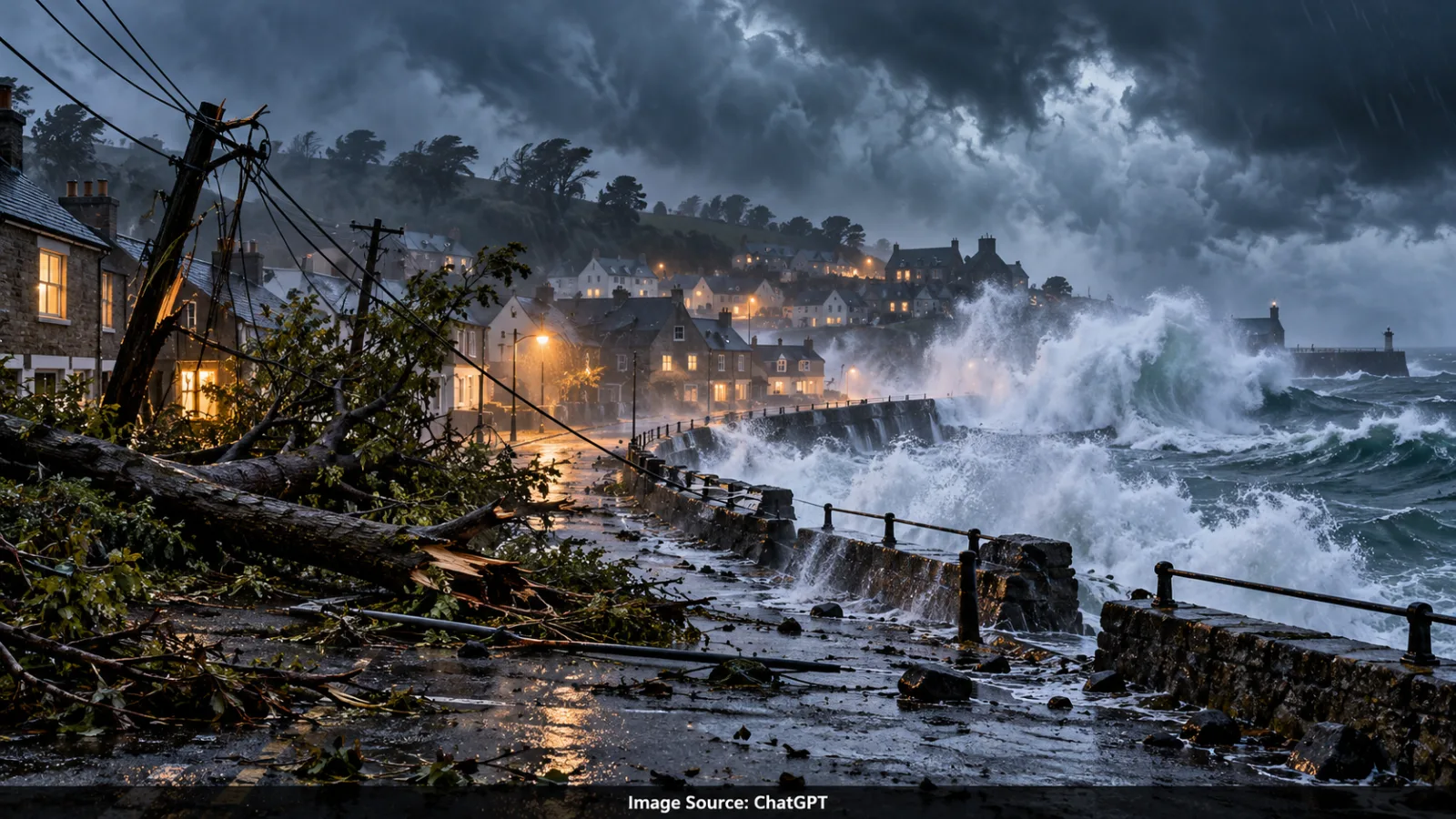
Northern Europe faced a dangerous weekend of extreme weather as two powerful Atlantic storms swept through several countries, damaging electricity networks, disrupting transportation and leaving communities dealing with fallen trees, flooding and widespread uncertainty.
Storm Austen and Storm Boelo struck in quick succession between October 23 and 25, 2026. Their combined effects extended across the United Kingdom, France, Germany, Belgium and the Netherlands, while Denmark, Norway and Sweden experienced additional travel disruption and severe weather conditions.
By Sunday, October 25, reports indicated that more than 150,000 homes across Britain, France and Germany had been affected by power cuts. The number reflected a snapshot of outages rather than the total number of properties losing electricity throughout the weekend.
The storms also claimed lives. Two men died in separate falling-tree incidents in Britain on Sunday, while injuries were reported in France, Germany, Belgium and the Netherlands.
Beyond the immediate destruction, the emergency raised an important question: how prepared are European households, businesses and essential services for multiple powerful storms arriving within days of each other?
Key Highlights of the Northern Europe Storm Disaster
Widespread blackouts: More than 150,000 homes were reported without power across Britain, France and Germany during Sunday's disruption.
Dangerous winds: Gusts reached approximately 135 km/h in parts of western Scotland.
Deaths and injuries: Falling trees caused two reported deaths in Britain, while storm-related accidents injured people elsewhere.
Major travel disruption: Flights, ferries, trains and road networks experienced cancellations, restrictions and closures.
Infrastructure challenges: Electricity restoration, telecommunications and emergency services became immediate priorities.
Two Atlantic Storms Strike Within Days
The unusual intensity of the weekend's disruption came partly from the timing of the weather systems.
Storm Austen was named on October 20 and brought strong winds and heavy rainfall to southern England and Wales on Thursday night and Friday. It subsequently moved towards continental Europe, affecting France, Belgium, the Netherlands and Germany.
Storm Boelo, named on October 22, followed with a separate area of low pressure. Its strongest impacts developed across Northern Ireland, Scotland and northern England during Saturday night and Sunday.
The UK Met Office had warned that Boelo could produce widespread damaging gusts and exceptionally strong winds around exposed coastlines.
Together, the systems created a prolonged period of unsettled weather. Communities that had already secured damaged property or experienced transportation delays faced another round of warnings before normal activities could resume.
This succession made recovery more difficult because electricity engineers, transport operators and local authorities had to respond while challenging weather conditions continued.
Britain Faces Deadly Winds and Extensive Power Cuts
Scotland experienced some of the weekend's most destructive conditions.
Western areas recorded particularly powerful gusts, including winds reaching approximately 84 mph, or 135 km/h, in Argyll and Bute.
The combination of strong winds and wet ground increased the danger of uprooted trees. Fallen branches and damaged electricity infrastructure blocked roads and interrupted train operations.
A 60-year-old man died after being struck by a falling tree on a minor road at Mid Kelton in southwestern Scotland on Sunday morning.
Later that day, a man in his twenties died when a tree fell onto his car in the Mill Hill area of north London.
The two deaths illustrated that storm hazards were not restricted to exposed coastlines. Residential streets, country roads and wooded urban areas could also become dangerous.
Electricity disruption was extensive. According to later reporting citing Britain's Energy Networks Association, approximately 838,700 properties had experienced power interruptions during the two storms. Around 90,600 customers remained without electricity at 7 p.m. on Sunday.
These cumulative figures were considerably higher than earlier outage snapshots.
Across affected regions, people faced darkened homes, interrupted heating systems and difficulties charging mobile devices. Some communities also experienced unreliable communications, complicating attempts to contact relatives and obtain restoration updates.
France Records Hundreds of Thousands of Electricity Interruptions
Northern and northwestern France also suffered considerable damage as Storm Austen crossed the region.
Brittany and Normandy were among the hardest-hit areas, with powerful Atlantic winds affecting communities, electricity distribution lines and transportation networks.
French electricity distributor Enedis reported that approximately 288,000 homes were without electricity at the peak of the disruption on Saturday.
By midday Sunday, the number still without power had fallen to around 59,000, demonstrating substantial restoration progress despite difficult conditions.
Enedis mobilized approximately 2,600 employees and contractors to support repairs.
The response required careful coordination because damaged lines could not safely be accessed until wind conditions and surrounding hazards permitted crews to work.
Storm-related injuries added to the emergency. A runner participating in a marathon in Lille was injured when a tree was brought down by strong winds.
For residents, the most immediate concerns involved electricity, safe travel, food refrigeration and the ability to communicate with emergency services.
Germany Experiences Blackouts and Hospital Disruption
Germany faced another consequence of the storm system: interruptions to essential services.
Around 10,000 homes in and near Freiburg im Breisgau experienced power cuts on Sunday.
The outage also affected mobile phone services and forced the area's main hospital to restrict operations to emergency cases.
Such disruptions demonstrate why electricity failures become serious even when individual homes suffer no structural damage.
Healthcare facilities depend on reliable power for diagnostic equipment, electronic systems, communications and patient services.
Germany also reported serious storm-related injuries in Nastätten, where strong winds caused scaffolding to collapse during an autumn market.
Two people were seriously injured in the incident.
The German Weather Service had forecast strong coastal winds, adding to the need for precautions across exposed northern areas.
Belgium, the Netherlands and Scandinavia Feel the Impact
The disruption extended beyond the three countries accounting for the headline electricity figures.
In Brussels, Belgium, falling trees injured four people on Saturday.
The Netherlands experienced severe winds affecting aviation, shipping and local transportation.
Three crew members aboard a freight vessel north of the island of Schiermonnikoog were injured during storm conditions. Two were evacuated by helicopter for hospital treatment.
The incident demonstrated the additional dangers facing maritime workers when difficult weather combines with operational problems at sea.
Farther north, Denmark, Norway and Sweden experienced high winds and rain. Some ferry services were cancelled, selected railway operations were suspended and restrictions affected certain vehicles using Denmark's Great Belt Bridge.
Although the severity differed between regions, the broader disruption showed how Atlantic storm systems can affect multiple national transportation and infrastructure networks.
Why Did So Many Homes Lose Electricity?
Power failures during severe windstorms commonly begin with physical damage to distribution infrastructure.
Trees can fall onto overhead cables, branches can strike conductors and wind-driven debris can damage poles or related equipment.
A fault affecting one distribution line may interrupt electricity to hundreds or thousands of properties.
Strong winds also create safety concerns for repair crews. Even when a damaged location has been identified, engineers may need to wait for conditions to improve before beginning restoration.
A second major challenge involves access.
Blocked roads, flooding and unstable trees can prevent vehicles and equipment from reaching damaged infrastructure.
The consequences often extend beyond lighting and domestic appliances. Electricity interruptions can affect broadband equipment, mobile towers, electronically controlled heating, payment terminals and refrigeration.
Where several systems fail together, a household may lose its normal means of obtaining information precisely when reliable communication matters most.
This is why infrastructure resilience involves more than simply restoring electricity. It also requires maintaining emergency communications and protecting essential public services.
Flights, Railways and Roads Face Widespread Disruption
The storms created significant problems for travelers.
Amsterdam's Schiphol Airport warned passengers about delays and cancellations because strong winds reduced the number of aircraft that could safely take off and land.
Flights were also disrupted at airports in northern Britain, while railway operators introduced restrictions and suspended some services because of flooding, fallen trees and dangerous conditions.
Road authorities had to respond to debris, damaged infrastructure and standing water.
For travelers, the practical lesson was clear: a ticket or confirmed reservation did not necessarily mean a journey could proceed normally.
Passengers were advised to check their transport operator's latest information before leaving home.
In severe weather, allowing additional travel time is useful, but postponing a nonessential journey may be safer when authorities advise against travel.
What the Blackouts Mean for Ordinary Households
Electricity failures are often measured in numbers of customers affected, but the practical consequences differ considerably from one household to another.
A brief interruption may be inconvenient for a healthy adult with alternative lighting and a charged phone.
For an older person living alone, a prolonged outage can become a serious problem if heating, communication equipment or electrically powered medical devices are affected.
Families with young children may need to manage indoor temperatures, food preparation and disrupted school or work routines.
Small businesses encounter different challenges, including spoiled stock, interrupted payments and lost trading hours.
Residents who rely on home internet connections may discover that a charged laptop offers limited value when the broadband router and neighborhood telecommunications infrastructure have stopped working.
These experiences underline an important distinction: the duration of a blackout does not always reflect the severity of its consequences.
A household's vulnerability depends on its health needs, available resources, location and access to community support.
A 60-Day Household Experience and Recovery Matrix
The following matrix illustrates how a household affected by an October storm could organize its response over the subsequent 60 days.
This is a practical planning scenario, not a survey or a claim that families affected by the October 2026 storms have already completed 60 days of recovery.
| Period | Household Experience | Recommended Action | Key Success Indicator |
|---|---|---|---|
| Day 1 | Sudden blackout, poor visibility and uncertain restoration time | Confirm everyone's safety, use torches and check official alerts | Safe household and emergency contacts available |
| Days 2–3 | Heating, refrigeration or communication difficulties | Assess food safety, medical needs and alternative accommodation | Essential needs maintained |
| Days 4–7 | Possible property damage and disrupted routines | Document damage, contact insurers and arrange urgent inspections | Immediate hazards addressed |
| Days 8–14 | Cleaning, repair appointments and financial concerns | Track expenses, organize receipts and review damage assessments | Clear recovery priorities |
| Days 15–21 | Household routine gradually returning | Review backup lighting, charging and emergency supplies | Improved short-term preparedness |
| Days 22–30 | Repair follow-ups and insurance paperwork | Confirm outstanding claims and maintenance arrangements | Fewer unresolved issues |
| Days 31–45 | Opportunity to improve future resilience | Review drainage, tree risks and safe backup-power options | Risk-reduction improvements planned |
| Days 46–60 | Longer-term financial and preparedness review | Update emergency contacts, documents and household plans | A practical storm-response plan completed |
What a 60-Day Recovery Plan Can Teach Households
The first three days should focus on immediate safety rather than property improvements.
Residents should avoid damaged electrical equipment, check whether vulnerable family members need assistance and obtain reliable information about local hazards.
During the following week, attention can shift towards documenting damage and identifying repairs requiring professional assistance.
Photographs, receipts and written records may prove valuable when discussing an insurance claim.
Weeks two through four provide an opportunity to review what failed during the emergency.
Perhaps the household had insufficient lighting, no reliable way to recharge phones or an emergency contact list stored only on an inaccessible computer.
By the second month, those observations can become practical improvements.
The objective is not to purchase large quantities of emergency equipment. It is to reduce the likelihood that a future outage will create the same problems.
For example, a family that struggled with communications might maintain a charged power bank and keep important telephone numbers on paper.
A household that experienced drainage problems could request appropriate property assessments before the next period of heavy rainfall.
Essential Safety Steps During Storm-Related Power Cuts
The most important precaution is to avoid fallen electricity cables.
People should never touch a damaged wire, an object resting against one or a tree entangled with electrical infrastructure.
The area should be kept clear and the danger reported to the local electricity network operator or emergency services.
Food safety also requires attention during prolonged interruptions.
A closed refrigerator generally keeps food cold for approximately four hours, while a full freezer may maintain a safe temperature for around 48 hours. Actual conditions vary, and a half-full freezer typically offers less protection.
Portable generators must be operated outdoors, away from windows and ventilation openings. Barbecues and camping stoves should never be used inside homes for emergency heating or cooking because of the risk of carbon monoxide poisoning.
Anyone dependent on electrically powered medical equipment should follow their existing emergency care plan and contact the appropriate medical service if power loss threatens their health.
Residents should also stay away from exposed coastal paths, unstable trees and flooded roads.
Never attempt to drive through floodwater when its depth, current or road condition is uncertain.
How Electricity Companies Restore Power After Major Storms
Repairing a storm-damaged electricity network involves several stages.
Operators must first identify faults and assess the extent of damage. They may then isolate unsafe sections of the network to prevent additional hazards.
Where possible, electricity can sometimes be restored through alternative network connections while damaged equipment is repaired.
Engineers must prioritize safe access and coordinate with road authorities or emergency responders when fallen trees obstruct repair locations.
The restoration process can therefore progress unevenly.
A town center may regain electricity while a smaller rural community remains disconnected because its supply depends on a damaged overhead line in difficult terrain.
Longer repairs do not necessarily indicate that a community has been forgotten. They may reflect more extensive damage, limited access or the need for specialist equipment.
For customers, the most reliable source of restoration information is their own network operator rather than an unofficial estimate circulating online.
Are Powerful European Storms Becoming More Common?
Storm Austen and Storm Boelo have also renewed attention on changing weather risks.
A warmer atmosphere can hold more moisture, potentially contributing to heavier rainfall under suitable conditions.
However, the relationship between climate change and the frequency or intensity of European windstorms is more complicated.
The UK Met Office has noted that observed windstorm trends are difficult to distinguish from natural year-to-year and decade-to-decade variability.
Scientists investigate individual events through attribution studies, which compare current climatic conditions with modeled scenarios without human-caused warming.
It would therefore be inaccurate to claim, without specific analysis, that climate change directly caused these two October storms.
What is clear is that communities face considerable consequences when intense rainfall, strong winds and vulnerable infrastructure occur together.
Better forecasting, resilient electricity networks, flood planning and effective public warnings can help reduce those consequences.
What Happens Next for Northern Europe?
As of October 26, 2026, attention was shifting from emergency response towards electricity restoration, transportation recovery and assessment of property damage.
However, unsettled conditions were forecast to persist in parts of the United Kingdom during the early week, with further Atlantic low-pressure activity possible.
Residents in affected communities were advised to continue following official weather warnings rather than assuming that the departure of the strongest winds marked the end of all danger.
Floodwater, unstable trees and damaged electrical equipment can remain hazardous after rainfall and wind speeds have diminished.
The long-term impact will depend on restoration progress, the condition of local infrastructure and the effectiveness of recovery support.
Conclusion: A Warning About Europe's Infrastructure Resilience
Storm Austen and Storm Boelo demonstrated how quickly ordinary life can be disrupted when severe weather affects several countries in succession.
The deaths, injuries, electricity failures and transportation problems were immediate reminders that major storms are public-safety emergencies, not simply unusual weather events.
For governments and infrastructure operators, the challenge is to improve preparedness and accelerate safe restoration without exposing workers or residents to unnecessary risks.
For households, the lesson is more personal.
Reliable communications, emergency supplies, sensible travel decisions and basic knowledge of electrical safety can make a meaningful difference during the next serious storm.
The most valuable outcome of the October 2026 disaster would be stronger communities that are better equipped to protect people when severe weather returns.