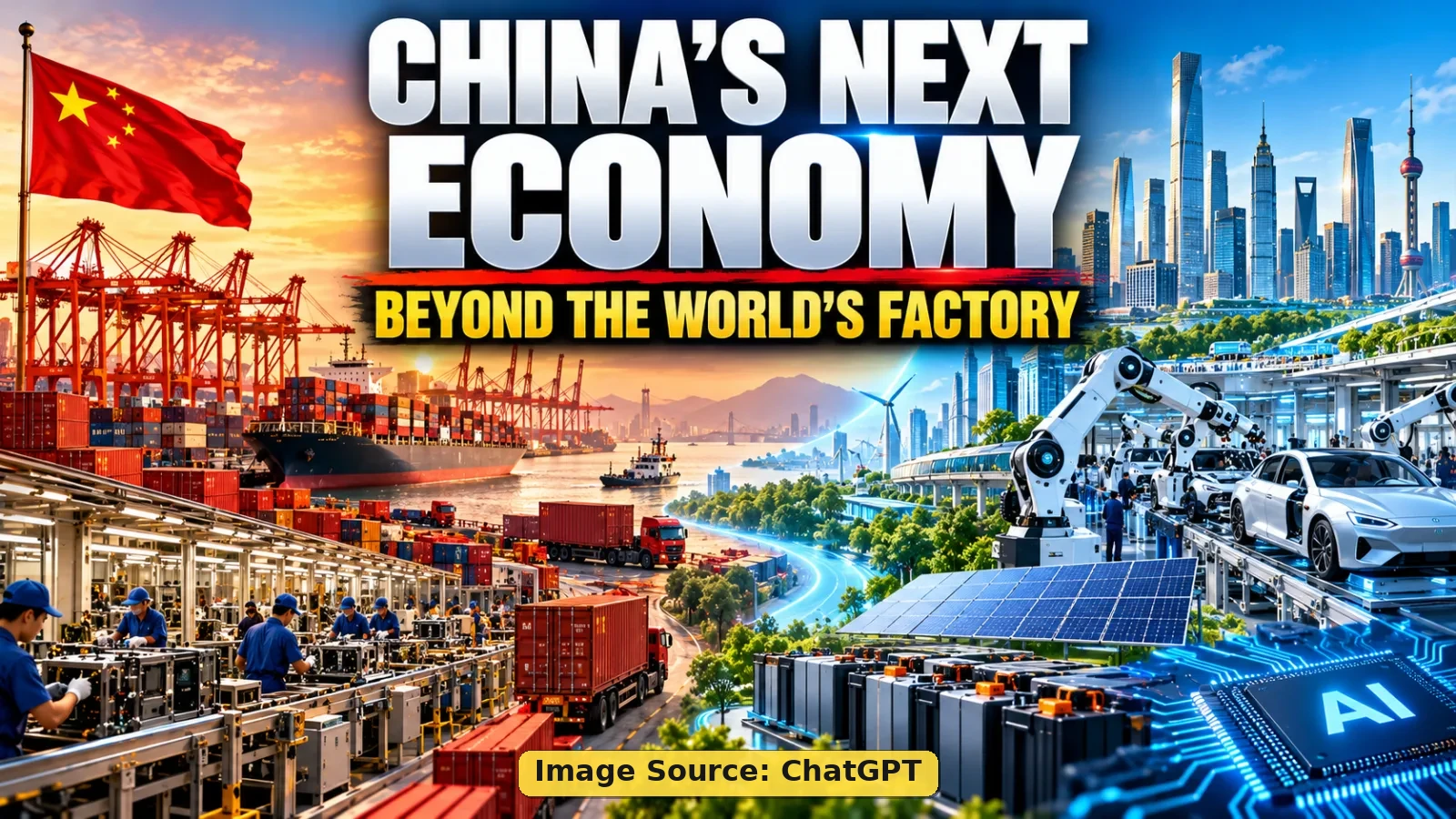
For more than three decades, China has been the manufacturing engine behind much of the world's consumer economy. From smartphones and household appliances to clothing, machinery and electric vehicles, Chinese factories have supplied products that influence everyday life across nearly every continent.
That extraordinary manufacturing success helped transform China into the world's second-largest economy, created millions of industrial jobs and established production networks that remain difficult for competitors to reproduce.
However, the economic model that supported China's rise is facing growing pressure.
Weak domestic consumption, a prolonged property-market downturn, demographic changes and international trade tensions are forcing Chinese policymakers to reconsider how the country generates sustainable economic growth.
The problem is not that China has suddenly lost its manufacturing strength. Its industrial sector remains enormous, technologically sophisticated and deeply connected to global supply chains.
Instead, China may be approaching the limits of an economic strategy that depends heavily on producing more goods than its domestic economy can comfortably absorb.
The next stage of development could depend on stronger household spending, advanced technology, higher-value services and a manufacturing sector focused increasingly on innovation rather than production volume alone.
1. How China Became the World's Manufacturing Powerhouse
China's transformation began with economic reforms introduced in the late 1970s.
The country gradually expanded market-oriented activity, encouraged foreign investment and developed industrial regions capable of producing goods for international markets.
Its large workforce, improving infrastructure and competitive production costs attracted manufacturers from around the world.
Coastal cities such as Shenzhen, Guangzhou and Shanghai became important industrial and trading centers.
Foreign businesses established factories, while domestic companies gradually developed expertise in electronics, textiles, machinery and other products.
China's entry into the World Trade Organization in 2001 accelerated this expansion.
Access to international markets encouraged greater investment in factories, ports, transportation networks and manufacturing capabilities.
Over time, China moved beyond assembling products designed elsewhere.
Domestic companies developed increasingly sophisticated production systems and became major competitors in their own right.
The result was an industrial transformation that changed international trade and made Chinese manufacturing central to the global economy.
2. China's Manufacturing Dominance Remains Extraordinary
Despite growing discussion about manufacturers relocating elsewhere, China continues to hold an exceptional position.
According to the United Nations Industrial Development Organization, China accounted for approximately 32% of global manufacturing production in 2024.
That exceeded the combined share of the United States, Japan, Germany and South Korea.
The comparison demonstrates why predictions of China's immediate industrial decline are misleading.
Few countries possess the same combination of production capacity, supplier networks, engineering expertise and logistics infrastructure.
A consumer electronics manufacturer operating in China may find component suppliers, packaging companies, equipment specialists and transportation providers within the same industrial region.
That concentration reduces coordination costs and supports large production volumes.
Even when companies move final assembly to another country, they may continue purchasing critical components from Chinese suppliers.
China is therefore unlikely to stop being a major global manufacturing center.
The more important question is whether manufacturing dominance alone can continue delivering the economic improvements expected by its population.
3. China's Economy Is Showing Signs of an Imbalance
The contrast between industrial production and household spending became especially visible in October 2026.
Official data released on October 19 showed China's economy expanding by 4.5% year over year during the third quarter.
Industrial production increased by 5.5% in September, while retail sales grew by only 1.1%.
The difference reveals an important challenge.
Factories continue producing goods, but domestic consumers are not increasing their spending at a comparable pace.
The property-market downturn has also weakened confidence, while concerns about employment and income growth influence household financial decisions.
Many families prefer saving money rather than making expensive purchases.
Businesses respond to weaker demand by competing more aggressively on prices, making it harder to maintain profitability.
Exports have helped offset domestic weakness, but this creates additional dependence on foreign customers.
An economy of China's size cannot rely indefinitely on other countries absorbing ever-increasing quantities of manufactured goods.
4. China's Record Trade Surplus Creates New Pressures
China's export industry remains remarkably competitive.
By September 2026, the country's merchandise trade surplus had reached approximately $938 billion for the first nine months of the year.
That placed China on a path toward potentially exceeding its record surplus of roughly $1.2 trillion in 2025.
For individual manufacturers, strong international demand can support employment, revenue and continued investment.
However, exceptionally large trade surpluses also create economic and diplomatic complications.
Trading partners may argue that Chinese goods are entering their markets faster than domestic industries can compete.
This can produce demands for tariffs, import restrictions and investigations into government support for particular industries.
A manufacturing strategy that works for one country may therefore become increasingly difficult to sustain when it generates political resistance elsewhere.
The challenge is developing stronger domestic demand while maintaining the advantages of international trade.
5. The China Plus One Strategy Is Reshaping Global Supply Chains
Businesses around the world are reconsidering how heavily they depend on manufacturing in one country.
A common approach is known as the China Plus One strategy.
Instead of abandoning Chinese suppliers, companies establish additional manufacturing capacity in countries such as Vietnam, India, Mexico, Indonesia and Thailand.
The objective is to reduce exposure to supply disruptions, tariffs and geopolitical uncertainty.
For example, a consumer electronics business might retain component manufacturing in China while expanding final assembly in India or Vietnam.
An automotive supplier could establish production in Mexico to serve North American customers more directly.
These decisions can create employment and investment opportunities outside China.
However, building a factory is not the same as developing an entire industrial ecosystem.
Reliable suppliers, skilled workers, transportation networks and quality-control systems take years to establish.
Consequently, diversification may reduce dependence on Chinese manufacturing without eliminating it.
6. Why Replacing Chinese Factories Is More Difficult Than It Sounds
China's competitive advantage extends far beyond labor costs.
Its industrial regions contain extensive networks of suppliers capable of producing specialized materials, components, tools and machinery.
These relationships allow manufacturers to coordinate complicated projects efficiently.
Consider a company developing a new electronic device.
Producing the final product requires more than an assembly facility.
It also involves printed circuit boards, batteries, displays, sensors, packaging and testing equipment.
If those products are available from nearby suppliers, production can proceed more efficiently.
Relocating assembly to another country may reduce certain costs, but imported components can still represent a substantial share of the final product.
This helps explain why global supply chains are becoming more geographically diverse without rapidly disconnecting from China.
The future may involve a more distributed manufacturing network in which China remains a central supplier of essential industrial inputs.
7. China Is Moving Toward Higher-Value Manufacturing
One possible answer to China's economic challenges is manufacturing more sophisticated products rather than simply increasing production volumes.
The country has already made substantial progress in electric vehicles, batteries, renewable energy equipment, industrial machinery and advanced electronics.
These industries require research capabilities, specialized engineering and complex manufacturing processes.
They also create opportunities for businesses to compete through technology, performance and product quality.
China's electric vehicle industry provides a striking example.
According to the International Energy Agency, China accounted for approximately 70% of global electric car production in 2025.
Chinese manufacturers also produced more than 80% of the world's battery cells.
These figures demonstrate that the country is no longer defined solely by inexpensive consumer goods.
However, technological leadership does not automatically guarantee strong profits.
Companies still need sustainable demand and commercially viable pricing.
8. Robotics and Artificial Intelligence Are Transforming Chinese Factories
Industrial automation is becoming central to China's manufacturing strategy.
According to the International Federation of Robotics, Chinese factories installed approximately 354,000 industrial robots in 2025.
That represented around 59% of global installations.
Robots can perform repetitive tasks, support quality control and improve precision in industries such as electronics and automotive manufacturing.
Artificial intelligence may further improve production planning, equipment maintenance and inventory management.
These technologies can help Chinese companies remain competitive even as labor costs and demographic conditions change.
However, increased automation also affects workers.
Some routine production jobs may become less necessary, while demand grows for technicians, software specialists and employees capable of operating advanced equipment.
This creates an important responsibility for businesses and policymakers.
Industrial upgrading should be accompanied by practical training opportunities so workers can participate in new forms of employment.
Otherwise, higher factory productivity may not translate into broad improvements in household income.
9. An Aging Population Changes China's Economic Future
China's demographic situation adds another challenge.
Official statistics show that its population declined by approximately 3.39 million people during 2025.
The number of older residents continues increasing, while the working-age population faces long-term pressure.
These changes could affect labor availability, public finances and household spending.
A smaller workforce may encourage additional automation.
At the same time, an aging population increases demand for healthcare, elderly services and retirement support.
That creates opportunities for businesses providing medical technology, assisted living, financial services and specialized consumer products.
However, demographic adjustments require long-term planning.
Workers need opportunities to maintain productivity, while older citizens require dependable support.
China's future economic success will depend partly on how effectively it converts demographic challenges into opportunities for innovation and improved public services.
10. Why Domestic Consumption Could Become China's Most Important Growth Engine
China has a massive domestic consumer market, but household spending remains relatively weak compared with the country's industrial capacity.
The International Monetary Fund has argued that stronger consumption should become a central economic priority.
One obstacle is uncertainty about future expenses.
Families worried about healthcare costs, retirement needs or employment security may prefer saving money.
The prolonged housing downturn has also affected household wealth and confidence.
Policies that improve social protection, income security and public services could encourage more spending.
For example, stronger pension coverage and affordable healthcare may reduce the need for precautionary savings.
Higher household consumption would create demand for services and manufactured products within China.
It could also reduce dependence on overseas customers.
The objective is not simply persuading people to spend more money.
It is creating economic conditions in which households feel financially secure enough to do so.
11. China's Property Crisis Remains a Major Obstacle
The property sector played an important role in China's earlier economic expansion.
Residential construction supported demand for steel, cement, appliances, furniture and numerous related industries.
Housing also became a major component of household wealth.
The prolonged property downturn has weakened those connections.
Families concerned about declining home values may reduce discretionary spending.
Developers facing financial difficulties can delay construction or struggle to complete projects.
Local governments that previously depended heavily on land-related revenue also face financial pressure.
These problems cannot be resolved through manufacturing expansion alone.
Restoring confidence requires policies addressing unfinished housing, financial vulnerabilities and sustainable property-market development.
A more stable housing sector could support consumption by reducing uncertainty.
However, rebuilding confidence may take time, particularly if households remain concerned about employment and future income.
12. Services Could Create China's Next Major Employment Opportunities
Manufacturing will remain important, but China's next phase of growth may require a larger and more productive service economy.
Potential opportunities include healthcare, education, tourism, entertainment, software, professional services and elderly care.
These industries can generate employment that is less dependent on physical goods exports.
For example, expanding demand for senior care may create opportunities for healthcare workers, technology providers and community-service businesses.
Digital services can also help small companies reach customers throughout the country.
However, developing a strong service economy requires more than opening additional businesses.
It depends on skilled workers, consumer confidence, effective regulation and access to financing.
The IMF has noted that China's service sector is relatively small compared with those of other major economies.
Expanding high-quality services could help create more balanced growth while providing employment opportunities for graduates and workers transitioning from traditional industries.
13. China's 15th Five-Year Plan Offers a Roadmap for Change
Beijing has acknowledged many of these economic challenges through its 15th Five-Year Plan covering 2026 to 2030.
The plan emphasizes technological innovation, advanced manufacturing, stronger domestic demand and greater economic resilience.
China has also announced an objective of increasing annual retail sales of consumer goods to approximately 60 trillion yuan by 2030.
Other priorities include artificial intelligence, robotics, semiconductors, biotechnology, advanced materials and new energy technologies.
The government wants to strengthen domestic technological capabilities while encouraging consumption and improving industrial efficiency.
However, ambitious development targets require effective implementation.
A new factory or research center does not automatically create lasting economic value.
Commercial success depends on consumer demand, productivity and the ability of businesses to compete sustainably.
China's challenge will be balancing industrial ambitions with policies that support household income and private-sector confidence.
14. Excess Production and Price Wars Threaten Profitability
One of the risks associated with aggressive industrial expansion is overcapacity.
When numerous manufacturers increase output faster than demand grows, companies may cut prices to attract customers.
This can benefit consumers in the short term.
However, prolonged price competition may reduce profitability and weaken investment incentives.
Industries such as electric vehicles and solar manufacturing have experienced intense competition as production capacity expanded.
Some businesses may struggle to generate acceptable financial returns despite technological progress.
The Chinese government has responded with efforts to address excessive competition and improve industrial discipline.
But creating a healthier market also requires difficult decisions.
Less productive businesses may need to restructure, consolidate or exit particular markets.
A sustainable manufacturing sector cannot depend indefinitely on producing larger quantities at continuously lower prices.
15. Green Technology Could Become a Long-Term Strength
China's leadership in clean-energy manufacturing provides another possible foundation for future economic growth.
The country is a major producer of solar panels, batteries and electric vehicles.
The International Energy Agency estimates that Chinese manufacturing represents approximately 85% of global solar supply-chain production capacity.
These industries are important because countries worldwide are investing in cleaner electricity and transportation systems.
However, China's position also creates new international competition.
Other governments are developing domestic clean-energy industries to reduce dependence on imported equipment.
As a result, Chinese manufacturers may increasingly establish operations overseas, collaborate with foreign companies or focus on higher-value technology.
Environmental performance will also become more important.
Energy-efficient factories, recycling systems and responsible supply chains could influence future competitiveness.
The opportunity is substantial, but lasting success will depend on innovation, market demand and commercial sustainability.
16. What China's Transformation Means for Other Countries
A changing Chinese economy could create both opportunities and challenges internationally.
India and Southeast Asian countries may attract additional manufacturing investment as companies diversify production.
Mexico could benefit from its proximity to the United States and established industrial relationships.
Meanwhile, countries that supply raw materials may experience changing demand as China's industrial priorities evolve.
Consumers could benefit from greater competition and more diversified sources of manufactured products.
However, shifting production also involves costs.
New factories require infrastructure, trained employees and reliable supply chains.
Countries hoping to attract investment must develop competitive environments rather than depending exclusively on lower wages.
For China, expanding domestic consumption could also create opportunities for foreign exporters.
A more balanced Chinese economy might purchase a wider variety of international goods and services.
The global consequences will therefore depend on how successfully China manages its transition.
17. What Would a Successful Economic Transition Look Like?
China's transformation should not be measured only by whether factories continue producing large quantities of goods.
A more meaningful assessment would examine several indicators.
First, household consumption would become a stronger and more reliable contributor to economic growth.
Second, businesses would generate sustainable profits without depending excessively on price reductions or repeated subsidies.
Third, productivity improvements would support better employment opportunities and household incomes.
Fourth, stronger services would create additional career pathways beyond industrial production.
Finally, international trade relationships would become more balanced and less vulnerable to recurring disputes.
None of these changes requires China to abandon manufacturing.
Instead, success would mean using the country's industrial strength as one foundation of a more diversified economy.
The central objective is to connect technological development and productivity with broader improvements in living standards.
Final Outlook: China's Next Economic Success Will Require More Than Factories
China's rise as the world's manufacturing powerhouse ranks among the most significant economic transformations of modern history.
Its enormous factories, logistics networks and engineering capabilities will continue influencing global trade for years to come.
However, the economic challenges of 2026 demonstrate that industrial strength alone is not sufficient.
Weak consumer demand, demographic pressure, property-market difficulties and international trade tensions are exposing the limitations of excessive dependence on exports and investment.
The country's next stage of development may require a different combination of strengths.
Advanced manufacturing and artificial intelligence could improve productivity, while stronger household spending and expanded services could support more balanced growth.
Greater financial security may encourage consumers to participate more confidently in the economy.
The transition will be difficult, and outcomes remain uncertain.
But China does not need to stop manufacturing products for the world to develop a more sustainable economic future.
The real challenge is moving beyond an economy primarily measured by how much it produces toward one that is also measured by how successfully its businesses innovate, its workers prosper and its households benefit from economic growth.
China's future may depend less on remaining the world's factory and more on becoming an economy capable of creating, consuming and sustaining value on a much broader scale.