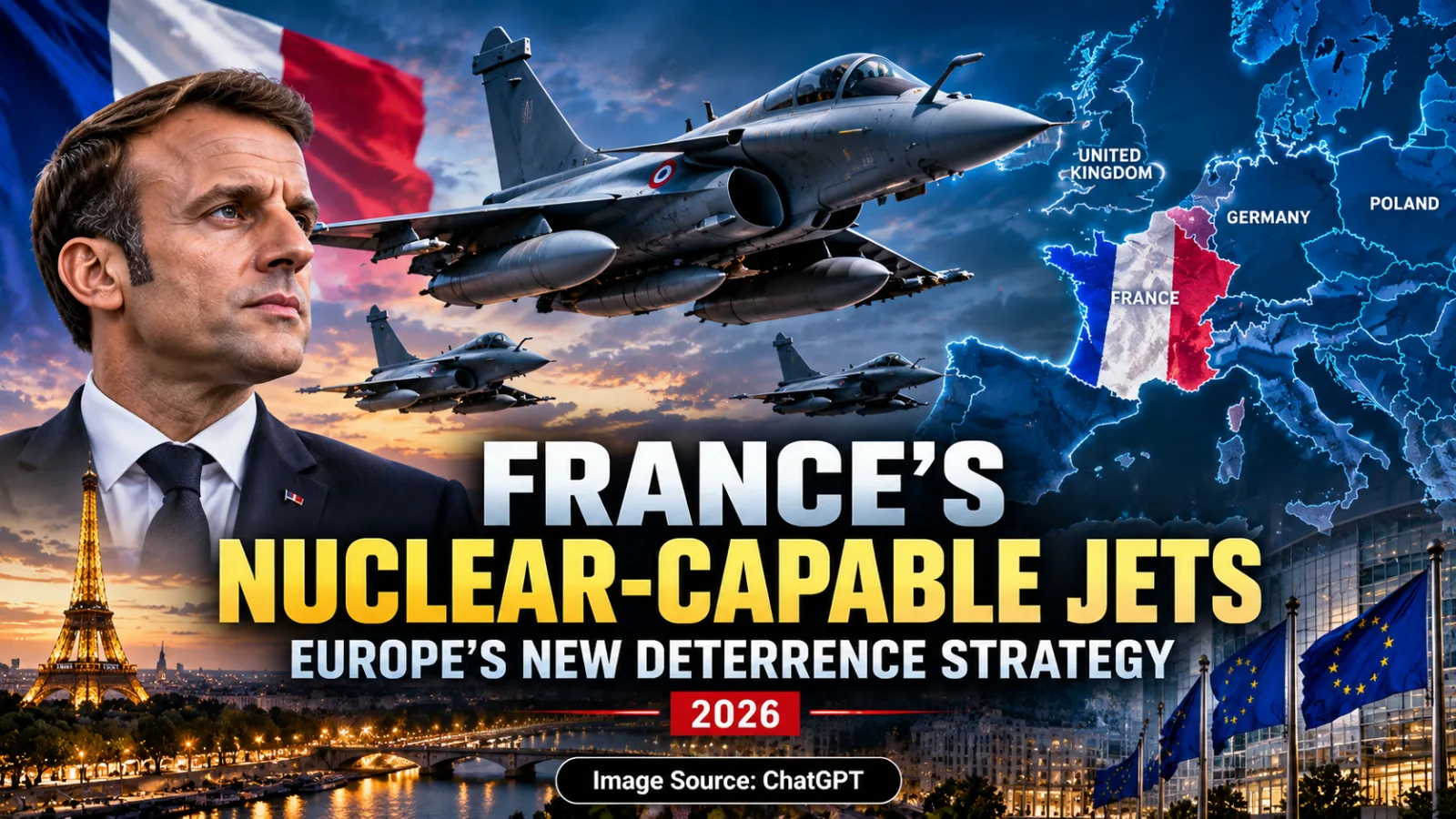
France is advancing one of the most significant changes to its nuclear defence strategy in decades, preparing to position nuclear-capable fighter aircraft across allied European countries as governments seek stronger protection against emerging security threats.
The initiative, introduced by President Emmanuel Macron in March 2026, marks a shift in how France intends to contribute to European security. Instead of relying exclusively on forces operating from French territory, Paris is exploring a more geographically distributed deterrence posture involving cooperating European partners.
The strategy, known as forward deterrence, has already produced visible developments, including French Rafale deployments to Germany, expanded strategic discussions with neighbouring governments, and a landmark nuclear mission simulation involving British fighter aircraft.
The policy arrives at a time when Russia's war against Ukraine, evolving military technology and uncertainty over long-term American commitments have transformed Europe's defence priorities.
However, the strategy has an important limitation: France will retain independent control of its nuclear arsenal. Participating European countries will not automatically receive French nuclear weapons or acquire authority to use them.
What France Actually Plans to Deploy
The aircraft involved are nuclear-capable Dassault Rafale fighter jets, not aircraft powered by nuclear reactors.
The distinction matters because nuclear propulsion and nuclear weapons delivery are entirely different technologies.
A nuclear-powered vehicle uses energy generated through a nuclear reactor for propulsion. French Rafale fighters instead operate using conventional jet engines.
Their nuclear capability comes from the weapons certain Rafale variants are designed and certified to carry.
France's airborne deterrent includes Rafale aircraft capable of delivering nuclear-armed air-launched cruise missiles. These aircraft are operated by specialized military units and supported by aerial refuelling and command systems.
Under the new policy, France may temporarily deploy elements of these strategic air forces to participating European countries.
Such deployments could involve training, military exercises and deterrence demonstrations, depending on agreements between Paris and the receiving government.
Importantly, the presence of a nuclear-capable aircraft does not by itself establish that a nuclear weapon is present at the location.
Macron's March 2026 Announcement Changed the Debate
On March 2, President Macron outlined France's revised nuclear doctrine during a speech at the Île Longue naval base in Brittany.
His announcement established three major priorities: strengthening the French nuclear arsenal, increasing strategic cooperation with European partners and allowing French nuclear forces to operate more widely across the continent.
Macron argued that Europe's security environment required a more adaptable deterrence strategy.
The underlying idea is relatively straightforward.
If France can operate strategic aircraft from different locations, a potential adversary must consider a wider range of military and political responses.
This uncertainty could strengthen deterrence by making attempts to threaten or neutralize France's forces more complicated.
However, Macron also emphasized that France would make nuclear-use decisions independently.
The proposal therefore creates opportunities for greater European participation without transforming France's nuclear weapons into a shared multinational arsenal.
Why Europe Is Reconsidering Its Nuclear Security
European governments have traditionally relied heavily on the United States and NATO for nuclear deterrence.
American nuclear forces remain central to the alliance's strategic defence arrangements, while Britain and France maintain their own nuclear arsenals.
Russia's full-scale invasion of Ukraine in February 2022 fundamentally changed European security calculations.
Military planners began reassessing the possibility of prolonged confrontation, attacks against critical infrastructure and the risks associated with nuclear coercion.
At the same time, uncertainty regarding the future consistency of American security commitments encouraged European countries to discuss additional defence responsibilities.
France's proposal responds to these concerns by offering another layer of European deterrence.
It does not eliminate dependence on American capabilities, nor does it create a single European nuclear command.
Instead, it introduces a framework in which France's independent deterrent can become more closely connected with allied defence planning.
Germany Becomes an Important Partner
Germany has emerged as one of the most significant participants in France's strategy.
In March 2026, Macron and German Chancellor Friedrich Merz announced a high-level nuclear steering group intended to strengthen bilateral strategic cooperation.
The framework includes consultations about nuclear deterrence, missile defence, conventional military capabilities and responses to escalating threats.
A notable operational development followed on July 17, when aircraft belonging to France's Strategic Air Forces deployed to Nörvenich Air Base in Germany.
Both governments described this as an initial operational step in their closer cooperation.
The deployment demonstrated that strategic cooperation could extend beyond diplomatic meetings and involve actual military aircraft operating on allied territory.
Germany also plans conventional participation in French nuclear exercises.
Nevertheless, Germany's involvement does not mean that it has gained control over French nuclear weapons.
The agreement is designed to complement existing NATO commitments.
Britain and France Conduct a Historic Joint Exercise
Another important milestone came on October 20–21, 2026.
British Royal Air Force Typhoon fighters participated for the first time in a French airborne nuclear deterrence exercise, known as Exercise Rummy.
The exercise involved French Rafale aircraft departing from Saint-Dizier Air Base and performing a simulated nuclear strike mission over the Mediterranean.
British Typhoons provided an escort role, demonstrating the ability of the two air forces to coordinate during a strategically sensitive operation.
The exercise did not involve actual nuclear weapons.
Its principal purpose was to test coordination, operational procedures and interoperability between the two European nuclear powers.
The development also reflected stronger cooperation under the UK–France Northwood Declaration.
Although Britain and France retain separate nuclear decision-making systems, their growing coordination could improve collective military preparedness during periods of serious international tension.
For Europe, the exercise provided an example of how conventional and nuclear-related forces can cooperate without transferring nuclear command authority.
More European Countries Join Strategic Discussions
France's initiative has attracted interest from several governments.
Countries involved in discussions or cooperation have included Germany, the United Kingdom, Poland, Sweden, Denmark, Belgium, the Netherlands, Greece and Norway.
Their involvement is not identical. Each government has its own defence priorities, domestic political considerations and existing military commitments.
Sweden established a nuclear steering dialogue with France in April 2026, indicating that the initiative could extend into Northern Europe.
Finland formally joined the forward deterrence initiative on September 14, 2026.
The Finnish and French governments announced plans to establish a bilateral nuclear steering group to develop their cooperation.
These developments illustrate growing European interest in strategic consultation.
However, participation in discussions should not be interpreted as confirmation that each country will host nuclear-capable aircraft or nuclear weapons.
Such decisions would require further political and operational arrangements.
How France's Nuclear-Capable Rafale Jets Work
The Dassault Rafale is a multirole fighter aircraft used by the French Air and Space Force and French naval aviation.
Its conventional roles include air defence, reconnaissance, precision strikes and maritime operations.
Specially equipped Rafale aircraft also form part of France's nuclear deterrent.
The current airborne nuclear mission uses the ASMPA family of air-launched nuclear missiles.
The aircraft's operational effectiveness depends on far more than its ability to carry a weapon.
Aerial refuelling aircraft extend mission endurance and operational reach. Command structures support decision-making, while maintenance teams and airbase personnel ensure the aircraft remain available.
France is also developing a future airborne nuclear system.
The planned Rafale F5 standard will be designed to carry the ASN4G next-generation nuclear missile, with entry into service targeted around 2035.
These investments demonstrate that France views airborne deterrence as a long-term strategic capability rather than a temporary response to current events.
France Is Also Expanding Its Nuclear Arsenal
Macron's March announcement included a decision to increase the number of French nuclear warheads.
Before the policy change, public estimates generally placed France's arsenal at approximately 290 warheads.
The French government has not announced a new numerical target and has indicated that it will stop publishing detailed stockpile figures.
France's deterrent has two principal components.
The first is submarine-based nuclear capability, maintained through ballistic-missile submarines designed to provide a survivable response even during an extreme crisis.
The second is the airborne component, which provides operational flexibility through nuclear-capable aircraft.
Together, these capabilities support France's longstanding strategy of maintaining an independent national deterrent.
An expansion may strengthen the credibility and resilience of these forces, but it also raises questions about cost, transparency and the wider international arms-control environment.
Will France Replace America's Nuclear Umbrella?
France's initiative is not intended to replace NATO's existing nuclear arrangements.
The United States maintains a much larger nuclear arsenal and provides extensive capabilities supporting European security.
American commitments also involve established alliance planning, military infrastructure and nuclear-sharing arrangements.
France does not participate in NATO's nuclear-sharing mechanism.
Its new strategy is designed to operate alongside that structure while remaining independent.
This creates an additional option for European security rather than an immediate substitute for American protection.
Some European leaders view stronger French cooperation as a sensible form of strategic diversification.
Others may question whether France has sufficient military resources to support broader European expectations, particularly when its nuclear forces remain primarily dedicated to protecting French vital interests.
Both considerations will influence how far forward deterrence develops.
What Does the Strategy Mean for Russia?
Russia is a central factor in the renewed European debate about nuclear deterrence.
French officials have pointed to Moscow's military activities, nuclear rhetoric and continued war against Ukraine as reasons for strengthening their defence posture.
From the French perspective, dispersing strategic forces could make coercion more difficult and demonstrate that European countries remain prepared to respond collectively to major threats.
From Moscow's perspective, closer coordination between European militaries and additional nuclear-capable aircraft operating in allied countries could be interpreted as an expansion of Western strategic military activity.
These differing interpretations create a challenge for policymakers.
Deterrence is intended to discourage aggression, but military movements can also intensify suspicion when communication deteriorates.
Clear diplomatic channels, careful military signalling and effective crisis-management procedures will therefore remain important.
Why Temporary Deployments Matter
Temporary deployments allow military forces to operate from locations outside their permanent bases.
For France, this could provide experience working with different airbases, logistical systems and allied command structures.
It also allows participating governments to develop practical familiarity with French strategic aviation.
From a deterrence perspective, the ability to operate from multiple locations could complicate an adversary's assessment of French readiness and available options.
However, operating strategic aircraft outside their normal bases introduces demanding requirements.
Host countries need appropriate airfield facilities, security arrangements, logistics and coordination procedures.
Allied militaries must also distinguish between conventional training, deterrence exercises and any activities involving actual nuclear weapons.
Effective preparation is therefore essential if the initiative is to become a dependable component of European security.
The Economic and Industrial Implications
France's strategic shift could influence European defence industries.
Modernizing fighter aircraft, missile systems, airbase infrastructure, communications networks and supporting capabilities requires substantial investment.
French aerospace companies and specialized defence suppliers are likely to remain important participants in the modernization of France's airborne deterrent.
Cooperation with other European governments could also generate demand for compatible conventional equipment, training systems and defence infrastructure.
Nevertheless, potential economic opportunities should be considered alongside government spending priorities.
Nuclear modernization involves significant long-term costs, and countries must balance defence investments with other public commitments.
The industrial impact will depend on funded programs and procurement decisions rather than expectations alone.
What European Citizens Should Understand
For ordinary Europeans, nuclear deterrence is not simply a military planning issue.
It concerns national security, public spending, democratic accountability and the prevention of war.
Residents near participating airbases may be interested in increased aircraft activity, operational safety and environmental considerations.
Taxpayers may want to understand how defence budgets are allocated and what benefits military cooperation is intended to provide.
Citizens may also ask whether stronger deterrence improves stability or increases the risk of confrontation.
These are reasonable questions that deserve factual explanations.
The presence of nuclear-capable fighter jets at an allied airbase should not automatically be confused with the stationing of nuclear warheads there.
Public confidence depends partly on governments communicating this distinction accurately.
60-Day Stakeholder Experience and Strategic Impact Matrix
The following matrix covers October 27 to December 25, 2026.
It is a forward-looking monitoring framework for understanding how the strategy may develop over the next 60 days. It does not present invented public experiences, undisclosed military operations or confirmed future deployments.
| Period | Stakeholder Experience and Monitoring Focus | Key Indicators |
|---|---|---|
| Days 1–10 | European citizens and defence observers assess official announcements | New government statements and confirmed cooperation arrangements |
| Days 11–20 | Military analysts examine coordination between participating air forces | Announced exercises, training programs and institutional meetings |
| Days 21–30 | Residents and journalists monitor public information concerning participating airbases | Verified deployments, safety information and official explanations |
| Days 31–40 | Defence researchers evaluate NATO and French cooperation | Published policy updates and evidence of complementary planning |
| Days 41–50 | Policymakers and industry observers review modernization priorities | Procurement decisions, budget commitments and research milestones |
| Days 51–60 | European governments and citizens assess diplomatic and security implications | Confirmed operational progress, public debate and international responses |
How to Evaluate the Results
During the first two weeks, the most useful indicators will be confirmed announcements and developments in existing bilateral working groups.
The following weeks may reveal whether participating countries are developing additional training arrangements or operational coordination.
By the end of the 60-day period, analysts can compare completed activities against previously announced intentions.
The strongest evidence of progress would include verified exercises, published policy decisions or clearly established institutional arrangements.
A lack of public announcements would not necessarily prove inactivity, since some defence planning remains confidential.
Equally, diplomatic statements alone should not be treated as proof that nuclear weapons have been deployed abroad.
The Risks of a More Complex Nuclear Environment
France's initiative brings important strategic benefits but also introduces potential challenges.
Greater military coordination can make allied deterrence more credible, yet multiple governments and military organizations must understand their respective responsibilities.
Communication failures during a serious crisis could have significant consequences.
Arms-control advocates have also raised concerns about the expansion of nuclear arsenals and the possibility of renewed competition among nuclear powers.
The challenge for European leaders is to strengthen defence capabilities while preserving the distinction between deterrence and escalation.
Confidence-building measures, international legal commitments and diplomatic engagement can remain important even as governments modernize their military forces.
What Happens Next?
The coming months will reveal how quickly France's forward deterrence initiative develops beyond its initial demonstrations.
Further bilateral consultations, military exercises and strategic planning activities are possible as participating governments implement their agreements.
France's long-term investments in Rafale modernization and future nuclear missile systems will also shape the strategy's development.
Political continuity will be another important consideration, particularly with France approaching its 2027 presidential election.
Future French leadership will influence the pace and direction of European nuclear cooperation.
For now, the most important distinction is between a developing operational framework and a fully established multinational nuclear defence system.
France has made meaningful progress toward the former. The latter has not been created.
Conclusion: A New Chapter in European Deterrence
France's preparations to operate nuclear-capable fighter aircraft across Europe represent a consequential development in the continent's security architecture.
President Emmanuel Macron's initiative combines a stronger French nuclear arsenal with wider strategic cooperation and more flexible military operations.
The deployment of French strategic Rafales to Germany and the recent joint exercise with British Typhoons demonstrate that cooperation has begun moving from policy statements toward practical military activity.
Nevertheless, France continues to control its own nuclear weapons and has not established a shared European nuclear command.
The strategy's long-term significance will depend on whether participating countries can improve military coordination, maintain public confidence and strengthen deterrence without increasing the danger of uncontrolled escalation.
As Europe confronts an increasingly complex security environment, France is positioning its independent nuclear deterrent as a more visible element of continental defence.
The coming years will determine how far this ambitious transformation extends.