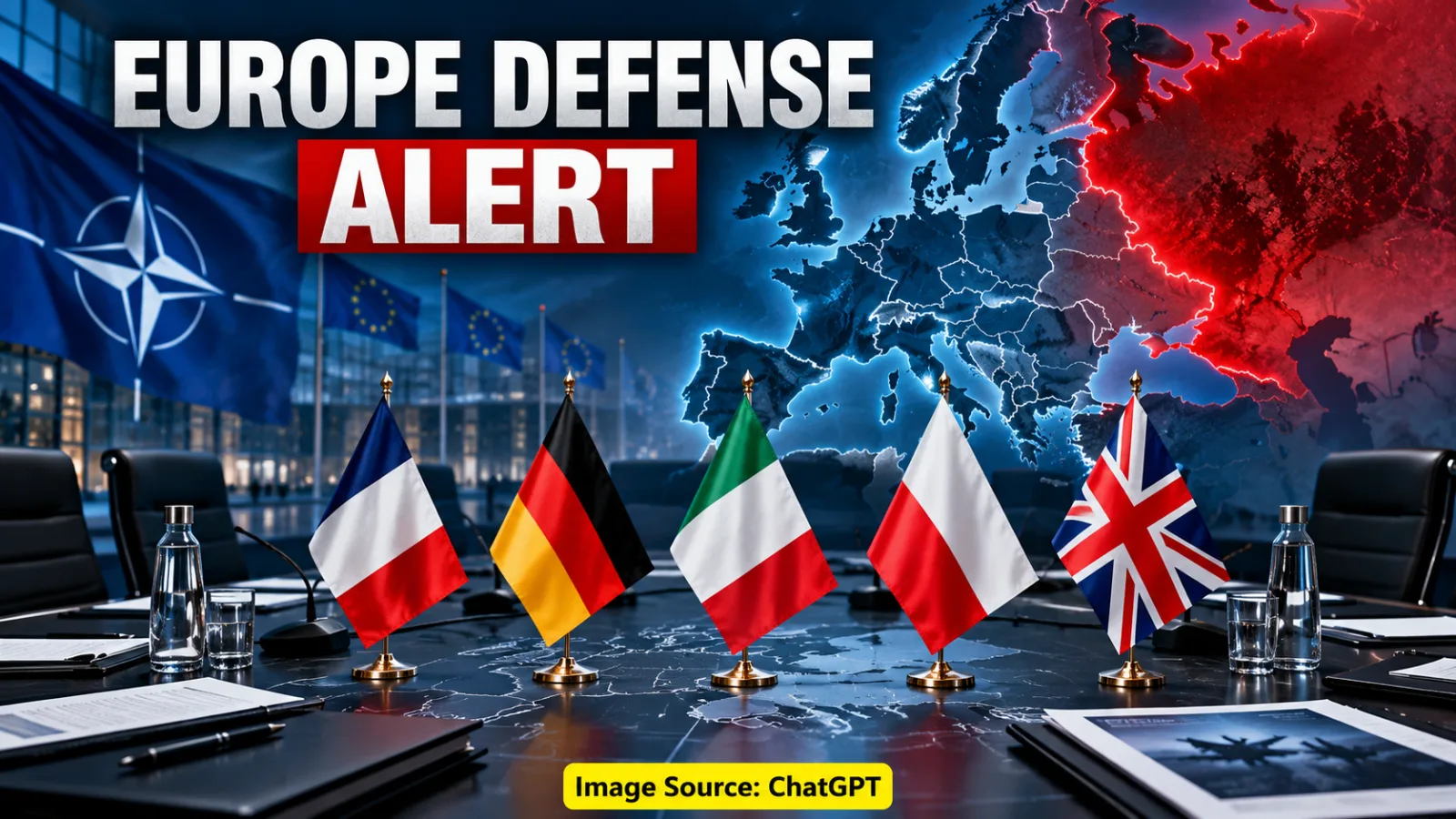
Europe's security priorities are entering a decisive phase as five of the continent's largest military spenders prepare to deliver a coordinated warning about Russia's growing threat to regional stability.
France, Germany, Italy, Poland and the United Kingdom, collectively known as the E5, are expected to identify Russia as Europe's most serious long-term security challenge during a defense ministers' meeting in Paris on October 26, 2026.
The proposed declaration comes amid continuing warfare in Ukraine, concerns about suspected sabotage operations, cyberattacks, drone incursions and pressure on European defense infrastructure.
According to reporting on a draft statement, the five governments intend to reaffirm their support for Ukraine while emphasizing that European nations must accept greater responsibility for their own security.
The anticipated announcement signals more than diplomatic disagreement with Moscow. It reflects a wider effort to strengthen military readiness, coordinate defense manufacturing and protect critical national infrastructure.
For European citizens, the consequences could eventually extend beyond foreign policy into public spending, cybersecurity, industrial employment and the reliability of essential services.
The central question is whether Europe's largest defense contributors can turn their shared assessment into practical cooperation.
Key Highlights: Europe's E5 Defense Warning
Five major powers: France, Germany, Italy, Poland and the United Kingdom are coordinating their security priorities through the E5 format.
Russia assessment: A draft declaration reportedly identifies Moscow as Europe's most serious and enduring security threat.
Ukraine support: The countries are expected to maintain their commitment to Ukraine's defense.
Hybrid warfare concerns: Suspected sabotage, cyber operations, drone activity and infrastructure threats are central to discussions.
European responsibility: Governments want stronger defense capabilities while continuing cooperation with NATO and the United States.
Economic implications: Expanded military investment could influence national budgets, technology development and defense employment.
What Is Happening at the October 26 Meeting in Paris?
The meeting brings together defense representatives from Europe's five largest military-spending countries to discuss shared security challenges.
French Armed Forces Minister Catherine Vautrin is hosting the gathering in Paris, where the participating governments are expected to consider a joint declaration.
Reporting published on October 25 indicated that the draft would characterize Russia as the most significant long-term danger to European security.
The language also addresses Russia's war against Ukraine and alleged hostile activities affecting European countries.
Importantly, the statement had not been finalized when the draft was reported. Its precise language and any additional commitments could change before official publication.
The meeting represents another stage in an increasingly structured relationship between the five countries.
Their cooperation is intended to complement NATO rather than create a replacement military alliance.
While all five belong to NATO, the E5 also includes Britain, which is outside the European Union. The arrangement therefore allows major European defense contributors to coordinate across EU membership boundaries.
Why Are European Governments Identifying Russia as the Main Threat?
The underlying concern is that Europe's security environment has changed fundamentally since Russia launched its full-scale invasion of Ukraine in February 2022.
The conflict demonstrated that large-scale conventional warfare remains possible on the European continent despite decades of political and economic integration.
European governments have also become increasingly concerned about activities that fall below the threshold of open military conflict.
These include suspected interference with communications, espionage, cyber intrusions, hostile information campaigns and threats against strategically important infrastructure.
Officials fear that a combination of military pressure and unconventional operations could weaken public confidence, disrupt essential services and complicate decision-making during a crisis.
Recent European intelligence assessments have highlighted the importance of protecting defense manufacturers and organizations supplying military equipment to Ukraine.
Russia denies responsibility for some incidents attributed to it by Western governments. Individual allegations require investigation, and not every unexplained drone sighting, network outage or industrial accident can automatically be attributed to Moscow.
Nevertheless, European officials increasingly view the accumulation of security incidents as a reason to strengthen preparedness.
The Ukraine War Remains at the Center of European Security
Ukraine remains central to the E5 discussions because the outcome of the conflict has implications for the wider European security order.
European governments argue that allowing borders to be changed through military force would create dangerous precedents.
They also recognize that Ukraine's military experience offers lessons in drone warfare, electronic defense, battlefield communications and the rapid adaptation of weapons systems.
Continued assistance to Kyiv may involve military equipment, training, industrial cooperation and political backing.
However, supporting Ukraine creates competing priorities for European governments.
They must balance immediate Ukrainian requirements against their own military stockpiles, domestic production capacity and long-term readiness.
The challenge is especially significant for air-defense missiles, ammunition and advanced weapons that can take considerable time to manufacture.
Ultimately, European leaders must decide how to maintain credible support for Ukraine while ensuring that their own armed forces remain equipped.
Understanding Russia's Hybrid Warfare Threat
Modern security threats extend well beyond traditional military attacks involving soldiers, aircraft and armored vehicles.
Hybrid warfare describes the coordinated use of military and nonmilitary methods to influence or weaken another country.
Such activities may involve cyberattacks, disinformation, economic pressure, espionage or covert operations against infrastructure.
A cyber intrusion affecting a transport operator, for example, could interrupt services without a conventional military confrontation.
An attack on communications infrastructure could interfere with emergency responses and business operations.
Similarly, hostile influence campaigns may attempt to undermine public confidence in democratic institutions.
Not every cyber incident is state-sponsored, and identifying the responsible party often requires extensive technical investigation.
For governments, the practical response involves improving digital security, protecting sensitive facilities, sharing intelligence and developing reliable procedures for responding to emergencies.
The emerging European approach increasingly treats cybersecurity, military readiness and civilian infrastructure protection as interconnected responsibilities.
The Five E5 Countries and Their Defense Priorities
Although the E5 members share broad objectives, their geographical positions, military capabilities and national priorities differ.
| Country | Major Security Strength | Strategic Priority |
|---|---|---|
| France | Nuclear deterrence, aerospace capabilities and military operations | European strategic autonomy and advanced defense cooperation |
| Germany | Industrial manufacturing, logistics and economic capacity | Military modernization and defense production |
| Italy | Naval capabilities, aerospace manufacturing and Mediterranean operations | Regional security and defense-industrial partnerships |
| Poland | Eastern-flank geography, expanding land forces and military investment | Deterrence, border security and rapid military readiness |
| United Kingdom | Nuclear deterrence, intelligence capabilities, naval forces and advanced defense technology | NATO leadership, intelligence cooperation and Ukraine support |
France: Promoting Greater European Defense Independence
France has consistently advocated a stronger European ability to respond to security challenges.
Its defense industry, advanced aerospace capabilities and independent nuclear deterrent give Paris a significant role in discussions about Europe's strategic future.
French policymakers seek closer cooperation without abandoning established NATO commitments.
Germany: Turning Economic Capacity Into Military Readiness
Germany's role is particularly important because of its industrial scale and position within European manufacturing networks.
Berlin faces pressure to accelerate military modernization, improve procurement and ensure that spending increases produce usable capabilities.
Industrial cooperation could help European manufacturers expand production while reducing duplication.
Italy: Connecting European and Mediterranean Security
Italy contributes naval capabilities, defense manufacturing expertise and experience with security challenges in the Mediterranean.
Rome's participation helps ensure that European security planning considers both eastern European threats and risks affecting southern regions.
Poland: Strengthening NATO's Eastern Flank
Poland's proximity to Ukraine and Russia's Kaliningrad region gives Warsaw a direct interest in deterrence.
Its defense priorities include military readiness, land forces, infrastructure resilience and the protection of NATO's eastern territory.
United Kingdom: Maintaining a Strong Transatlantic Connection
Britain contributes intelligence networks, nuclear capabilities, naval power and advanced military technology.
Although outside the EU, the United Kingdom remains a major NATO participant.
Its involvement demonstrates why European defense cooperation cannot be limited to European Union institutions.
NATO's New Defense Spending Commitments
The E5 discussions are taking place against the background of NATO's substantially increased defense investment goals.
At the 2025 summit in The Hague, NATO allies committed to investing the equivalent of 5% of their gross domestic product in defense and security-related activities by 2035.
The commitment includes at least 3.5% of GDP for core military requirements and up to 1.5% for broader security-related investments.
These broader activities can include cybersecurity, infrastructure protection, innovation and civilian preparedness.
The targets represent a major shift from NATO's previous 2% defense-spending benchmark.
However, higher spending does not automatically translate into stronger defense.
Governments must also address procurement delays, industrial capacity, personnel shortages, equipment maintenance and the ability of different national systems to work together.
The central measure of success will be operational capability rather than budget size alone.
Why Joint Defense Manufacturing Matters
Europe has numerous established defense manufacturers, but national procurement systems have often developed separately.
This can create problems when armed forces require compatible equipment, replacement components or shared ammunition supplies.
Joint development and purchasing arrangements could improve standardization and allow larger production orders.
Potential priorities include air-defense systems, unmanned aircraft, ammunition, long-range capabilities and military communications.
Cooperation may also reduce development costs by allowing countries to share research and testing.
Still, coordination involves difficult decisions.
Governments may disagree over industrial contracts, technology ownership, export regulations and where manufacturing facilities should be located.
Successful cooperation therefore requires transparent agreements and clear accountability.
What Does the Russia Threat Warning Mean for Ordinary Europeans?
The immediate announcement does not mean that European households face an imminent military attack.
In September 2026, NATO Secretary General Mark Rutte stated that there was no imminent Russian military threat to NATO territory.
That distinction matters because long-term security planning should not be confused with predictions of immediate war.
Nevertheless, defense policy can affect everyday life in several ways.
Higher government spending may influence taxation debates and decisions about public investment.
Defense production can create employment opportunities for engineers, technicians, cybersecurity specialists and industrial workers.
Enhanced cybersecurity programs may improve protection for hospitals, transportation systems, public utilities and financial services.
At the same time, citizens may reasonably question whether governments are balancing military needs with healthcare, housing, education and other priorities.
Public transparency is essential for maintaining confidence in these decisions.
A 60-Day Citizen Experience and Security Awareness Matrix
The following matrix illustrates how an ordinary European household or small business might respond to major defense-policy developments over a 60-day period.
It is a prospective planning example, not a report of customer interviews, actual household experiences or measured results from the October 26 meeting.
| Period | Possible Citizen Experience | Practical Action | Key Indicator |
|---|---|---|---|
| Day 1 | News about the E5 declaration creates uncertainty | Read the official statement and distinguish proposals from confirmed decisions | Accurate understanding |
| Days 2–3 | Conflicting political interpretations circulate | Verify claims through government and established news sources | Fewer unverified assumptions |
| Days 4–7 | Questions emerge about public safety | Review local emergency guidance and household contacts | Updated contact information |
| Days 8–14 | Increased interest in cyber threats | Enable multifactor authentication and install security updates | Stronger account protection |
| Days 15–21 | Discussion turns to critical infrastructure | Review appropriate local outage and emergency arrangements | Basic continuity plan |
| Days 22–30 | Concerns about defense spending develop | Examine published budget proposals and parliamentary debates | Better understanding of trade-offs |
| Days 31–45 | Businesses assess possible security risks | Review backups, staff awareness and cybersecurity procedures | Documented improvements |
| Days 46–60 | Households reassess news and preparedness habits | Update practical plans and monitor verified policy developments | Informed, proportionate preparedness |
First 30 Days: Understanding the Policy Change
During the first month, the greatest challenge for many citizens may be separating factual information from speculation.
A proposed defense commitment is not the same as an approved government budget.
A warning about cyber threats does not establish that a particular local incident was an attack.
Residents benefit from consulting official announcements and comparing multiple credible reports before drawing conclusions.
For small businesses, the period can also provide a reason to review basic digital security.
Maintaining secure backups, updating software and improving employee awareness are useful precautions regardless of international political developments.
Days 31–60: Building Long-Term Resilience
During the second month, attention can shift towards sustainable improvements.
Households may review emergency contacts, accessible documents and procedures for responding to local service interruptions.
Businesses can evaluate supplier dependencies and continuity arrangements.
Citizens interested in government accountability can examine budget proposals and determine whether promised defense investments correspond to identifiable outcomes.
The objective is not to encourage public anxiety. It is to support informed decision-making and proportionate preparedness.
Could Europe's Defense Expansion Affect the Economy?
Large military investment programs create both opportunities and financial pressures.
Manufacturers may benefit from increased orders, while technology companies could find demand for cybersecurity, communications and specialized engineering.
Long-term contracts may support industrial expansion and workforce training.
However, public finances are not unlimited.
Governments must consider borrowing costs, taxation, social spending and the effectiveness of procurement programs.
A poorly managed defense project can consume substantial resources without delivering the required capabilities.
Supporters argue that stronger deterrence can reduce the risk of costly future conflicts.
Critics emphasize the importance of financial oversight and preventing security concerns from becoming a justification for inefficient spending.
Both considerations belong in a serious public discussion about Europe's defense future.
Can Europe Strengthen Security While Preserving Diplomacy?
The E5 approach is largely intended to reinforce deterrence: convincing a potential adversary that aggression would be unsuccessful or excessively costly.
But deterrence and diplomacy are not necessarily competing strategies.
Military preparedness can coexist with arms-control discussions, crisis communications and efforts to negotiate an end to the Ukraine war.
European governments generally maintain that a durable peace must respect Ukraine's sovereignty and security.
Moscow has argued that Western military policies threaten Russian security, although NATO describes itself as a defensive alliance and rejects the justification for Russia's invasion of Ukraine.
These positions remain sharply divided.
Reducing the danger of escalation requires reliable communication, careful management of military incidents and credible diplomatic options.
What Happens After the Paris Defense Meeting?
The immediate next step is publication and examination of any finalized E5 declaration.
Observers will be looking for concrete commitments rather than general statements of concern.
Important questions include whether the five countries announce new procurement arrangements, shared industrial projects, cybersecurity measures or additional support for Ukraine.
Future NATO discussions and national budget decisions will also indicate whether political commitments are becoming operational capabilities.
Public accountability will be important because announcements alone cannot resolve longstanding military supply and coordination problems.
The most meaningful test will be whether European countries improve readiness while maintaining economic stability and avoiding unnecessary escalation.
Conclusion: Europe's Security Strategy Is Entering a New Phase
The expected E5 declaration reflects a significant change in how Europe's leading defense contributors assess long-term security.
France, Germany, Italy, Poland and the United Kingdom increasingly view the challenge posed by Russia as one requiring sustained coordination across military forces, industry, technology and civilian infrastructure.
Their response could influence European defense planning for years.
Yet the effectiveness of this cooperation will depend on more than stronger political language.
Europe must translate spending commitments into usable equipment, protect essential services, preserve democratic oversight and pursue opportunities for lasting peace.
For citizens, the most constructive response is to remain informed, examine the consequences of public policy and support sensible measures that strengthen resilience without encouraging unnecessary fear.
The challenge facing European governments is not simply to prepare for possible threats. It is to build a more secure and stable future while protecting the prosperity and democratic principles their defense policies are intended to safeguard.