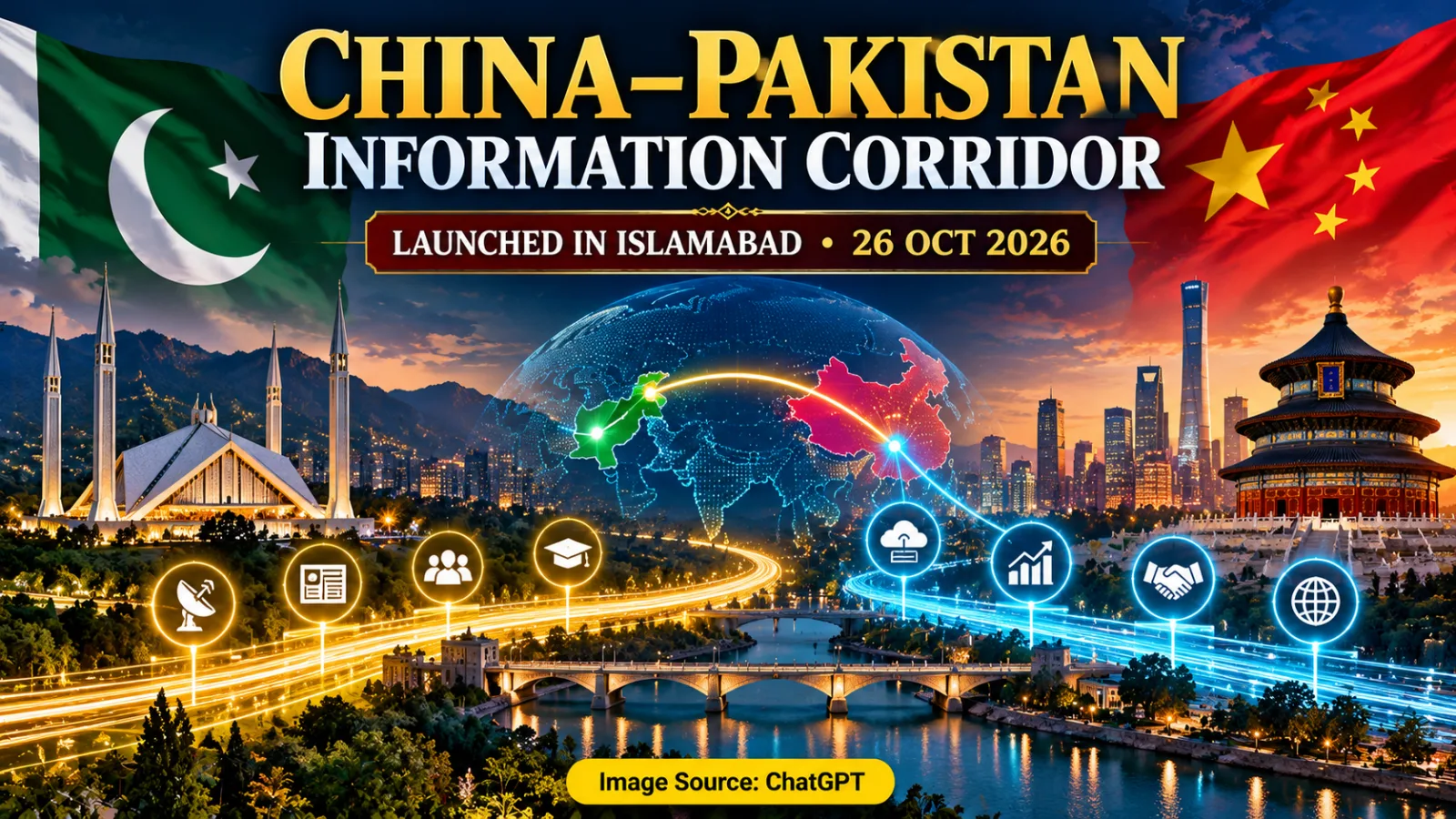
China and Pakistan have taken another significant step in their longstanding partnership with the official launch of the China–Pakistan Information Corridor (CPIC). Inaugurated on October 26 at the Pakistan–China Friendship Centre in Islamabad, the initiative seeks to extend bilateral cooperation beyond infrastructure and investment into information sharing, media collaboration, research, business networking and cultural exchange.
The launch comes as the two countries celebrate 75 years of diplomatic relations. For decades, their partnership has been associated with strategic cooperation, economic investment and the China–Pakistan Economic Corridor (CPEC). The Information Corridor introduces another dimension: strengthening connections between institutions, communities and individuals through communication.
Its success will depend on whether this diplomatic vision translates into practical opportunities for journalists, entrepreneurs, researchers, students and ordinary citizens.
A Major Diplomatic Launch in Islamabad
The inauguration brought together senior representatives from both countries, demonstrating the importance attached to the initiative.
Chinese Foreign Ministry spokesperson Mao Ning attended the ceremony alongside Pakistan's Federal Minister for Information and Broadcasting Attaullah Tarar, Chinese Ambassador Jiang Zaidong and Federal Secretary for Information and Broadcasting Ashfaq Ahmed Khalil.
Diplomats, media professionals, academics and representatives from different sectors also participated.
During the ceremony, Pakistani officials described the corridor as a mechanism for improving communication between the two countries and supporting their broader strategic partnership.
Tarar presented the Information Corridor as a complement to CPEC. While the economic corridor focuses on physical and commercial connections, the new initiative is intended to strengthen communication and mutual understanding.
Mao Ning emphasized the importance of accurate information and stronger exchanges between the two societies, particularly as misleading information spreads rapidly across digital platforms.
The event also featured cultural activities reflecting the longstanding relationship between Pakistan and China.
What Is the China–Pakistan Information Corridor?
The China–Pakistan Information Corridor is a bilateral cooperation initiative intended to connect media organizations, educational institutions, research communities, businesses and cultural organizations.
Unlike a conventional transport corridor, its central purpose is not constructing roads, railways or ports.
Instead, it seeks to create an organized framework through which Pakistani and Chinese institutions can communicate, collaborate and exchange knowledge.
For example, a Pakistani exporter seeking information about the Chinese market may benefit from improved business communication. A journalist researching a bilateral infrastructure project could gain access to more direct institutional information. A university researcher may find opportunities for joint studies with Chinese counterparts.
These are potential applications rather than services already confirmed as operational.
The initiative also supports public diplomacy, allowing both governments to communicate their perspectives and explain the outcomes of bilateral cooperation.
Its significance lies in treating information as an essential component of international connectivity.
Four Main Pillars of the Information Corridor
Officials have outlined four interconnected pillars that will guide the initiative's development.
1. Media Cooperation and Information Sharing
Media collaboration is one of the corridor's central objectives.
Pakistan and China intend to encourage information exchange between their respective media organizations, strengthen professional communication and develop mechanisms for addressing misinformation.
Potential activities include collaborative reporting, professional exchanges, access to official information and fact-checking partnerships.
For journalists, direct access to relevant institutions could improve reporting on infrastructure investments, diplomatic developments and bilateral business activities.
For readers, the practical benefit would be clearer reporting supported by evidence, identifiable sources and independently verifiable facts.
However, improving information quality requires more than increasing the quantity of published material. Accuracy, correction procedures, editorial independence and transparency will determine whether the media pillar earns public confidence.
2. Business, Enterprise and Investment Communication
The second pillar focuses on strengthening connections between businesses in Pakistan and China.
Commercial opportunities often depend on timely information about market requirements, potential partners, regulatory conditions and investment procedures.
An information-sharing network could make it easier for businesses to identify relevant contacts and understand opportunities.
Pakistani companies interested in supplying agricultural products, textiles, minerals or manufactured goods to China may find such engagement valuable.
Chinese businesses exploring Pakistan could benefit from better information about local industries, investment policies and business conditions.
Small and medium-sized enterprises could be particularly important participants because many lack the resources to establish independent international networks.
The corridor's commercial value will ultimately be measured through useful contacts, successful partnerships and tangible business activity rather than promotional announcements alone.
3. Think Tanks, Universities and Research Collaboration
The third pillar brings academic and policy institutions into the relationship.
Research organizations can contribute by examining trade trends, industrial development, education, technology adoption, environmental concerns and regional economic conditions.
Joint conferences, policy discussions and research publications could create opportunities for scholars from both countries to exchange ideas.
Universities may also benefit from stronger academic networking and potential collaborative projects.
For this pillar to deliver lasting value, research should be methodologically sound and accessible to interested audiences.
An effective platform would encourage researchers to examine both achievements and challenges, helping policymakers understand which approaches produce meaningful results.
4. Culture, Tourism and Youth Engagement
The fourth pillar emphasizes people-to-people relationships.
Cultural programs, tourism initiatives, educational exchanges and youth participation can give bilateral cooperation a more personal dimension.
Students may develop greater interest in studying languages, understanding different traditions or pursuing academic opportunities.
Tourism professionals could potentially use improved institutional communication to develop travel partnerships and promote destinations.
Artists, cultural organizations and young professionals may also find opportunities for collaboration.
Long-term international relationships become stronger when citizens understand one another beyond diplomatic statements.
The cultural pillar therefore has the potential to complement economic cooperation by creating relationships that continue across generations.
Why the Corridor Matters for CPEC 2.0
The Information Corridor's launch is closely connected with the broader evolution of the China–Pakistan Economic Corridor.
CPEC has been a major component of China's Belt and Road Initiative, supporting cooperation in transport, energy, infrastructure and industrial development.
Its newer phase places greater emphasis on industrial cooperation, technology, business partnerships, agriculture and economic activity.
These priorities require access to accurate information.
A potential investor needs to understand available projects. A business owner needs information about regulations and partners. A researcher needs reliable data before evaluating development outcomes.
An organized information network could support these requirements by connecting relevant stakeholders.
There is an important distinction, however: the Information Corridor is not itself an announced replacement for telecommunications infrastructure, nor does its launch establish a new internet network.
Its publicly described functions concentrate on communication, media engagement and institutional cooperation.
The initiative will be most valuable when it supports the economic corridor through services people can actually access and use.
A Response to the Growing Misinformation Challenge
Misinformation has become a serious challenge for governments, businesses and digital media audiences worldwide.
False claims can spread rapidly, particularly when complex international projects involve multiple companies, government agencies and financing arrangements.
China and Pakistan have identified this problem as an important reason for strengthening information cooperation.
The corridor could support more systematic communication about bilateral projects, helping journalists and citizens locate official statements and verify important claims.
Nevertheless, combating misinformation is not the same as promoting only favorable coverage.
Reliable public communication should distinguish verified facts, official positions, independent analysis and opinions.
Corrections should be visible when mistakes occur.
If the Information Corridor develops credible verification practices, it could strengthen public understanding. If it primarily distributes promotional material, its usefulness to independent researchers and readers may be more limited.
New Opportunities for Pakistani Businesses
For Pakistan's business community, improved access to information could become one of the initiative's most practical benefits.
Entrepreneurs frequently encounter barriers when entering foreign markets, including language differences, unfamiliar procedures and difficulty identifying reliable partners.
An institutional network connecting business associations, investment agencies and companies could help reduce some of these difficulties.
Consider a Pakistani manufacturer interested in supplying products to Chinese buyers.
The manufacturer needs information about product standards, import requirements, logistics, payment procedures and potential customers.
A useful information platform could direct that business toward appropriate institutions and verified commercial resources.
Similar opportunities may emerge in agriculture, logistics, manufacturing, education and technology services.
However, access to information does not automatically guarantee investment, orders or profitability.
Businesses will still need to conduct due diligence, verify commercial partners and evaluate financial risks before making commitments.
Education, Skills and Youth Participation
Young people could become important beneficiaries of stronger Pakistan–China institutional relationships.
Students increasingly seek international exposure, research opportunities and practical knowledge of foreign markets.
Cooperation between universities and professional organizations may create pathways for academic discussions, language programs and skills development.
Digital communication could also make certain forms of educational collaboration easier.
For example, academic departments could organize virtual research discussions or jointly examine issues such as renewable energy, urban development and industrial innovation.
These possibilities would be especially meaningful for students outside major metropolitan centers who have fewer opportunities to attend international events.
The strongest outcomes would come from clearly announced programs with transparent eligibility requirements, accessible applications and measurable educational benefits.
Regional and International Significance
The launch also highlights the growing importance of information diplomacy in international relations.
Governments increasingly recognize that infrastructure and trade agreements are only part of an effective partnership.
Communication influences how businesses evaluate investment opportunities, how citizens understand foreign countries and how institutions respond to changing circumstances.
For China, the corridor offers another channel for engaging Pakistani institutions and audiences.
For Pakistan, it could create additional opportunities to communicate its economic priorities and expand relationships with Chinese organizations.
The development may attract attention elsewhere in South Asia because China–Pakistan cooperation carries wider strategic significance.
Even so, the initiative's announced functions concern bilateral information exchange, public diplomacy and institutional collaboration. Its launch alone does not establish a new military arrangement or demonstrate a specific operational shift against another country.
Its broader regional significance will become clearer as concrete programs emerge.
What Could Change for Ordinary Citizens?
Large diplomatic initiatives often receive extensive attention at launch ceremonies, but ordinary people usually judge them through practical experiences.
A journalist may ask whether obtaining reliable information has become easier.
A student may look for accessible academic or cultural programs.
A business owner may want dependable contacts and clear procedures.
A tourist may seek trustworthy destination information, while a researcher may need publicly available reports.
These needs provide a useful framework for evaluating the corridor.
The most meaningful measure of success will not necessarily be the number of official statements issued. It will be whether individuals and organizations can identify and use services that were previously difficult to access.
60-Day Stakeholder Experience and Impact Matrix
Because the corridor was inaugurated on October 26, 2026, a complete 60-day operational history is not yet available. The following matrix provides a forward-looking assessment framework, rather than invented customer testimonials or claimed results.
| Period | Stakeholder Experience to Evaluate | Key Success Indicator |
|---|---|---|
| Days 1–10 | Journalists and readers look for official information channels | Clear contacts, public announcements and accessible information |
| Days 11–20 | Businesses explore opportunities for cross-border engagement | Published business resources and identifiable partner organizations |
| Days 21–30 | Researchers assess possibilities for academic cooperation | Research contacts, proposed collaborations and documented activities |
| Days 31–40 | Students and youth organizations explore exchange opportunities | Clear participation information and accessible program details |
| Days 41–50 | Media professionals evaluate fact-checking and information-sharing procedures | Evidence-based content, attribution and correction mechanisms |
| Days 51–60 | Businesses, educators and readers assess whether engagement produces value | Verified activities, useful partnerships and publicly documented outcomes |
How to Interpret the First 60 Days
The earliest stage should establish the corridor's organizational structure, public communication channels and participating institutions.
The next stage could demonstrate whether businesses, researchers and educational organizations can identify meaningful opportunities.
During later stages, observers should look for documented activities rather than relying solely on statements of intention.
For example, a confirmed institutional partnership would provide stronger evidence of progress than a general announcement promising future cooperation.
Similarly, a published research project or accessible youth program would be more meaningful than promotional claims about potential benefits.
Sixty days is too short to assess the initiative's full economic or diplomatic impact, but it offers a reasonable initial period for evaluating implementation.
Important Challenges the Initiative Must Address
Several operational challenges may influence the corridor's development.
Institutional coordination: The initiative involves multiple sectors with different priorities. Clearly assigned responsibilities will help avoid duplication and confusion.
Language accessibility: Effective cooperation requires communication that Pakistani and Chinese participants can understand. Translation quality and accessible explanations will be important.
Credibility: Media-related initiatives need reliable sourcing, transparent attribution and clear distinctions between official messaging and independent reporting.
Digital security: Platforms exchanging institutional or personal information should establish appropriate privacy protections and cybersecurity safeguards.
Public access: Smaller enterprises, independent researchers and students should have practical opportunities to participate rather than leaving engagement limited to major institutions.
Measurable outcomes: Regular reporting on completed activities would help observers distinguish operational progress from diplomatic announcements.
Addressing these issues could substantially improve the initiative's long-term credibility and usefulness.
What Happens After the Launch?
The next important development will be implementation.
Observers should watch for announcements identifying participating institutions, the responsibilities of the corridor's secretariat, operational communication channels and the availability of specific services.
Business associations may seek details about networking opportunities, while academic institutions will be interested in research and exchange arrangements.
Media organizations will want to understand how verification cooperation works in practice.
Clear public information will make it easier for potential participants to determine whether the corridor is relevant to their activities.
Over time, the initiative could become an established platform for bilateral communication. That outcome will depend on sustained institutional commitment, accessible programs and demonstrated results.
Conclusion: Moving Beyond Infrastructure Toward Information Connectivity
The launch of the China–Pakistan Information Corridor represents a notable development in the relationship between Islamabad and Beijing.
After decades of cooperation in diplomacy, infrastructure, security and commerce, both countries are placing additional emphasis on the exchange of information, knowledge and cultural experiences.
Its four pillars provide a broad framework for connecting media institutions, businesses, researchers and citizens.
The initiative's greatest potential lies in making cooperation more accessible and practical for people who interact with these sectors every day.
Whether it becomes a lasting platform will depend on implementation, transparency, reliability and measurable benefits.
For now, the October 26 inauguration marks the beginning of a new chapter in China–Pakistan communication, with the real test beginning after the ceremony ends.