YouTube has evolved from a simple video-sharing website into one of the world's most influential entertainment, education and information platforms. From a student learning mathematics to a family watching documentaries on television, the service reaches audiences with remarkably different interests.
But which country has the biggest YouTube audience in 2026? How many people can advertisers reach worldwide? And which age groups are most represented?
According to DataReportal's analysis of Google's advertising tools, YouTube's potential global advertising reach reached 2.77 billion in October 2026, with India, the United States and Indonesia occupying the top three positions.
There is an important distinction: these figures measure potential advertising reach, not necessarily unique monthly active users or total viewing hours.
Understanding that difference makes the statistics far more useful.
Key Highlights: YouTube in 2026
Global advertising audience: 2.77 billion.
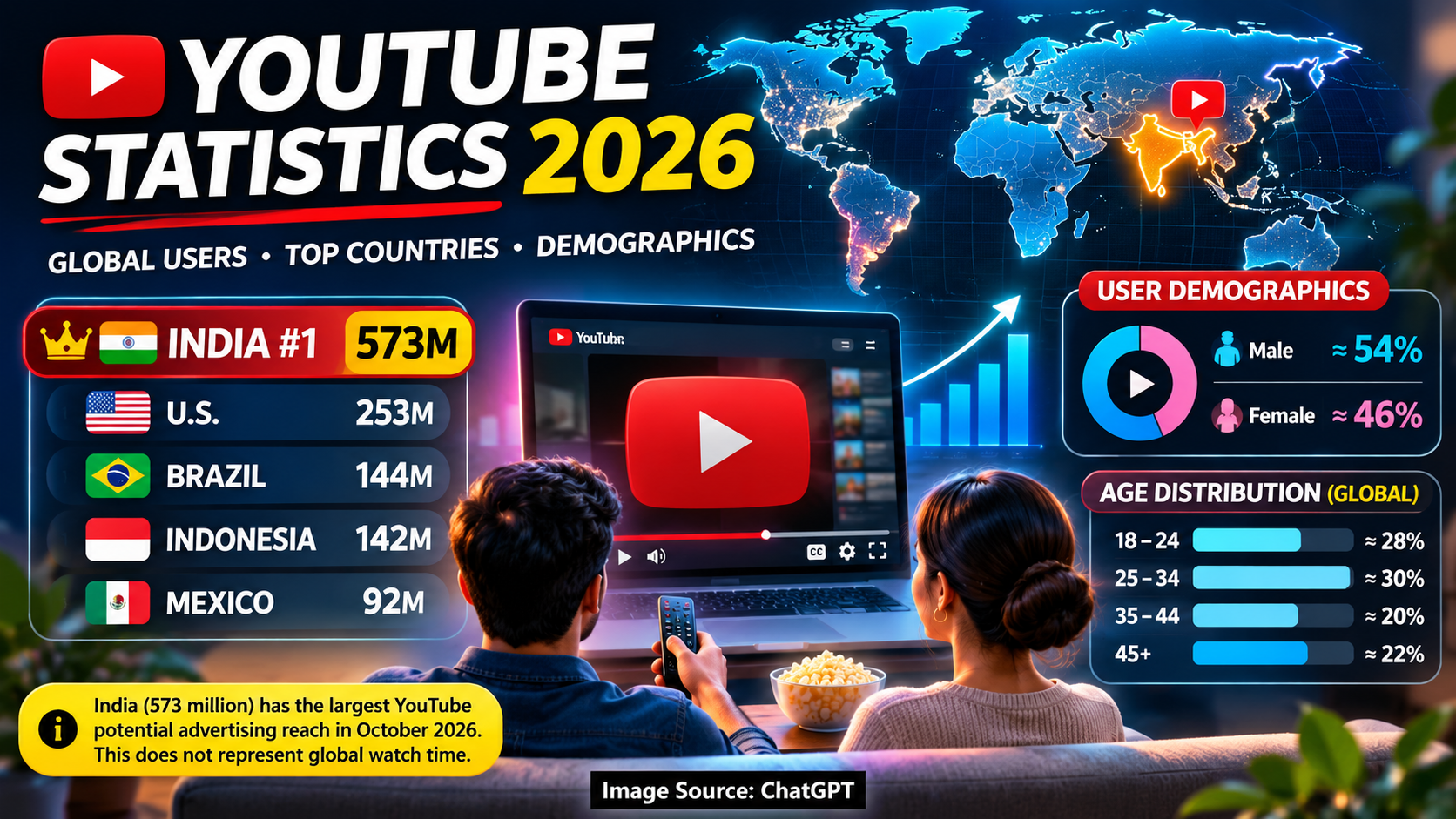
Largest country audience: India, with 573 million.
Second-largest market: United States, with 268 million.
Third-largest market: Indonesia, with 155 million.
Global gender distribution: 51.8% male and 48.2% female in the reported ad audience.
Largest reported adult age bracket: 25–34 years.
Shorts consumption: Approximately 200 billion daily views, according to YouTube.
Annual advertising-reach growth: 7.3% through October 2026.
These highlights reveal YouTube's scale, but audience size is only one part of the platform's influence.
1. How Many People Use YouTube Worldwide in 2026?
Google's advertising resources indicated a potential YouTube audience of 2.77 billion worldwide in October 2026, according to DataReportal.
This was equivalent to approximately 33.3% of the global population and 45.1% of internet users, using the population and connectivity estimates applied in the analysis.
The platform's reach increased by approximately 189 million, or 7.3%, compared with October 2025.
However, advertising reach should not automatically be described as monthly active users. The figures represent accounts or audiences that Google's tools indicate advertisers may be able to reach. Not every viewer is necessarily counted, and the estimates can be affected by advertising eligibility, methodology and duplicate accounts.
The headline figure is therefore a powerful measure of marketing scale rather than a precise census of people who watched a video.
2. Which Country Watches YouTube the Most in 2026?
India ranks first by potential YouTube advertising audience, followed by the United States, Indonesia and Brazil.
India's 573 million reachable users substantially exceed the United States' 268 million. That makes India's reported advertising audience more than twice as large.
Yet the phrase "watches YouTube the most" can mean several things.
A country may have the largest number of reachable users without having the highest viewing time per person. Another country may have a smaller population but a greater percentage of residents using the platform.
Because comparable total national watch-hour figures are not publicly available for every country, the most defensible global ranking uses a clearly defined measure such as advertising reach.
3. Top 20 Countries by YouTube Advertising Audience
The following rankings reflect October 2026 estimates.
| Rank | Country | Ad Reach |
|---|---|---|
| 1 | India | 573 million |
| 2 | United States | 268 million |
| 3 | Indonesia | 155 million |
| 4 | Brazil | 154 million |
| 5 | Mexico | 89.4 million |
| 6 | Japan | 83.3 million |
| 7 | Germany | 68.8 million |
| 8 | Vietnam | 63.9 million |
| 9 | Philippines | 62.0 million |
| 10 | Turkey | 61.0 million |
| 11 | Pakistan | 60.6 million |
| 12 | United Kingdom | 59.0 million |
| 13 | Bangladesh | 54.3 million |
| 14 | France | 53.5 million |
| 15 | Egypt | 53.1 million |
| 16 | Thailand | 48.2 million |
| 17 | Italy | 44.1 million |
| 18 | South Korea | 43.7 million |
| 19 | Spain | 40.5 million |
| 20 | Nigeria | 36.0 million |
Source: DataReportal and Statista, October 2026 YouTube advertising audience estimates.
The rankings reveal the geographical breadth of YouTube. Large Asian and American markets dominate the leading positions, while European countries such as Germany, the United Kingdom and France also maintain substantial audiences.
4. Why India Is YouTube's Largest Market
India's position reflects a combination of population size, internet connectivity and multilingual content demand.
YouTube serves Hindi-speaking viewers alongside audiences consuming videos in Tamil, Telugu, Bengali, Marathi, Malayalam and many other languages.
Education, technology tutorials, entertainment, music, cricket analysis and regional news provide many reasons to return to the platform.
DataReportal estimated India's YouTube advertising reach at 500 million in late 2025 and 573 million in October 2026, an increase of approximately 73 million.
India's expanding digital audience presents opportunities for local creators, educational publishers and businesses seeking national or regional visibility.
Nevertheless, a large audience does not guarantee high advertising revenue. Viewer location, purchasing power, advertiser competition and content category all influence earnings.
5. United States: A Major Market for Video and Creators
The United States had an estimated YouTube advertising audience of 268 million in October 2026.
Its importance extends beyond its position in the global ranking. YouTube has become a major competitor for television viewing, alongside streaming services and conventional broadcasters.
Pew Research Center's 2025 survey found that 84% of U.S. adults reported ever using YouTube. That survey measures self-reported platform use, so it should not be directly compared with Google's advertising estimates.
American audiences watch entertainment, music, commentary, sports, educational programs, interviews and creator-produced shows.
For publishers, the United States can be a valuable commercial market, but audience quality matters more than location alone. A focused channel with engaged viewers may perform better than a much larger channel with limited retention.
6. Indonesia and Brazil: Two Major Video Markets
Indonesia and Brazil were separated by just one million in the October 2026 rankings, with advertising audiences of 155 million and 154 million respectively.
Indonesia benefits from a large mobile-connected population and extensive interest in entertainment, gaming, education and local creators.
Brazil's Portuguese-language video ecosystem also supports substantial audiences for music, sports, lifestyle content and digital entertainment.
These content themes illustrate potential audience opportunities rather than a verified ranking of each country's most-watched categories.
Both markets demonstrate why creators should consider localization carefully. Videos created for local language preferences, cultural references and viewer needs may have greater relevance than broadly translated global content.
7. Audience Size Is Different From Penetration
Comparing countries purely by audience size favors those with large populations.
Penetration offers another perspective: the proportion of a defined population that uses a service.
Statista's October 2026 summary highlighted the Philippines as having more than 86% penetration among its digital population, based on the underlying usage measure.
That does not mean the Philippines has more YouTube users than India. It means YouTube can occupy a particularly prominent place within the country's connected population.
Care is needed because surveys measuring monthly usage and advertising tools measuring potential reach use different populations and methods.
For international marketing, both measures are informative: total reach identifies scale, while penetration can indicate how deeply the platform is established.
8. YouTube Gender Demographics in 2026
DataReportal reported the following global advertising-audience distribution in October 2026:
| Gender Identifier | Audience Share |
|---|---|
| Male | 51.8% |
| Female | 48.2% |
The overall balance is relatively close, although differences become more noticeable within individual countries.
India's adult advertising audience was approximately 55.3% male and 44.7% female. In the United States, the reported balance was approximately 48.9% male and 51.1% female.
These differences matter for advertisers, but they should not be treated as universal preferences. The gender composition of a cooking channel, programming tutorial or financial education channel may differ considerably from the national average.
Google's reported gender categories also do not describe the full diversity of people's identities.
9. YouTube Users by Age Group in 2026
Age demographics help explain how YouTube serves different generations.
DataReportal's October 2026 figures indicate the following shares of the global advertising audience, calculated by combining the reported female and male percentages for each age bracket:
| Age Group | Share of Global Ad Audience |
|---|---|
| 18–24 years | 14.1% |
| 25–34 years | 20.9% |
| 35–44 years | 18.7% |
| 45–54 years | 14.8% |
| 55–64 years | 10.9% |
| 65+ years | 10.6% |
The 25–34 bracket is the largest of these reported groups.
The percentages do not total 100%, partly because advertising tools provide limited information for younger audiences and because of source-data and reporting differences.
These are advertising-audience shares, not estimates of the percentage of each age group that uses YouTube.
10. Why Adults Aged 25–34 Matter
The 25–34 audience is commercially interesting because many people in this stage of life are making decisions about careers, education, technology, housing and personal finances.
Videos about professional skills, product comparisons and practical problem-solving can help viewers research those decisions.
That does not establish that this group watches more minutes than every other age bracket. Its significance in the available data comes from its large share of the advertising audience.
Younger adults may prefer different formats, while older audiences may value detailed explanations and familiar subjects.
Creators should test those assumptions against their own analytics instead of designing every video around a single demographic stereotype.
11. What About Teenagers and Children?
YouTube is important to younger audiences, but measuring their activity presents challenges.
Some children use supervised accounts, family devices or YouTube Kids. Advertising tools do not provide a complete demographic picture of these viewers.
Consequently, estimates covering adults cannot simply be extended to children, and missing age percentages should not be treated as proof that younger viewers are absent.
YouTube's January 2026 CEO letter emphasized parental controls and age-appropriate experiences, including improvements to supervising Shorts consumption.
For creators producing content intended for children, safety, appropriate labeling and applicable advertising protections are especially important.
12. YouTube Shorts Statistics in 2026
Short-form video remains a major part of YouTube.
In January 2026, CEO Neal Mohan reported that YouTube Shorts averaged approximately 200 billion views per day.
This figure refers to views, not 200 billion different people. One viewer can generate multiple views during a single session.
Shorts can help audiences discover a creator quickly, while longer videos provide room for tutorials, interviews, documentaries and detailed analysis.
A useful strategy is to treat the formats as complementary rather than interchangeable.
For example, a short clip might introduce an interesting scientific question, while a longer video explains the research, uncertainty and practical implications.
The important measure is not views alone but whether viewers find the content worthwhile.
13. YouTube Viewing on Television
YouTube is no longer restricted to smartphones and computers.
The company has reported more than one billion hours of YouTube content watched on television screens each day worldwide. Its 2026 CEO letter also emphasized the platform's leading position in U.S. streaming watch time, citing Nielsen.
Connected-TV viewing changes how creators should produce content.
Small text may be difficult to read from a sofa, while clear audio, organized chapters and well-designed visuals become especially valuable.
Longer educational programs, interviews and documentary-style videos can benefit from a comfortable living-room viewing experience.
However, a high connected-TV watch-time total does not identify which country contributes the greatest number of hours.
14. News and Educational Content Have Substantial Audiences
Entertainment may attract attention, but practical information is also an important part of YouTube's appeal.
In October 2026, YouTube reported that viewers had watched more than 35 billion hours of news content globally during 2025. Over 12 billion of those hours came from connected televisions.
This demonstrates that people use YouTube for serious information as well as recreation.
Educational videos can also serve distinctive needs: someone learning spreadsheet formulas may want a concise demonstration, while a student preparing for an examination may prefer a structured lesson.
The opportunity for publishers is to answer genuine questions accurately and clearly. Engagement-focused packaging should not come at the expense of trustworthy explanations.
15. How Fast Is YouTube Growing?
YouTube's global potential advertising reach increased by approximately 7.3% between October 2025 and October 2026.
DataReportal also reported a rise of 127 million, or 4.8%, between July and October 2026.
Country-level change can vary. India recorded an increase of 73 million in potential reach between late 2025 and late 2026, while the United States increased by approximately 14 million.
These figures suggest expansion, but they should not be interpreted as a direct count of newly registered or newly active people.
Changes in Google's measurement systems, advertising inventory and audience definitions can influence reported reach.
16. What the Numbers Mean for Creators
A large national audience provides potential viewers, not guaranteed subscribers.
A creator publishing videos in Hindi may find an extensive audience in India, but competition is also substantial. Someone producing Portuguese-language tutorials might serve Brazilian viewers more effectively with a smaller, tightly defined topic.
The most useful channel-level statistics include click-through rate, average view duration, audience retention, returning viewers and subscriber conversion.
Creators should also examine how performance changes between Shorts, long-form videos and live streams.
For international channels, subtitles and translated metadata may improve accessibility where appropriate, but accurate language and cultural context remain essential.
Rather than chasing the country with the largest population, successful planning begins with identifying people who genuinely need the content.
17. Advertising Opportunities and the Creator Economy
YouTube supports creators through several revenue models, including advertising, subscriptions, memberships and commerce-related features where available.
In its 2026 CEO letter, YouTube stated that it had paid more than $100 billion to creators, artists and media companies over the preceding four years.
This is a cumulative company-reported payout figure, not an annual earnings estimate or a guarantee for individual channels.
Advertisers should consider audience relevance, creative quality and measurable business outcomes.
A product demonstration viewed by a small number of highly interested customers may generate more useful results than a widely watched video that has little connection to the product.
For creators, the strongest long-term strategy combines trustworthy content with an understanding of viewer needs and appropriate monetization options.
18. Why YouTube Watch-Time Rankings Are Difficult
The question "Which country watches YouTube the most?" deserves a precise answer.
India leads the available country ranking by advertising audience size. But to establish the country with the greatest total viewing time, researchers would need comparable watch-hour data for every market over the same period.
To determine which population watches the longest per person, they would also need an appropriate denominator and reliable viewing-time measurements.
Neither question can be answered simply by rearranging advertising audience figures.
A responsible statistics article distinguishes potential reach, monthly usage, views, watch hours and viewing frequency instead of presenting them as equivalent.
That distinction protects readers from misleading conclusions.
19. How to Use YouTube Statistics Responsibly
Before using platform statistics in a marketing proposal or business plan, check the measurement date, population covered and original definition.
Do not compare a 2025 survey about adult usage with a 2026 advertising estimate without identifying the methodological differences.
Similarly, a percentage calculated using internet users is not directly comparable with one calculated using total population.
Age and gender distributions describe broad audiences and should not replace actual customer research.
Most importantly, avoid presenting public platform-level statistics as if they predict the performance of an individual video or guarantee revenue.
The figures are valuable when used as context for better questions and more careful decisions.
Frequently Asked Questions
Which country has the most YouTube users in 2026?
India has the largest reported potential advertising audience, at approximately 573 million in October 2026.
How many YouTube users are there worldwide?
Google's advertising tools indicated potential global reach of 2.77 billion in October 2026. This should not be equated with a verified count of unique monthly active users.
Which country ranks second?
The United States, with approximately 268 million in potential advertising reach.
What is YouTube's largest reported age group?
The 25–34 age bracket represents approximately 20.9% of the global advertising audience in the available age-and-gender data.
Are most YouTube viewers male or female?
Globally, the reported advertising audience was 51.8% male and 48.2% female in October 2026. Country-specific distributions vary.
How many YouTube Shorts views occur daily?
YouTube reported an average of approximately 200 billion daily Shorts views in January 2026.
Does India also have the highest total watch time?
The available country advertising-reach figures cannot establish that. Comparable total national watch-hour data would be needed.
Conclusion
YouTube's 2026 statistics reveal a platform with enormous international reach and increasingly diverse viewing habits.
India leads the advertising-audience ranking, the United States remains a major market, and Indonesia and Brazil contribute large audiences.
At the same time, Shorts, connected-TV viewing, education and news demonstrate how widely YouTube's role has expanded.
The central lesson is that audience size, actual usage and watching time are different measurements.
For creators, researchers and businesses, understanding those differences is more valuable than repeating an impressive figure without context.