Motorola is preparing its next big premium-phone moment in India
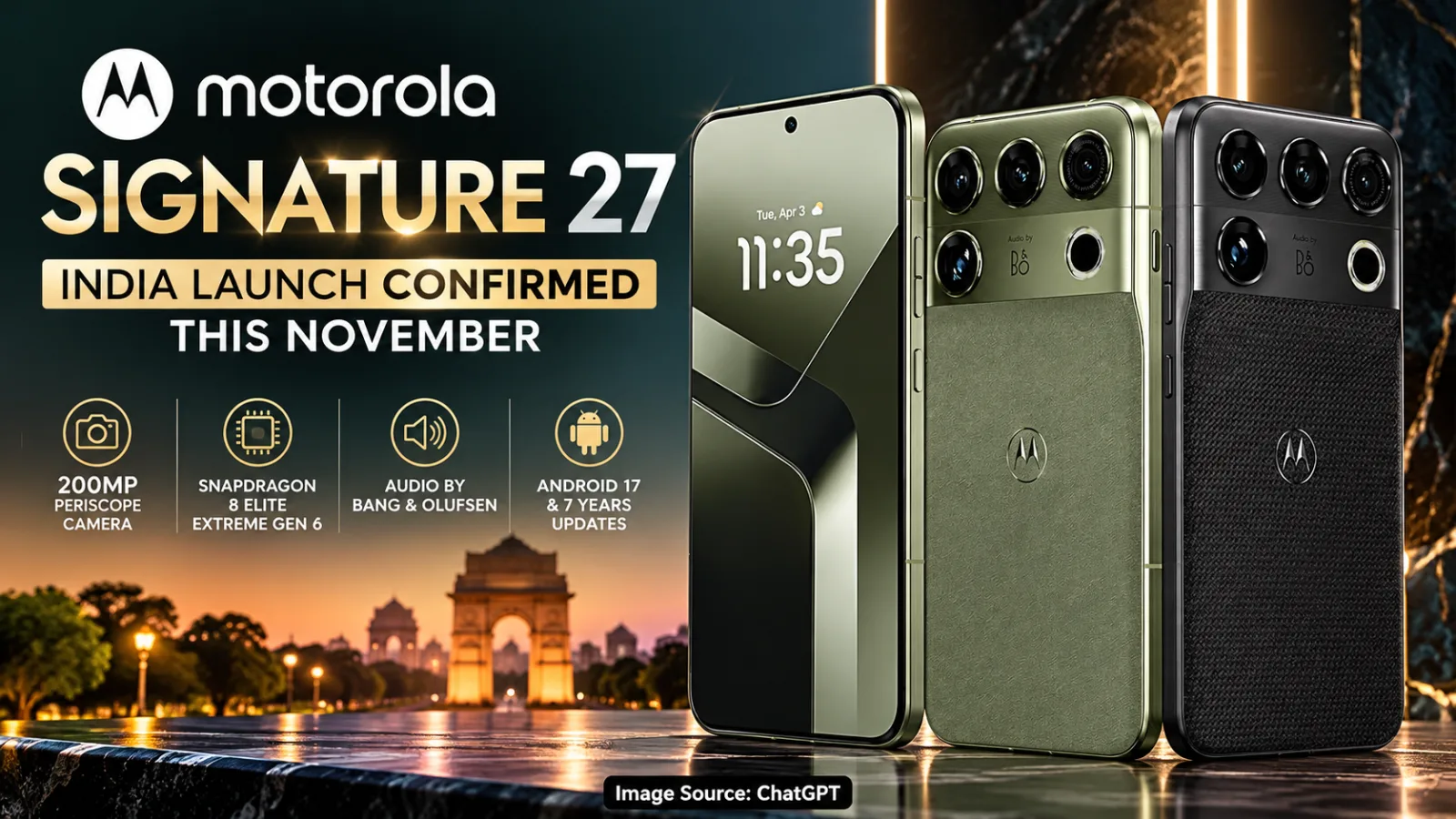
The Motorola Signature 27 is moving from an ambitious global preview to an India-focused launch campaign. After introducing the handset at the Snapdragon Summit in September and showcasing it at India Mobile Congress in October, Motorola has opened an Indian product page promising more information in November 2026. An exact event date, retail price, and first sale date have not yet been announced.
That distinction matters. Buyers searching for the Motorola Signature 27 India launch date may encounter confident predictions about price, battery capacity, or availability. Some reports contain reasonable expectations, but expectations are not specifications. The most useful way to evaluate this phone now is to separate demonstrated features from decisions that must wait until the full launch.
India launch timeline: November is the window, not a confirmed sale date
Motorola introduced the second-generation Signature handset during Qualcomm’s September 2026 Snapdragon Summit. On October 9, it showed the device at India Mobile Congress, signaling that Indian customers would be included in the rollout. By October 28, the company's India microsite was inviting registrations and pointing to November for further announcements.
The practical takeaway is straightforward: November 2026 is the announced arrival window, but there is no confirmed day for an unveiling, pre-orders, or deliveries as of October 29. The most reliable place to monitor updates is Motorola India's Signature 27 page, rather than treating an unofficial launch calendar as final.
The number “27” is not a promise that the device will first appear in 2027. Motorola says the new naming convention uses the last two digits of the upcoming year. This explains why a phone introduced in late 2026 is called the Signature 27.
Snapdragon 8 Elite Extreme Gen 6: performance beyond benchmark scores
At the centre of the device is Qualcomm's Snapdragon 8 Elite Extreme Gen 6 mobile platform. Motorola is positioning it as a foundation for responsive gaming, high-end image processing, multitasking, and local AI workloads. Industry reporting describes it as a 2nm-class flagship chipset, although actual battery efficiency and sustained performance must still be measured on a finished retail phone.
Buyers should therefore look beyond a single benchmark chart. More meaningful launch reviews will examine frame-rate stability, app reloads, video export times, mobile-data efficiency, and how comfortably the phone behaves in India's warm weather. Strong peak numbers are impressive; consistently strong performance is what makes an expensive device pleasant to own.
ArcticMesh cooling aims to protect performance during demanding use
Motorola has described an upgraded ArcticMesh cooling system combining diamond-infused thermal gel, liquid metal, copper mesh, and a redesigned three-dimensional vapour chamber. It says the cooling assembly is 40% larger than the previous generation's solution.
This is particularly interesting for people who record extended 4K footage, use navigation outdoors, or play demanding games while connected to mobile data. During those activities, the important question is not whether the processor can reach its maximum speed for a moment, but how long it maintains useful performance without uncomfortable surface heat.
The larger cooling hardware is a credible design improvement, not a guarantee of low temperatures. Independent tests should measure sustained speed, thermal throttling, comfort while holding the phone, and whether the camera reduces recording options when the device becomes hot.
A 200MP periscope camera is the headline photography upgrade
Camera versatility looks set to be one of the Signature 27's clearest advantages. Motorola has identified a 200-megapixel periscope telephoto camera alongside a 50-megapixel Sony LYTIA 910 main sensor. Its Super Zoom Pro system is promoted for magnification up to 100x with AI-assisted processing, while optical stabilisation is intended to improve handheld shooting.
A periscope design folds the optical path inside a relatively slim phone, making longer focal lengths more practical. For travellers, that can mean better framing of distant architecture, landscapes, or stage performances without walking closer. For families, a capable telephoto lens can also produce more flattering portraits from a comfortable distance.
But the 200MP label should not be confused with 200MP of visible detail at every zoom setting. Sensor resolution, lens quality, optical magnification, lighting, and processing all affect the final image. At extreme digital zoom levels, software may reconstruct fine detail. That can create an attractive photograph, but it should not be treated as a documentary record of tiny distant objects.
Buyers who prioritise the camera should inspect side-by-side photographs at everyday focal lengths: main camera, portraits, moderate zoom, and night scenes. A well-balanced camera that performs reliably at 1x through useful telephoto ranges will deliver more lasting value than a spectacular 100x promotional demonstration.
Main camera, stabilisation, and video deserve equal attention
The 50MP Sony LYTIA 910 main sensor is promising because a phone's main camera handles the majority of daily moments. Think of a child moving indoors, a family meal under mixed lighting, a sunset with bright skies, or a quick photo of an important document. In these situations, colour balance, shutter response, focus accuracy, and natural skin tones matter more than the headline pixel count.
Motorola is also discussing video enhancement technology and stabilisation working with 3.5-degree optical image stabilisation hardware. That could be useful for travel clips, walking shots, and handheld recording, but recording limits and supported resolutions still need to be checked when the complete Indian specification sheet appears.
The design shows a multi-camera system, yet not every camera sensor and lens has been fully explained for Indian buyers. Avoid assuming a specific ultrawide resolution, selfie specification, or recording capability until Motorola publishes it. A careful purchase decision considers the whole imaging system, not just its two star sensors.
Bang & Olufsen audio may improve the everyday experience
The Signature 27 introduces Audio by Bang & Olufsen, an important part of Motorola's premium positioning. Sound tuning often receives less attention than cameras or processors, despite being used throughout the day for podcasts, films, music, conference calls, and games.
What should consumers listen for? Clear dialogue at moderate volume, consistent left-right balance in landscape mode, controlled bass rather than exaggerated vibration, and audio that remains comfortable during long listening sessions. Motorola has highlighted listening modes for different forms of entertainment, but their effectiveness is best assessed with real content.
Distinctive materials give the Signature 27 its personality
Motorola is offering two particularly thoughtful finishes: Pantone Coal Smoke with a Tactical Weave-inspired texture and Pantone Capulet Olive with a brushed, textile-inspired surface. The company also describes an aluminium body, contoured edges, and a camera area with ceramic and brushed-metal detailing.
This approach gives the handset an identity beyond another glossy slab. Texture can improve grip, reduce visible fingerprints, and create a more comfortable feeling in the hand. The Coal Smoke option should appeal to buyers who prefer a restrained, dark appearance, while Capulet Olive offers a warmer, more expressive look.
Display and battery: two important questions still unanswered
The screen is where owners spend most of their time, yet a complete set of confirmed India-specific display details was not available at the time of writing. Brightness, refresh-rate behaviour, eye comfort, touch response, and outdoor visibility could all affect the phone's long-term appeal.
Battery capacity and charging specifications also remain open questions. A high-performance chipset, ambitious camera system, and extensive AI functions create a compelling feature list, but buyers will want a full day of mixed use without planning their lives around a charger.
The right battery test is not simply how many hours a phone lasts playing a video in controlled conditions. Real ownership involves 5G, navigation, photography, mobile payments, messaging, Bluetooth devices, and background apps. Charging heat, overnight battery drain, and long-term battery-care settings also deserve attention. Wait for measured results rather than assuming a large battery or a particular charging wattage.
Android, updates, and AI could shape long-term value
Motorola has pledged seven operating-system upgrades and up to seven years of security updates for the Signature 27, subject to market and model conditions. Android 17 is reported as the launch software. For a buyer who plans to keep a phone for four or five years, this support promise may be as important as the chip.
A long update policy offers the potential for newer Android features, ongoing security fixes, and better app compatibility. Still, buyers should examine Motorola's delivery record: updates that arrive promptly and reliably are more useful than a number printed in advertising.
Google Gemini is central to the company's AI pitch. Motorola has discussed creative tools for generating video or music, as well as more helpful everyday assistance. Availability can vary by language, region, app, subscription, and network access. Before buying for one particular AI feature, verify that it actually works in India and fits the tasks you perform.
Motorola Signature 27 expected price in India
There is no official Indian price as of October 29, 2026. Pre-launch reporting has floated a possible starting range around ₹70,000–₹80,000, but that is speculation, not a launch offer. The final number may differ because of storage variants, taxes, promotional discounts, and market positioning.
The original Motorola Signature debuted in India at a listed starting price of ₹59,999, giving shoppers a useful reference point. The new model's upgraded processor, camera hardware, and design ambitions may justify a higher price for some buyers, but the value calculation changes significantly between ₹70,000, ₹80,000, and beyond.
Rather than deciding on a rumour, set a budget ceiling now. Compare the actual launch price, storage offered at the base tier, bank discounts, trade-in terms, charger availability, warranty, and repair support. A lower promotional price is useful only if the total ownership experience matches what you need.
Signature 27 versus the first Motorola Signature
The first Signature already offered an ambitious premium mix: a slim body, a 6.8-inch high-refresh-rate OLED display, a Snapdragon 8 Gen 5 chip, a multi-camera configuration built around 50MP sensors, and an extended software-support promise. It was designed to be elegant as well as capable.
The Signature 27 changes the emphasis. Qualcomm's newer high-end silicon, the 200MP periscope camera, expanded cooling architecture, and Bang & Olufsen collaboration are the most visible advances. These are potentially meaningful for mobile photographers, demanding users, and anyone who values media playback.
A practical 60-day customer experience matrix
Because the Signature 27 has not entered general Indian retail sale, authentic 60-day ownership results cannot yet exist for local buyers. The matrix below is a prospective testing framework, not invented user feedback. It shows how a customer can evaluate the phone after purchase and which observations deserve more weight than first-day excitement.
| Ownership period | Everyday usage test | Key highlights to evaluate | What a satisfactory experience looks like |
|---|---|---|---|
| Days 1–7 | Setup, 5G calling, Wi-Fi, payments, outdoor display | Network stability, comfort, interface clarity | Dependable essentials without recurring interruptions |
| Days 8–14 | Family photos, portraits, night scenes, 3x–10x-style zoom tests | Natural colours, focus, practical telephoto quality | Consistent usable photos beyond showcase conditions |
| Days 15–21 | Gaming, navigation, video recording, app switching | Sustained speed, heat, camera reliability | Predictable performance during longer sessions |
| Days 22–30 | Podcasts, streaming, speakerphone, wireless audio | Dialogue clarity, stereo balance, connection quality | Enjoyable listening without constant adjustment |
| Days 31–45 | Commute, travel, work, mixed mobile-data use | Battery endurance, charging comfort, standby drain | A routine that does not require frequent emergency charging |
| Days 46–60 | Continued daily use, updates, backups, AI features | Software stability, useful AI, durability, service access | Confidence that the phone fits long-term needs |
To make this exercise useful, owners can keep a brief weekly note rather than recording dozens of synthetic scores. Note what went well, what caused friction, whether an update improved anything, and whether the phone was comfortable to use without changing normal habits.
A person who rarely plays games should give gaming temperature less weight than camera consistency or battery life. Someone creating videos for work may reasonably rank stabilisation, storage, audio capture, and export speed above all else. The best smartphone is the one that handles an individual's actual routines, not the one with the longest list of premium adjectives.
Who should consider buying the Signature 27?
The Signature 27 looks particularly attractive to photography enthusiasts who want reach beyond the standard wide camera, travellers who value a versatile lens setup, content creators who need a capable performance platform, and buyers who appreciate distinctive industrial design. The cooling system and long software-support pledge also make it interesting for people who keep their devices for several years.
It may be less compelling for shoppers who mainly call, message, scroll social feeds, and watch short videos. A more affordable phone can already perform those tasks smoothly. Likewise, someone whose top priority is battery endurance should wait for independent endurance figures before committing to a premium preorder.
Before purchasing, try to answer three questions. Will its camera capabilities improve photographs you already like taking? Will its performance or software support save meaningful frustration over the coming years? And does its actual selling price leave enough value compared with the alternatives available at the same moment? Those answers are more useful than any blanket recommendation.
Frequently asked questions
When is the Motorola Signature 27 launching in India? Motorola's Indian teaser points to November 2026. An exact launch date and sale date remain unannounced as of October 29.
What processor does the Motorola Signature 27 use? Motorola has identified the Snapdragon 8 Elite Extreme Gen 6 platform, with an emphasis on flagship performance and AI functions.
Does the Motorola Signature 27 have a 200MP camera? Yes. Motorola has confirmed a 200MP periscope telephoto unit and a 50MP Sony LYTIA 910 main camera. The complete India camera specification should be checked at launch.
How much will the Motorola Signature 27 cost? Motorola has not announced an Indian price. Numbers circulating before launch are estimates rather than verified retail prices.
Should existing Motorola Signature owners upgrade immediately? Not necessarily. Compare actual camera output, battery life, heating, software experience, and launch pricing before replacing a working phone.
Final verdict: promising hardware, with value still to be proven
The Motorola Signature 27 has the ingredients of a convincing ultra-premium Android smartphone: advanced Snapdragon performance, an ambitious periscope camera, purposeful cooling, refined audio, carefully chosen materials, and a long update commitment. These features create genuine reasons to pay attention to its November India announcement.
The final buying decision should wait for three things: official Indian pricing, a complete specification sheet, and independent tests of photography, thermals, display, and battery endurance. If Motorola delivers a balanced daily experience at a competitive price, the Signature 27 could be a distinctive choice for people who want flagship capability without sacrificing personality.