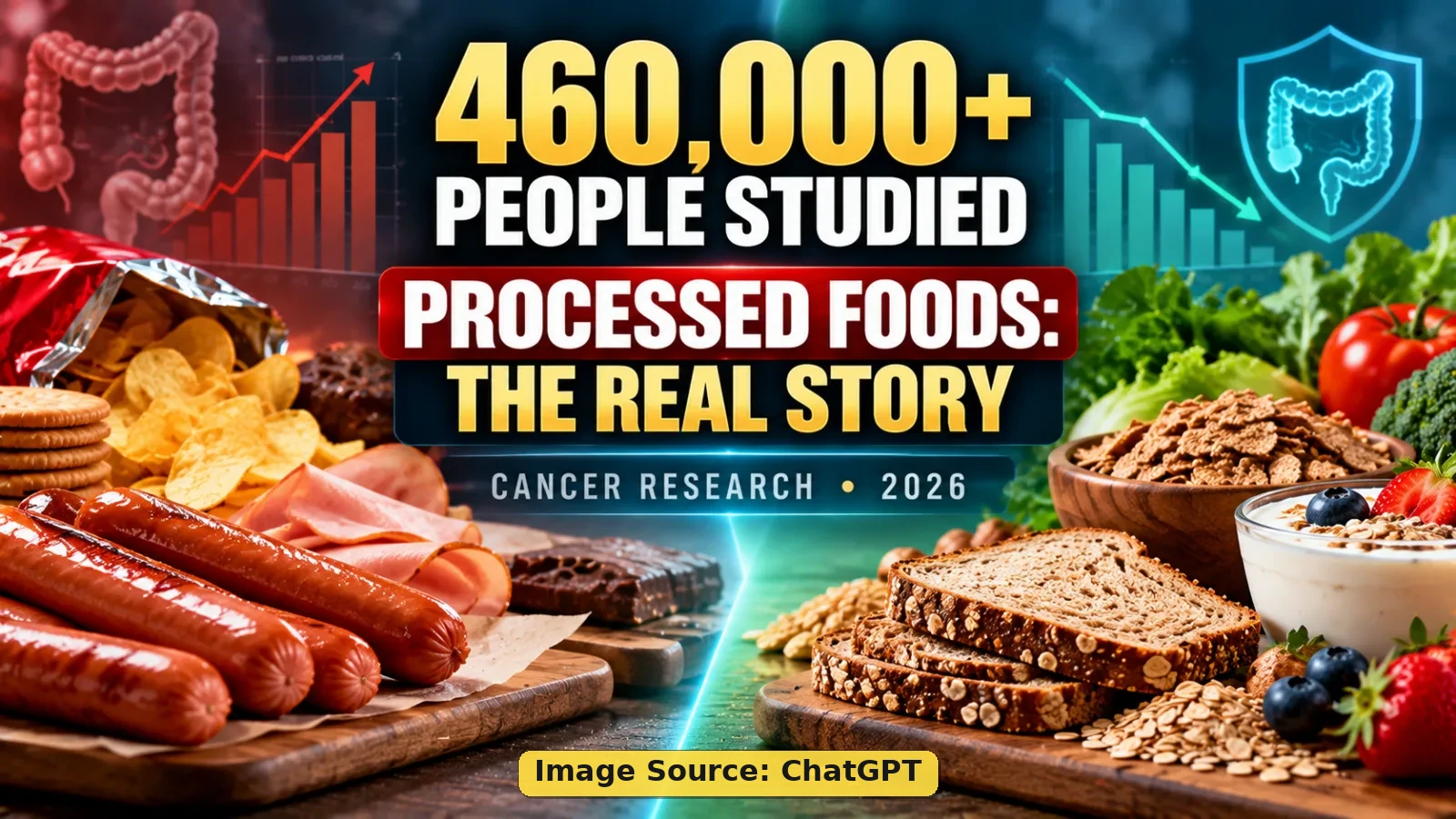
A major American study is prompting scientists to reconsider how they evaluate ultra-processed foods after researchers found no significant overall association between their consumption and colorectal cancer incidence.
The research, published in the medical journal PLOS Medicine, examined dietary information from 461,682 adults participating in the NIH-AARP Diet and Health Study.
Researchers followed participants for a median of nearly 19 years, documenting more than 10,000 cases of colorectal cancer.
The central finding challenges a common assumption about modern diets: foods classified as ultra-processed do not necessarily carry identical health risks.
While processed meat products were associated with higher colorectal cancer incidence, certain whole-grain and dairy products within the same processing category showed associations with lower incidence.
The findings suggest that the nutritional composition of individual foods may be just as important as the industrial processes used to manufacture them.
However, researchers caution that the results should not be interpreted as evidence that all ultra-processed foods are harmless.
Instead, the study highlights the importance of distinguishing between different food groups when assessing long-term health outcomes.
What Did the Study of 461,682 Americans Discover?
Researchers from the U.S. National Cancer Institute and collaborating institutions analyzed dietary and health records from the NIH-AARP Diet and Health Study.
Participants were between 50 and 71 years old when they enrolled in 1995 and 1996.
At the beginning of the research, individuals completed questionnaires describing their eating habits, lifestyle characteristics and general health.
Scientists used this information to estimate how much of each participant's diet consisted of ultra-processed foods.
Cancer diagnoses were subsequently tracked through 2018.
During a median follow-up period of 18.8 years, researchers recorded 10,075 cases of colorectal adenocarcinoma, a major form of cancer affecting the colon or rectum.
The researchers compared participants with the highest consumption of ultra-processed foods against those with the lowest consumption.
After adjusting for several demographic and lifestyle factors, they found no statistically significant relationship between total ultra-processed food intake and colorectal cancer incidence.
The statistical estimate comparing the highest and lowest consumption groups was a hazard ratio of 0.97, with a 95% confidence interval ranging from 0.91 to 1.03.
Because that interval includes 1.0, the result does not provide clear evidence of either increased or decreased risk.
This does not prove that ultra-processed foods cannot contribute to cancer.
It means the researchers did not detect a meaningful overall association in this particular population using the study's methods.
Why These Findings Are Important for Nutrition Research
Ultra-processed foods have attracted increasing attention because many popular products contain substantial amounts of added sugar, sodium, refined carbohydrates or saturated fat.
Previous research has also associated higher consumption of ultra-processed foods with various chronic health conditions.
However, the category is extremely broad.
A packaged whole-grain breakfast cereal and a processed meat product may both be classified as ultra-processed, despite having very different nutritional profiles.
Treating them as nutritionally equivalent can make dietary research difficult to interpret.
For example, whole-grain products may provide dietary fiber that supports digestive health.
Processed meat, by contrast, has been associated with increased colorectal cancer risk.
When these foods are combined into a single statistical category, their different associations may partially offset one another.
This creates a situation in which the overall category shows little relationship with a particular disease, even though individual components show important differences.
The new study demonstrates why looking beyond the ultra-processed label can provide a more useful understanding of diet and health.
What Exactly Are Ultra-Processed Foods?
Ultra-processed foods are generally classified using the Nova food-processing system.
The system divides foods into four categories according to the extent and purpose of industrial processing.
Minimally processed foods include items such as fresh vegetables, fruit, eggs and plain milk.
Processed culinary ingredients include substances such as oils, butter and sugar.
Processed foods generally combine recognizable ingredients using methods such as cooking, preservation or fermentation.
Ultra-processed foods often contain industrial formulations, additives or ingredients that are not commonly used in home cooking.
Examples include packaged snacks, certain breakfast cereals, commercially produced breads, instant noodles, processed meats and many ready-to-eat meals.
However, not every product in this category has the same nutritional characteristics.
Some are high in sugar and low in fiber.
Others may contain substantial amounts of whole grains, calcium or other nutrients.
This diversity is one of the main reasons researchers are investigating whether processing classifications should be considered alongside detailed nutritional information.
Processed Meat Was Associated With Higher Cancer Incidence
One of the clearest findings involved processed meat.
The researchers observed that higher consumption of meat from ultra-processed sources was associated with increased colorectal cancer incidence.
Products in this category can include hot dogs, sausages and reconstituted meat preparations.
The finding is consistent with previous scientific assessments of processed meat and colorectal cancer.
The World Health Organization's International Agency for Research on Cancer has classified processed meat as carcinogenic to humans based on evidence linking consumption to colorectal cancer.
That classification identifies the strength of the evidence that an exposure can cause cancer. It does not mean processed meat carries the same level of risk as every other substance within the same classification group.
For consumers, the practical implication is that the type of processed food matters.
A meal containing processed meat should not be assumed to have the same nutritional characteristics as a high-fiber breakfast cereal simply because both are industrially manufactured.
The new findings reinforce existing recommendations to limit processed meat consumption.
Whole-Grain Foods Showed More Favorable Results
The study also identified a different pattern involving whole grains.
Higher consumption of whole-grain products, including those classified as ultra-processed, was associated with lower colorectal cancer incidence.
Whole grains contain nutrients and compounds that may support digestive and metabolic health.
Dietary fiber is particularly important because it contributes to normal bowel function and helps maintain healthy dietary patterns.
Researchers found that ultra-processed foods supplied a substantial proportion of participants' whole-grain intake.
This is significant because commercially manufactured bread and breakfast cereals can contain meaningful amounts of whole grains.
Automatically eliminating all packaged grain products could therefore reduce access to useful dietary fiber for some consumers.
However, the findings should not be interpreted as evidence that every commercially manufactured cereal or bread is beneficial.
Products differ considerably in added sugar, fiber content, sodium and other ingredients.
A whole-grain cereal containing substantial fiber may offer a different nutritional profile from a heavily sweetened product containing mostly refined grains.
Reading nutrition labels remains important.
Dairy Products Were Also Linked to Lower Cancer Incidence
Another interesting finding involved dairy foods.
Researchers observed that higher consumption of dairy products and calcium, including amounts obtained from ultra-processed sources, was associated with lower colorectal cancer incidence.
Dairy products can provide calcium, protein and other nutrients.
Some also contain added sugar or flavoring ingredients, making their overall nutritional value dependent on the specific product.
The study identified favorable associations for certain milk products and frozen desserts.
However, those associations do not establish that eating frozen desserts prevents cancer.
Observational research cannot determine whether a particular food directly caused the difference in cancer incidence.
Other dietary habits, health characteristics or unmeasured factors may have influenced the results.
The more useful conclusion is that foods grouped together as ultra-processed may have very different nutritional properties.
A calcium-rich dairy product and a sugary packaged snack should not automatically be treated as interchangeable.
Replacing Just 10% of Ultra-Processed Food Was Associated With a Small Benefit
The researchers also investigated a possible dietary substitution.
Their statistical analysis estimated what might happen if 10% of ultra-processed food intake, measured by weight, were replaced with minimally processed foods.
The substitution was associated with approximately 2% lower colorectal cancer incidence.
This result is interesting because it suggests that relatively modest dietary differences may be worth investigating.
However, the estimate came from statistical modeling rather than a clinical experiment.
Researchers did not randomly assign participants to replace foods and then measure whether their cancer risk declined.
Consequently, the result cannot establish that making this specific change will reduce an individual's cancer risk by exactly 2%.
Nevertheless, replacing some packaged snacks or processed meat with vegetables, fruit, legumes and other nutritious foods can support a healthier dietary pattern.
The key is choosing replacements that improve overall nutritional quality rather than focusing exclusively on whether a product is packaged.
Why the Study Does Not Mean Ultra-Processed Foods Are Completely Safe
The absence of an overall association with colorectal cancer should not be confused with proof that ultra-processed foods pose no health concerns.
First, the research examined one specific cancer outcome.
It did not establish the effects of every ultra-processed food on cardiovascular disease, diabetes, obesity or other cancers.
Second, the study was observational.
Researchers analyzed existing differences in dietary habits rather than controlling what participants ate.
Although statistical models accounted for factors such as smoking, alcohol consumption, physical activity and education, unmeasured influences could still affect the findings.
Third, participants reported their diets at the beginning of the study.
Eating habits may have changed substantially during the following decades.
The American food supply also changed between the mid-1990s and 2018, including the availability and formulation of many packaged products.
Finally, the study primarily involved older American adults.
Its findings may not apply equally to younger populations or people living in countries with different dietary patterns.
These limitations are important when interpreting the results.
How Does This Research Compare With Previous Studies?
The broader scientific literature contains evidence associating high ultra-processed food consumption with several adverse health outcomes.
A separate meta-analysis published in September 2026 combined findings from 51 prospective cohorts involving approximately 8.8 million adults.
That analysis reported associations between greater ultra-processed food consumption and increased risks of several chronic diseases, including cardiovascular conditions and certain cancer outcomes.
However, the authors also described the certainty of evidence as low or moderate.
Different studies can produce different findings because they examine different populations, dietary measurements and health outcomes.
A study evaluating colorectal cancer among older American adults is not necessarily comparable to research investigating all cancer types across multiple countries.
Additionally, dietary habits often involve combinations of foods rather than isolated ingredients.
People who regularly consume large quantities of certain packaged products may also differ in physical activity, smoking habits, alcohol consumption and overall food quality.
Researchers attempt to account for these differences, but doing so perfectly is difficult.
The latest National Cancer Institute findings therefore add important evidence without eliminating the need for further research.
Why Food Quality May Matter More Than a Simple Processing Label
The most valuable lesson from the study may be the importance of examining foods individually.
Consider two different breakfast options.
One contains a high-fiber whole-grain cereal with plain yogurt and fruit.
The other consists mainly of processed meat and a sugary beverage.
Depending on their manufacturing methods, both meals could contain products classified as ultra-processed.
Yet their overall nutritional characteristics differ substantially.
The first may provide more fiber, calcium and useful nutrients.
The second may contain more processed meat, added sugar or sodium.
A processing label alone cannot capture all these distinctions.
This does not mean manufacturing methods are irrelevant.
Food additives, product formulations and eating behavior remain legitimate research topics.
However, a useful nutritional assessment should also consider fiber, nutrient density, added sugar, sodium, saturated fat and the broader dietary pattern.
That approach gives consumers more practical information than treating every packaged product as identical.
What Should Consumers Eat to Support Colorectal Health?
The new findings broadly support established recommendations emphasizing nutritious foods and balanced eating patterns.
The American Cancer Society recommends diets containing vegetables, fruits and whole grains while limiting red and processed meats.
For everyday meals, this can involve choosing foods that provide meaningful amounts of fiber and other essential nutrients.
Beans, lentils, vegetables, fruit and whole grains can help improve the nutritional quality of a diet.
Plain yogurt and other appropriate calcium-rich foods may also contribute useful nutrients.
At the same time, reducing frequent consumption of processed meats can help align eating habits with evidence-based cancer-prevention recommendations.
Consumers do not necessarily need to eliminate every packaged food.
Instead, they can compare products based on nutritional content and portion size.
For example, selecting a whole-grain bread with substantial fiber may be a reasonable alternative to a lower-fiber option.
Choosing water instead of sugary drinks can also support healthier consumption patterns.
Regular physical activity, maintaining a healthy weight and limiting alcohol are additional considerations associated with colorectal cancer prevention.
Importantly, healthy eating does not replace recommended colorectal cancer screening, which helps identify disease or precancerous changes.
Could These Findings Change Future Dietary Guidelines?
The study raises questions about how nutrition policies should communicate the risks associated with industrially manufactured food.
Broad classifications can help researchers identify population-level eating patterns.
However, they may become less informative when products within the same category have very different health associations.
Future research may need to distinguish more carefully among types of ultra-processed foods.
That could involve evaluating processed meat separately from whole-grain products, dairy foods, sweetened beverages and snack foods.
Researchers may also investigate how additives, manufacturing methods and nutrient composition interact.
More detailed dietary information would help scientists understand whether specific ingredients or processing techniques contribute independently to disease outcomes.
Such evidence could eventually support more targeted nutrition recommendations.
For now, the study does not justify abandoning established dietary guidance.
Instead, it provides another reason to emphasize the nutritional quality of individual foods and overall eating patterns.
Why More Research Is Still Needed
Although the study included more than 460,000 adults, size alone cannot eliminate every source of uncertainty.
Future research could benefit from repeated dietary assessments that capture changes in eating habits over time.
Studies involving younger and more diverse populations would also help determine whether similar patterns occur across different age groups and communities.
Researchers may additionally explore specific food additives and manufacturing processes to understand whether they influence colorectal cancer risk independently of nutrient content.
Another important area involves distinguishing foods that are industrially processed for preservation or convenience from products formulated primarily for palatability and long shelf life.
Better understanding these differences could improve the scientific usefulness of broad processing categories.
The central challenge is identifying which food characteristics are genuinely associated with health outcomes and which are simply correlated with other lifestyle factors.
What the Study Means for Everyday Food Choices
For consumers, the research offers a more practical message than simply labeling ultra-processed foods good or bad.
The evidence suggests that people should pay attention to the foods they choose within each category.
A convenient packaged product can still provide useful nutrients.
At the same time, a product marketed as natural or minimally processed is not automatically appropriate for every dietary need.
Nutrition decisions should consider ingredients, portion sizes, food variety and overall eating habits.
The study also reinforces the importance of avoiding extreme interpretations of scientific findings.
One large investigation rarely provides the final answer to a complicated health question.
Instead, research becomes more useful when considered alongside other studies, established dietary recommendations and individual health circumstances.
Final Outlook: The Real Cancer Question May Be What Foods Contain
The National Cancer Institute's latest research adds an important perspective to the ongoing debate over ultra-processed foods.
After examining 461,682 American adults and documenting more than 10,000 colorectal cancer cases, researchers found no significant overall association between total ultra-processed food intake and colorectal cancer incidence.
However, the results became more informative when individual food groups were considered.
Processed meat was associated with higher cancer incidence, while whole grains, fiber, dairy products and calcium from certain ultra-processed sources showed more favorable associations.
These differences illustrate why broad food classifications cannot always explain complex relationships between diet and disease.
The findings do not establish that all ultra-processed foods are safe, nor do they eliminate concerns raised by other research.
They suggest that nutritional quality and the specific foods people consume deserve careful consideration.
The most important lesson is that healthy eating cannot be reduced to a single label. Understanding what a food contains, how it fits into the overall diet and what scientific evidence says about its effects may be more useful than judging it by processing alone.
For researchers, the study opens the door to more precise investigations. For consumers, it offers a reason to focus on balanced, evidence-based food choices rather than fear every product that comes in a package.