

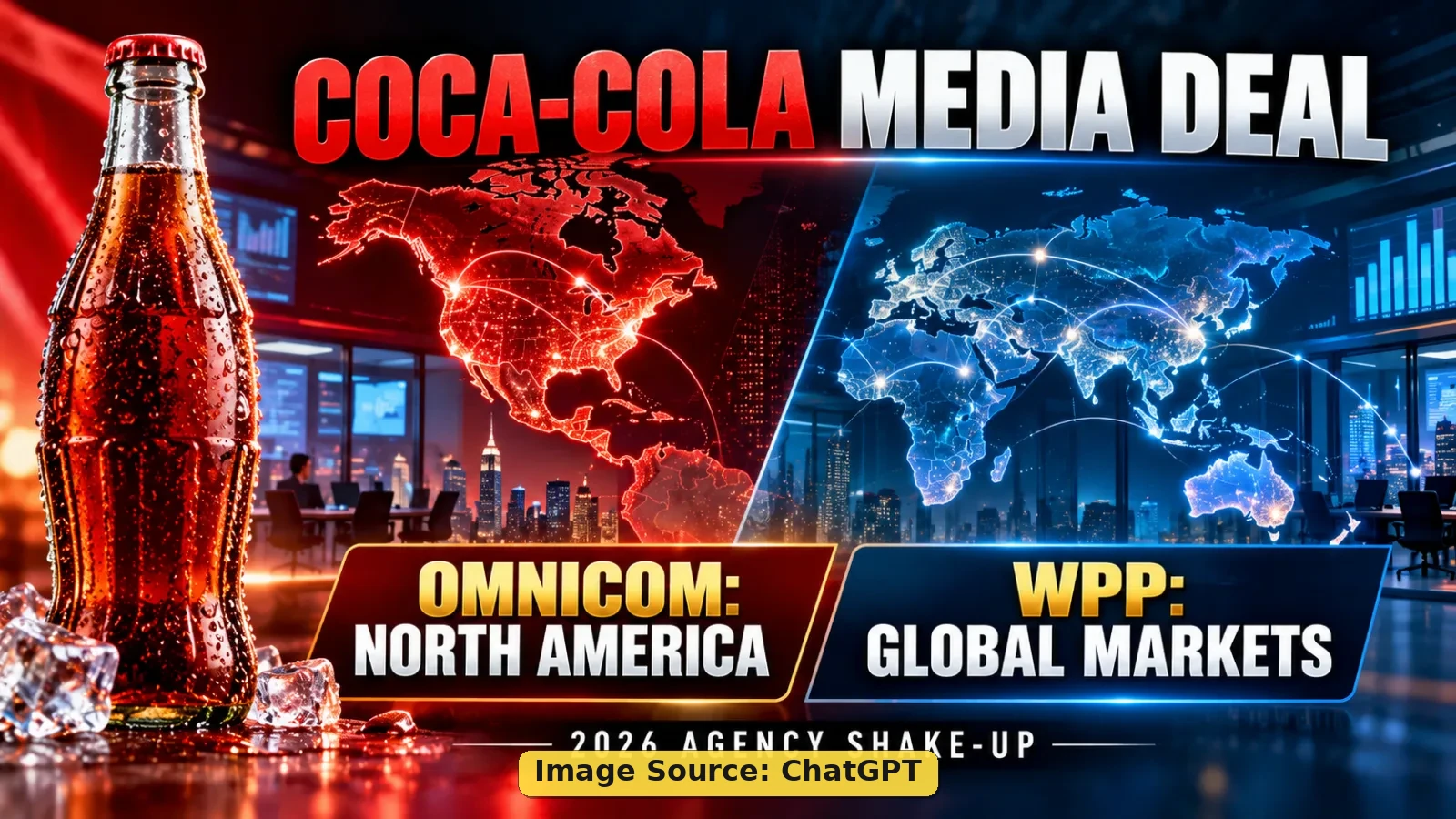
The Coca-Cola Company has reshaped its international advertising partnerships, selecting Omnicom to manage its North American media business while keeping WPP as its principal media and creative partner across most global markets.
The decision, announced on October 22, follows a wide-ranging review of Coca-Cola's marketing operations and brings an important chapter of competition among the world's biggest advertising groups to a close.
Omnicom's North American appointment is particularly significant because it follows the company's recent loss of PepsiCo's global media account to rival Publicis Groupe. Meanwhile, WPP has defended one of its most valuable international client relationships at a time when advertising agencies face growing pressure to demonstrate stronger capabilities in artificial intelligence, consumer data and digital marketing.
Industry estimates place Coca-Cola's North American media account at approximately $700 million to $800 million in annual media billings, making the agreement a substantial commercial victory for Omnicom.
The revised agency structure will be implemented in phases beginning December 1, 2026.
Beyond the financial significance, the decision illustrates how global brands are reconsidering their relationships with advertising partners in an increasingly complex marketing environment.
Omnicom Wins Coca-Cola's North American Media Account
Omnicom has secured responsibility for Coca-Cola's media operations in North America, including the important United States and Canadian markets.
The appointment gives the advertising group responsibility for supporting media planning and buying while developing closer connections among customer data, loyalty initiatives, digital marketing and creator partnerships.
Coca-Cola intends to bring these capabilities together rather than managing them as separate advertising functions.
This approach reflects the growing importance of connected marketing, where companies coordinate advertising across social platforms, streaming services, online retail environments and other consumer touchpoints.
For Omnicom, the victory represents an opportunity to strengthen its position in one of the world's most competitive advertising markets.
The company brings extensive media-buying capabilities and a broad international network to the relationship.
Its expanded scale following the acquisition of Interpublic Group gives it additional resources in analytics, technology and negotiations with major media platforms.
However, securing the account is only the beginning.
Omnicom must now demonstrate that its resources can help Coca-Cola improve marketing efficiency, maintain brand recognition and reach consumers more effectively.
WPP Retains Coca-Cola's Global Media and Creative Business
Although Omnicom has taken the North American assignment, WPP remains a central part of Coca-Cola's marketing strategy.
The British advertising group will continue serving as Coca-Cola's media partner across most international markets through its dedicated Open X operation.
The arrangement excludes North America, Japan and South Korea.
Dentsu will continue managing Coca-Cola's media business in Japan and South Korea, where its responsibilities were not included in the latest review.
WPP also retains Coca-Cola's global creative business, which was not part of the competitive media review.
This distinction is important because media buying and creative production serve different purposes.
Creative agencies develop advertising concepts, brand messages and campaign materials.
Media agencies determine where, when and how those messages reach their intended audiences.
Retaining creative responsibilities allows WPP to remain closely involved in the development of Coca-Cola's international brand identity, even as Omnicom takes over media responsibilities in North America.
WPP StudioX will work alongside Omnicom in the region, helping maintain coordination between creative development and media execution.
For WPP, preserving this relationship provides continuity and reinforces the value of its integrated marketing approach.
Why Coca-Cola Decided to Review Its Advertising Agencies
Coca-Cola's agency review was not simply an exercise in selecting a lower-cost advertising supplier.
The company wanted to evaluate whether its marketing partnerships could meet changing consumer expectations and support future growth.
Traditional advertising relied heavily on television, radio, newspapers and outdoor placements.
Today's consumer environment is considerably more fragmented.
Brands must compete for attention across streaming platforms, social networks, retail websites, gaming environments and digital communities.
Consumers may encounter the same brand through a creator's video, a television commercial, an online shopping recommendation and an in-store promotion.
Managing those interactions requires more than purchasing advertising space.
Companies increasingly need integrated customer insights, reliable measurement and coordinated creative execution.
Coca-Cola's leadership indicated that its review focused on establishing the right combination of partners, capabilities and operating structures for this environment.
The resulting arrangement combines WPP's international infrastructure with Omnicom's North American resources and Dentsu's established presence in two major Asian markets.
Rather than concentrating every responsibility within one advertising holding company, Coca-Cola has chosen a structure that allows different organizations to serve specific market needs.
PepsiCo's Agency Switch Helped Reshape the Competition
The Coca-Cola decision cannot be understood without examining the recent changes involving rival beverage and food company PepsiCo.
In September 2026, PepsiCo selected Publicis Groupe to manage its global media business, ending an Omnicom relationship that had continued for nearly three decades.
The development represented a significant setback for Omnicom.
However, it also changed the competitive landscape surrounding Coca-Cola's own agency review.
Publicis had previously taken responsibility for Coca-Cola's North American media operations in 2025 and had been competing for additional international responsibilities.
After winning PepsiCo's global media account, Publicis withdrew from Coca-Cola's business.
That created an opening for another agency to take over the North American assignment.
Omnicom subsequently emerged as the successful bidder.
The sequence produced an unusual redistribution of major advertising accounts among competing agency groups.
Publicis strengthened its position through PepsiCo. Omnicom gained Coca-Cola's North American media business. WPP maintained Coca-Cola's wider international partnership.
For the agencies involved, these decisions represent significant changes in client portfolios and future business opportunities.
For Coca-Cola and PepsiCo, they provide an opportunity to redesign marketing operations around evolving commercial priorities.
How Much Is Coca-Cola's North American Media Business Worth?
Industry reporting estimates the value of Coca-Cola's North American media business at approximately $700 million to $800 million annually.
Digiday cited COMvergence estimates placing the account at about $785 million in yearly media billings.
This figure is comparable to PepsiCo's previously estimated North American media spending of approximately $780 million.
The comparison helps explain why Omnicom's victory carries considerable importance.
It allows the company to recover a substantial volume of media business after losing PepsiCo's account.
However, annual media billings should not be confused with the revenue that Omnicom will recognize from the contract.
Media billings generally represent advertising expenditure handled on behalf of a client.
An agency's actual earnings depend on factors such as service fees, contractual arrangements, staffing costs and the scope of work performed.
Coca-Cola has not publicly disclosed the detailed commercial terms of its new agency agreement.
Consequently, the reported account value should be understood as an estimate of media business under management rather than guaranteed profit.
The distinction matters when assessing how much the appointment could contribute to Omnicom's financial performance.
What Coca-Cola's Decision Means for Omnicom
For Omnicom, winning Coca-Cola's North American account delivers several potential advantages.
First, the company gains a major relationship with one of the world's most recognizable consumer brands.
Second, the agreement provides an opportunity to demonstrate the advantages of its expanded technology, analytics and media infrastructure.
Third, a successful transition could strengthen Omnicom's position when competing for other large multinational accounts.
The appointment also comes during an important period for the advertising group as it integrates capabilities acquired through its combination with Interpublic.
Larger agency networks can potentially offer clients access to specialized talent, integrated technology and broader media-buying resources.
However, size does not automatically guarantee better advertising outcomes.
Omnicom will need to deliver coordinated campaigns, accurate performance measurement and meaningful commercial results.
Its ability to do so may influence how other multinational advertisers assess large integrated agency groups.
Why Retaining Coca-Cola Is Important for WPP
The announcement also represents an important result for WPP and its chief executive, Cindy Rose.
Coca-Cola has been among WPP's most significant international clients, making the outcome of the agency review particularly important.
The relationship dates to Coca-Cola's decision in 2021 to appoint WPP as a global marketing network partner.
That appointment resulted in the creation of Open X, a specialized operation designed to connect creative development, media, technology and data across Coca-Cola's international business.
Over the following years, the partnership supported marketing activities spanning more than 200 countries and territories.
Coca-Cola highlighted WPP's technology and data capabilities when announcing the latest decision.
The beverage company also pointed to work associated with the 2026 FIFA World Cup as an example of how the partnership had supported large-scale international marketing.
For WPP, retaining the international assignment demonstrates that clients continue to see value in its connected marketing model.
It also gives the company an opportunity to strengthen its position in a competitive advertising industry undergoing rapid technological change.
Nevertheless, maintaining the contract brings continued expectations.
WPP must demonstrate that its global structure can provide consistency without sacrificing flexibility in individual markets.
Artificial Intelligence Is Becoming Central to Advertising Agency Competition
One of the most important aspects of Coca-Cola's latest agency decision is the growing role of artificial intelligence.
Major advertisers increasingly expect their agency partners to use technology for more than generating advertisements.
AI can help marketing teams analyze large datasets, identify patterns in consumer behavior and make faster decisions about campaign performance.
For example, advanced analytics can help a beverage brand understand how purchasing preferences differ across geographic markets.
Technology can also support decisions about advertising frequency, audience segmentation and budget allocation.
AI-assisted tools may help agencies develop creative variations for different platforms while maintaining consistent brand messaging.
However, successful implementation requires careful attention to data quality, consumer privacy and advertising effectiveness.
For Coca-Cola, the challenge is to use these capabilities without weakening the emotional connections that have historically supported its brands.
Technology may help determine which audiences should receive a campaign, but effective storytelling remains essential to making that campaign memorable.
WPP's Open Intelligence capabilities and Omnicom's data-driven marketing infrastructure will therefore play important roles in their respective responsibilities.
Coca-Cola Wants More Connected Consumer Experiences
The North American appointment reflects Coca-Cola's interest in moving beyond advertising operations managed through separate channels.
Historically, a company might organize television, digital media, retail advertising and customer loyalty campaigns through different teams.
That structure can create difficulties when measuring the overall customer experience.
A consumer might see an advertisement on a streaming platform, encounter the same product through a social media creator and later purchase it at a supermarket.
Understanding how these interactions contribute to purchasing decisions requires more coordinated information.
Coca-Cola's revised North American operating model is intended to connect media planning, consumer data, customer relationship management, loyalty programs and creator partnerships.
This could support more consistent communication and more effective allocation of marketing resources.
For example, an integrated campaign might use audience research to identify consumer interests, social media creators to introduce a product and retail advertising to reach shoppers closer to purchase.
The potential advantage is not simply reaching more consumers.
It is improving the relevance and consistency of the interactions those consumers experience.
Whether the new structure achieves those objectives will depend on execution and measurable results.
Why Omnicom and WPP Will Need to Work Together
Although the two advertising groups have different media responsibilities, their work will remain connected.
Coca-Cola must maintain recognizable brand messaging across international markets while adapting campaigns to regional preferences.
For example, a global marketing initiative may use a common creative concept while requiring different language, media platforms and cultural references in North America, Europe and Asia.
WPP's continuing creative responsibilities mean its teams will need to coordinate with Omnicom on campaigns reaching North American consumers.
Clear communication will be essential.
If creative production and media planning operate independently, campaigns can experience delays, inconsistent messaging or unnecessary duplication of work.
Coca-Cola's approach will therefore test whether competing agency organizations can cooperate effectively within a shared brand ecosystem.
Success could demonstrate the commercial value of combining global creative leadership with specialized regional media partnerships.
What the Agency Shake-Up Means for the Advertising Industry
The changes involving Coca-Cola, PepsiCo, Omnicom, WPP and Publicis illustrate several important developments within the advertising sector.
Large brands are increasingly willing to reconsider long-standing relationships when new technology and consumer behavior create different requirements.
Traditional agency reputations remain important, but they are no longer sufficient on their own.
Advertisers want evidence of technological capability, transparent measurement and effective coordination across digital platforms.
The ability to connect advertising with customer relationships, retail activity and sales outcomes is becoming especially valuable.
Competition among major agency groups is also intensifying.
A single global account decision can significantly alter the distribution of advertising expenditure across rival networks.
At the same time, client requirements are becoming more complicated.
Large brands must balance global consistency with local flexibility, making agency coordination a central part of their marketing strategies.
Coca-Cola's decision suggests that the industry may continue moving toward operating models in which several specialized partners share responsibilities rather than relying on one organization for every service.
What Happens When the New Agency Structure Begins?
Coca-Cola plans to introduce its revised marketing arrangements in phases beginning December 1, 2026.
The transition will require coordination among the agencies involved.
Omnicom will need to establish its operating processes for the North American business, while WPP StudioX continues supporting creative activities.
WPP Open X will maintain its international responsibilities, and Dentsu will continue operating in Japan and South Korea.
The transition may involve changes to media planning processes, reporting systems, campaign workflows and technology integration.
Preserving campaign continuity will be particularly important for a company operating numerous beverage brands across different markets.
Marketing teams will also need clear systems for evaluating agency performance.
Measures such as advertising reach, customer engagement, campaign efficiency and incremental sales impact could help Coca-Cola assess the effectiveness of its revised arrangements.
The company has not publicly established detailed performance targets for the new structure.
As a result, the success of the transition will become clearer through implementation and subsequent business performance rather than the announcement alone.
What Should Investors and Marketing Professionals Watch Next?
The immediate winners of the agency review are identifiable, but the longer-term business consequences remain to be seen.
For Omnicom, investors will be interested in how efficiently the company integrates Coca-Cola's North American account and whether the relationship contributes to sustainable revenue growth.
WPP will face continued scrutiny over its ability to protect major client relationships and deliver improvements through its technology and data platforms.
For Coca-Cola, the central question will be whether the revised partnerships produce stronger marketing outcomes.
The most useful indicators will extend beyond the number of campaigns launched or advertisements purchased.
Marketing efficiency, improved customer understanding, effective technology integration and consistent brand execution will provide more meaningful evidence of success.
Advertising professionals will also be watching whether this arrangement encourages other multinational companies to reconsider how they divide creative and media responsibilities.
Final Outlook: Coca-Cola's Advertising Strategy Enters a New Phase
Coca-Cola's decision to award its North American media business to Omnicom while retaining WPP across most international markets represents one of the advertising industry's notable agency developments of 2026.
For Omnicom, the appointment is a valuable commercial victory following the loss of PepsiCo's global media account.
For WPP, retaining Coca-Cola's international media and creative responsibilities reinforces a major relationship and supports its integrated marketing strategy.
For Coca-Cola, the new structure reflects a broader ambition to connect consumer insights, advertising, technology and creative execution more effectively.
The arrangement also highlights a larger shift in the marketing industry.
Advertising success increasingly depends on the ability to combine compelling ideas with sophisticated data, efficient media buying and a consistent understanding of consumer behavior.
The real significance of Coca-Cola's decision will ultimately be determined not by which agency wins the largest account, but by which partnerships deliver stronger consumer connections and measurable business growth.
As the new arrangements begin taking effect in December, Omnicom, WPP and Coca-Cola will have an opportunity to demonstrate how modern global advertising partnerships can operate in a rapidly changing digital economy.