

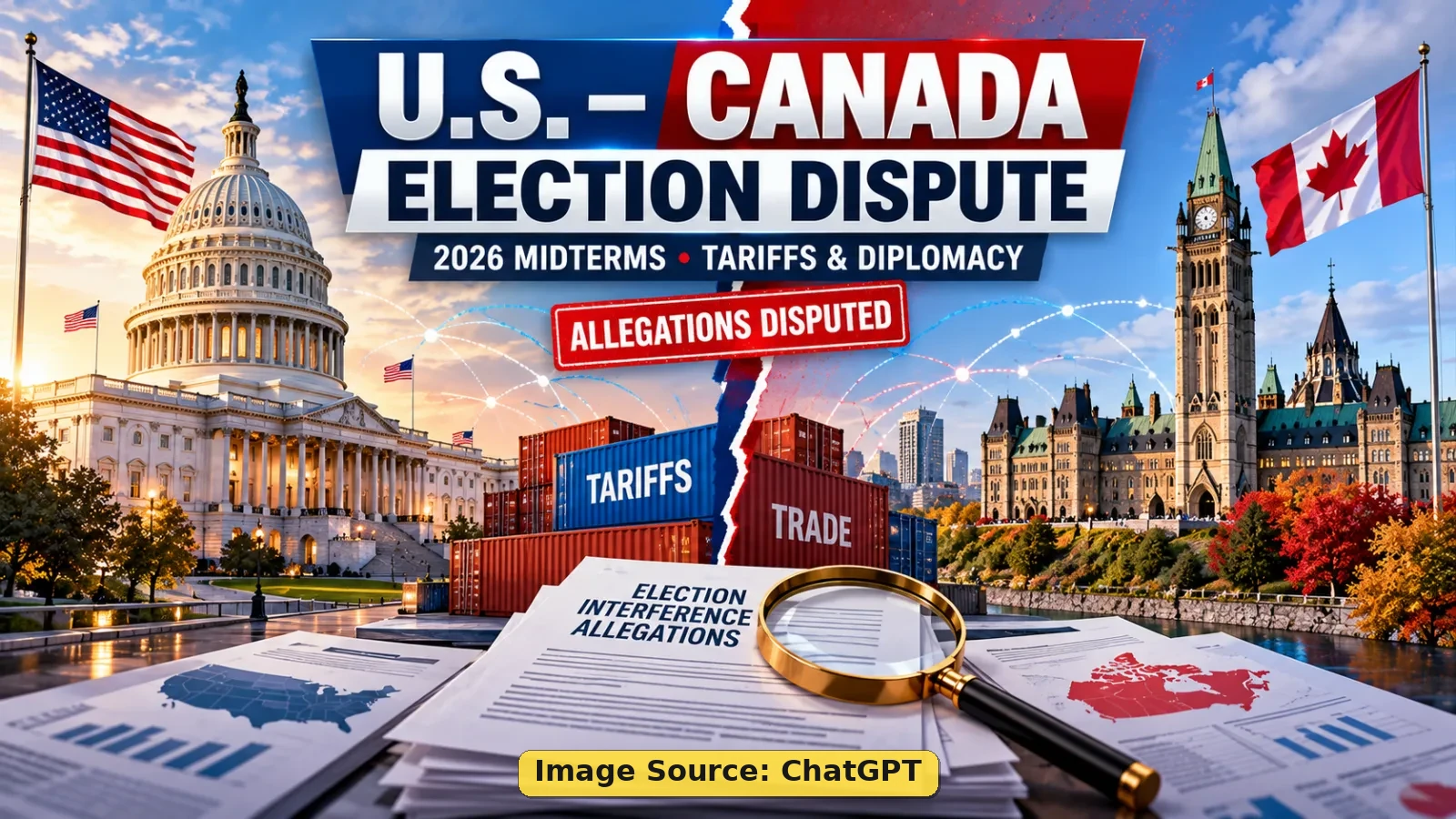
A new diplomatic dispute has emerged between the United States and Canada after American officials accused Canadian politicians of attempting to influence the upcoming U.S. midterm elections through trade retaliation, political meetings and public advertising campaigns.
The U.S. Embassy in Ottawa published a fact sheet on October 21 alleging that Canadian leaders have engaged in activities that could influence American political decisions ahead of the November 3 elections.
The accusations focus primarily on Canada's opposition to tariffs introduced by President Donald Trump's administration, which have significantly strained relations between the neighboring countries.
Canadian Prime Minister Mark Carney, Industry Minister Mélanie Joly and Ontario Premier Doug Ford have rejected suggestions of improper election interference, maintaining that their actions are intended to protect Canadian businesses, workers and economic interests.
The controversy raises an important question about international relations: when does legitimate diplomatic pressure become unacceptable foreign involvement in another country's politics?
The answer could have consequences extending beyond the election, particularly as Washington and Ottawa struggle to maintain cooperation across their deeply interconnected economies.
U.S. Embassy Raises Election Interference Allegations Against Canada
The latest dispute began when the U.S. Embassy released a document identifying nine examples of Canadian political activity it considered relevant to concerns about foreign influence.
The fact sheet focused on statements made by senior Canadian officials, meetings with American politicians, retaliatory tariff proposals and an advertising campaign criticizing U.S. trade policies.
American officials argued that Canadian political leaders had openly discussed using economic pressure to influence decisions made in Washington.
The embassy urged Canadian officials and citizens to avoid involvement in American elections.
However, the document did not establish that Canada had conducted a coordinated covert operation to manipulate election results.
Instead, much of the evidence involved public statements and activities that Canadian officials describe as ordinary diplomacy.
This distinction is central to understanding the controversy.
Governments regularly attempt to influence international policies through negotiations, trade measures and public communication.
Determining whether those efforts become improper electoral interference requires examining their objectives, methods and legality.
Why the Dispute Emerged Just Before the November 3 Midterms
The timing of the accusations has attracted significant attention.
American voters are scheduled to participate in midterm elections on November 3, 2026, with control of Congress and numerous state offices at stake.
The results could significantly influence the remainder of Trump's second presidential term.
Both major American political parties are focusing on economic conditions, household expenses, employment and government policy.
Trade has become a particularly sensitive issue because tariffs can affect manufacturing businesses, supply chains and consumer prices.
Canada is one of America's most important economic partners.
Consequently, trade disagreements between the two countries can influence economic discussions in politically competitive American states.
The U.S. Embassy's accusations suggest that Washington is concerned about Canadian officials deliberately using those economic pressures to shape domestic political debate.
Canadian leaders counter that responding to tariffs is a legitimate responsibility of their government.
The disagreement has transformed what might otherwise have remained a trade-policy dispute into a broader diplomatic controversy.
Donald Trump's Tariffs Are at the Center of the Conflict
Relations between Washington and Ottawa have deteriorated since Trump returned to the White House in January 2025.
The administration introduced tariffs affecting Canadian goods, arguing that stronger trade measures would support American industries and economic priorities.
Canada responded with its own countermeasures.
The resulting trade conflict has affected businesses that depend on cross-border transportation, manufacturing and consumer demand.
Automakers and steel producers have faced particular uncertainty because their supply chains often operate across the international boundary.
A vehicle assembled in one country may contain components manufactured in the other.
Tariffs applied during different stages of production can therefore create additional costs and complications.
Canadian officials argue that retaliatory measures are necessary to defend domestic industries and encourage negotiations.
The Trump administration views certain Canadian strategies as attempts to generate political pressure within the United States.
Those competing interpretations explain why the trade conflict has become closely connected with allegations involving the midterm elections.
Why Washington Singled Out Industry Minister Mélanie Joly
Canadian Industry Minister Mélanie Joly was among the principal officials named in the embassy's fact sheet.
American officials highlighted earlier comments in which she discussed designing retaliatory tariffs to create pressure in particular U.S. states.
Such strategies are not unusual in international trade disputes.
Governments sometimes select products for retaliatory tariffs based on their economic importance and the political influence of affected industries.
The objective may be to encourage businesses and elected representatives to support negotiations.
Washington argues that targeting politically sensitive states can also influence domestic political calculations.
Joly rejects the suggestion that her work amounts to election interference.
She has explained that her discussions with American politicians and businesses are intended to attract investment and defend Canada's economy.
The distinction between influencing trade policy and interfering with an election remains disputed.
Targeting the economic interests of elected officials can create political pressure, but additional evidence would be needed to establish that such conduct constituted an unlawful electoral operation.
Meetings With Democratic Politicians Become a Point of Contention
The U.S. Embassy also raised concerns about Joly's meetings with Democratic officials in American cities, including Boston and Chicago.
Its document referenced comments involving governors and potential future presidential candidates.
American officials interpreted those discussions as evidence that Canadian leaders were considering the political consequences of the U.S. elections.
Joly responded that she had also met Republican officials during her visits.
She described the meetings as normal diplomatic engagement intended to encourage economic cooperation.
Foreign officials routinely communicate with politicians from different parties because government policies can change after elections.
Maintaining relationships across party lines may help countries prepare for potential changes in leadership.
However, governments also have responsibilities to avoid prohibited campaign financing, covert electoral activity and other unlawful involvement.
The relevant question is whether Canadian officials were conducting ordinary policy discussions or activities intended to improperly influence an election.
The publicly reported meetings alone do not resolve that question.
Ontario's Anti-Tariff Advertisement Returns to the Spotlight
Ontario Premier Doug Ford has also become a central figure in the controversy.
His provincial government previously funded an advertising campaign in the United States criticizing Trump's tariff policies.
The advertisement featured excerpts from a 1987 radio address in which former President Ronald Reagan discussed the economic disadvantages of tariffs.
The campaign attracted considerable attention when it aired during the 2025 World Series.
Trump responded by terminating trade negotiations with Canada in October 2025.
The U.S. Embassy has now cited that advertising effort as part of its broader concerns about Canadian attempts to influence American politics.
Ford maintains that his goal was to defend Ontario's economy and explain the consequences of U.S. tariffs.
The advertisement's government sponsorship was publicly identifiable, an important difference from covert influence campaigns that conceal who is responsible for their messaging.
Nevertheless, public advertising by a foreign government can still raise questions about the appropriate boundaries of diplomatic advocacy.
Prime Minister Mark Carney Rejects the Allegations
Prime Minister Mark Carney has defended Canada's trade response and rejected the implication that his government is improperly interfering in American elections.
Speaking in Ottawa on October 21, Carney emphasized that Canada's policies were developed in response to actions initiated by Washington.
He maintained that his government's priority is protecting Canadian employment, businesses and economic stability.
The prime minister also highlighted the effects that tariffs have had on American households and industries.
His position reflects a broader Canadian argument: criticizing another government's trade decisions is not equivalent to attempting to manipulate its electoral system.
Carney has previously emphasized the principle that governments should respect one another's democratic processes.
That position is especially relevant because Canada has its own concerns about potential foreign political influence.
The prime minister's response suggests Ottawa is attempting to defend its economic policies without allowing the accusations to define the entire bilateral relationship.
However, the disagreement may become harder to contain as the American election approaches.
Doug Ford Says Americans Must Decide Their Own Elections
Ontario Premier Doug Ford has also denied having any interest in influencing the outcome of the American midterms.
He emphasized that American voters are responsible for determining their country's political future.
Ford said his government's focus remains on protecting Ontario workers, businesses and communities affected by trade restrictions.
That response reflects the substantial economic interests involved.
Ontario's automotive and steel industries have close connections with manufacturing operations in the United States.
Changes in tariffs can influence investment decisions, factory operations and employment on both sides of the border.
Provincial governments therefore have strong incentives to communicate their concerns directly to American audiences.
Ford argues that such communication should be understood as economic advocacy rather than electoral interference.
His explanation does not eliminate every possible legal question about foreign-government messaging.
But it illustrates why Canadian officials consider public opposition to tariffs part of their normal responsibilities.
What Is the Difference Between Foreign Influence and Election Interference?
One of the most important elements of this controversy is the meaning of the words being used.
Foreign influence can describe efforts by a government or organization to shape another country's decisions, public attitudes or policies.
Such activity may include diplomatic meetings, economic negotiations, lobbying and public information campaigns.
Many forms of foreign influence are lawful and occur regularly between international partners.
Election interference is a more serious accusation.
It can involve attempts to disrupt voting systems, manipulate electoral administration or conduct prohibited activities intended to undermine democratic processes.
Covert influence operations may also involve hidden funding, deceptive identities or coordinated disinformation.
U.S. intelligence officials have previously distinguished between efforts to influence voter preferences and attempts to interfere with the actual conduct of elections.
Legal assessments depend on the specific activity and applicable laws.
That distinction matters in the present dispute because the embassy's examples largely involve publicly acknowledged policy advocacy.
A government attempting to influence another government's tariff decisions is not automatically conducting an illegal election operation.
Does the United States Have Evidence of a Coordinated Canadian Campaign?
The embassy's fact sheet included more than statements about trade policy.
It also referenced remarks by Canadian Liberal lawmaker Anthony Housefather concerning campaign activity in Florida on behalf of Democratic Representative Debbie Wasserman Schultz.
Separately, the document listed 11 Canadian individuals who had reportedly faced charges or sentences involving unlawful voting in past American elections.
These allegations concern different types of conduct.
Individual campaign participation raises legal questions distinct from those associated with official diplomatic meetings.
Cases involving unlawful voting should likewise be assessed according to their specific facts.
Importantly, the publicly reported information did not establish that those individuals were acting under instructions from the Canadian government.
Nor did the embassy demonstrate that the cited cases formed part of a coordinated national effort to change the 2026 election results.
The existence of separate incidents cannot, by itself, establish a government-directed conspiracy.
Independent evidence would be required to connect those activities.
Experts Question Whether the Accusations Meet Legal Standards
Several legal and political experts have questioned the broad interpretation of election interference advanced by the embassy.
Specialists interviewed by Canadian media argued that public diplomacy differs significantly from covert efforts to manipulate democratic processes.
Carleton University national security law professor Leah West emphasized that influencing political decisions does not automatically satisfy the legal standards associated with threatening foreign interference.
McGill University political scientist Daniel Béland also questioned the connection between the activities cited and actual electoral interference.
These assessments do not suggest that foreign governments should face no limits when engaging with American politics.
Instead, they emphasize the need to distinguish between lawful communication and prohibited conduct.
Evidence of hidden financing, fraudulent representation, illegal voting arrangements or interference with election infrastructure would raise substantially different concerns.
The appropriate assessment depends on what actually happened, not simply whether an activity had political consequences.
For readers, this is a useful principle when evaluating allegations made during highly charged election periods.
What the Trade Dispute Means for Workers and Families
Behind the diplomatic language are practical economic concerns affecting households in both countries.
Canada and the United States share manufacturing networks, transportation routes and consumer markets.
A Canadian factory may sell components to an American business, which then exports finished products back across the border.
When tariffs increase costs within that process, companies may need to adjust prices, investment plans or production schedules.
These decisions can affect workers and customers.
On October 21, Carney and Ford announced a support package worth approximately 8.7 billion Canadian dollars for Ontario's manufacturing sector.
The initiative included assistance for steelmakers, automakers and related industries facing economic pressures.
The announcement followed developments involving layoffs at a Hamilton steel facility operated by Cleveland-Cliffs.
For workers confronting employment uncertainty, the immediate concern is often financial stability rather than political messaging.
That reality helps explain why trade policy has become such a sensitive issue in both countries.
Why U.S.–Canada Relations Matter Beyond the Election
The United States and Canada share one of the world's most extensive bilateral relationships.
Their cooperation extends across trade, border security, energy, transportation and national defense.
The countries also participate in major international institutions and maintain important security relationships.
Political disagreements do not automatically erase those connections.
However, repeated disputes can weaken confidence among businesses and government institutions.
Companies making long-term investments need reasonable expectations about tariffs, market access and regulatory conditions.
Uncertainty may encourage businesses to delay decisions or reconsider where they establish operations.
Canadian officials have increasingly discussed reducing economic dependence on the American market by developing stronger relationships elsewhere.
Carney has identified expanding exports to other countries as a long-term national objective.
For Washington, a less integrated Canadian economy could also affect established business relationships.
The current dispute therefore involves more than campaign-season rhetoric.
It touches on the future structure of economic cooperation between two neighboring countries.
How Political Accusations Can Affect Public Trust
Claims of foreign election interference deserve serious examination because electoral integrity is fundamental to democratic government.
However, allegations also carry consequences when they are presented without clear supporting evidence.
Voters may become uncertain about whether ordinary diplomatic activity represents a threat to an election.
Political groups may use accusations to reinforce existing suspicions about opponents or foreign governments.
That can make informed public discussion more difficult.
A responsible assessment should distinguish verified actions from interpretations of those actions.
It should also identify which questions remain unanswered.
For example, a publicly funded advertisement criticizing tariffs is a documented political communication.
Whether that advertisement violates election-related rules is a separate legal question.
Similarly, meetings between foreign officials and American politicians are observable diplomatic activities, but their precise purposes require contextual evidence.
Clear distinctions help readers evaluate developments without accepting either accusation or denial automatically.
Could the Dispute Become More Serious Before November 3?
U.S. Ambassador to Canada Pete Hoekstra has warned that American officials are monitoring Canadian political activity ahead of the elections.
He has indicated that Washington could respond if it identifies conduct it considers improper interference.
The nature of any potential response has not been clearly established.
Possible developments include additional diplomatic statements, formal requests for clarification or closer scrutiny of specific activities.
However, such possibilities should not be mistaken for decisions that have already been announced.
Canadian officials have indicated that they intend to continue defending their economic interests.
This suggests that public disagreements over tariffs may persist even while both governments maintain normal diplomatic channels.
The immediate challenge is preventing political accusations from further disrupting practical negotiations.
For businesses and workers, the longer-term concern is whether the two governments can establish a more predictable trading relationship.
The election could influence Washington's political environment, but it will not automatically resolve the underlying economic disagreements.
What Should Readers Watch as the Midterms Approach?
Several developments could help clarify the direction of the dispute.
The first is whether the U.S. government presents additional evidence beyond the public activities already identified.
New information could strengthen or weaken the allegations.
The second is whether Canadian officials modify their approach to advertising, political meetings or retaliatory tariffs.
Third, the reaction of American political leaders may indicate whether the issue becomes a broader election campaign argument.
Finally, the direction of trade negotiations will remain important.
A renewed effort to resolve tariff disagreements could reduce tensions even if differences over election-related terminology continue.
For readers following the story, reliable reporting should distinguish official allegations, documented conduct and independent legal analysis.
This approach is particularly important when political developments are changing quickly.
It also helps keep attention on the real-world consequences of government decisions rather than treating every diplomatic disagreement as evidence of wrongdoing.
Final Outlook: A Trade Dispute Becomes an Election-Year Diplomatic Test
The U.S. Embassy's allegations against Canadian political leaders represent a notable escalation in relations between Washington and Ottawa.
American officials argue that Canada's tariff retaliation, political meetings and public advertising efforts raise concerns about influence over the November 2026 midterm elections.
Canadian leaders reject the suggestion of improper interference, maintaining that their actions are legitimate responses to trade policies affecting their economy.
The available public evidence establishes that Canadian officials have attempted to influence American trade policy.
It does not, by itself, demonstrate a coordinated Canadian government operation to manipulate U.S. election results.
That distinction is essential for understanding the controversy.
Both countries have legitimate interests in defending democratic processes, but they also have longstanding reasons to maintain communication and economic cooperation.
For ordinary citizens, the consequences extend beyond political statements.
Trade uncertainty affects employment, prices, investment and the stability of communities connected across the border.
The central question is whether Washington and Ottawa can distinguish normal diplomatic pressure from unlawful electoral activity while preserving the economic partnership that millions of people depend upon.
As November 3 approaches, that challenge will remain an important test of the relationship between two historically close allies.