

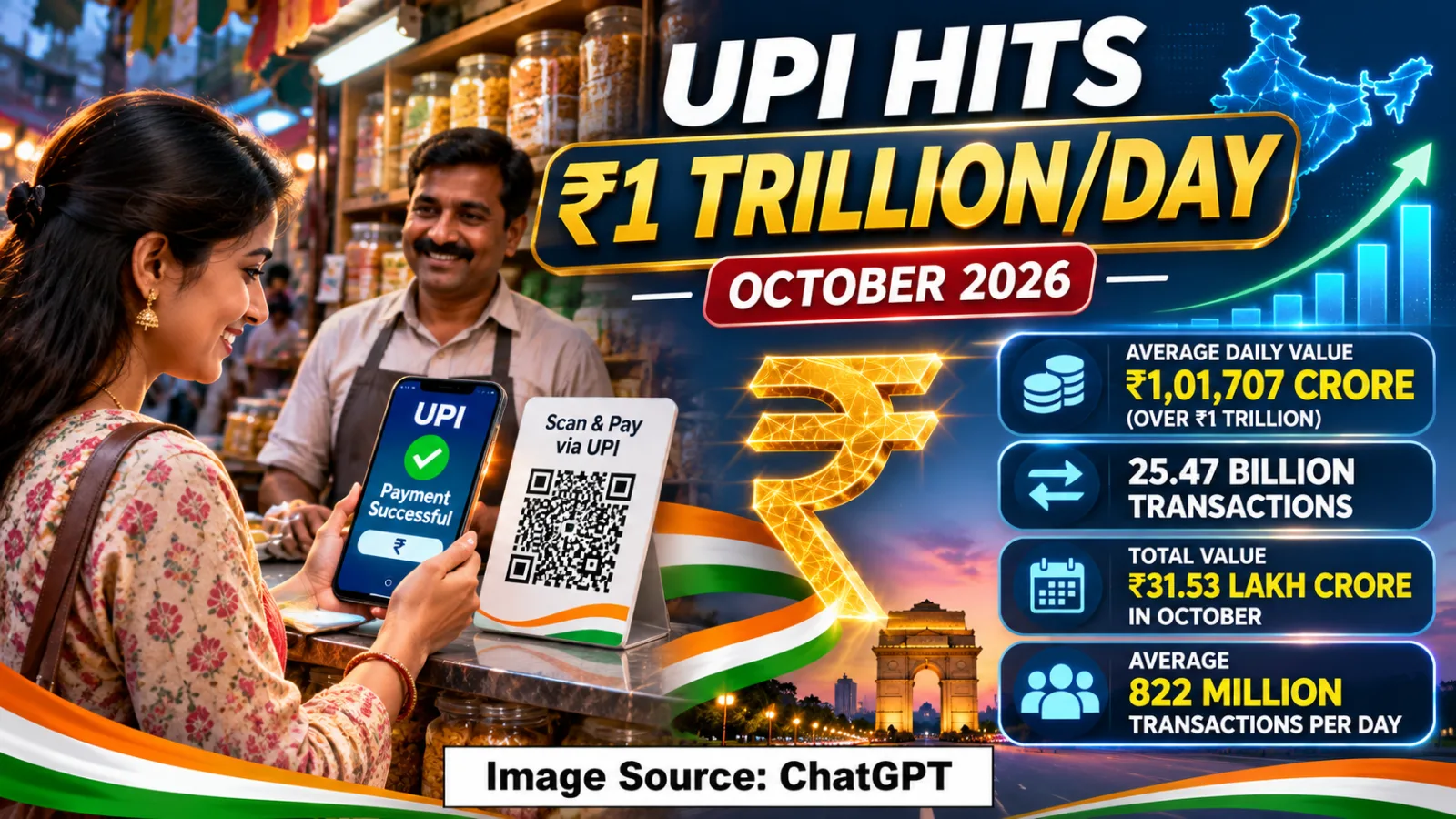
India's digital payments revolution has reached another extraordinary milestone. The Unified Payments Interface (UPI) processed more than ₹1 trillion in average daily transaction value during October 2026, marking the first time the country's instant payment network has crossed this threshold.
According to figures released by the National Payments Corporation of India (NPCI) on November 1, UPI handled 25.47 billion transactions worth ₹31.53 lakh crore throughout October. The average daily transaction value reached ₹1,01,707 crore, compared with ₹97,913 crore in September.
The milestone demonstrates how deeply digital payments have become integrated into everyday economic activity, from small neighborhood purchases to business payments and transfers between individuals.
UPI also recorded an average of approximately 822 million transactions per day, establishing another benchmark for India's payment infrastructure.
The achievement comes as the payments industry debates proposed merchant transaction charges, infrastructure costs, fraud prevention, and the sustainability of maintaining a massive real-time payment network.
For consumers, merchants, banks, and fintech companies, October's figures offer valuable insight into how India's financial habits are changing.
1. UPI October 2026: A Historic Month for Digital Payments
October delivered multiple records for India's most widely used instant payment infrastructure.
UPI transaction volume increased 5.8% compared with September, while monthly transaction value grew approximately 7.4%.
The year-on-year figures were equally significant. Transaction counts rose around 23%, while their combined value increased approximately 16%.
The results indicate continuing adoption alongside more frequent everyday usage.
UPI Transaction Statistics: October vs. September 2026
| Performance Indicator | October 2026 | September 2026 |
|---|---|---|
| Monthly Transactions | 25.47 Billion | 24.07 Billion |
| Monthly Transaction Value | ₹31.53 Lakh Crore | ₹29.37 Lakh Crore |
| Average Daily Transactions | 822 Million | 802 Million |
| Average Daily Value | ₹1,01,707 Crore | ₹97,913 Crore |
| Monthly Volume Growth | +5.8% | — |
| Monthly Value Growth | +7.4% | — |
| Year-on-Year Volume Growth | +23% | — |
| Year-on-Year Value Growth | +16% | — |
Source: NPCI figures reported November 1, 2026. Figures are rounded.
October had 31 days compared with September's 30, contributing to the higher monthly totals.
However, daily averages also increased, showing that growth was not explained entirely by the additional calendar day.
2. What Does ₹1 Trillion in Daily UPI Payments Actually Mean?
The amount is substantial, but understanding its meaning requires distinguishing payment activity from economic output.
One trillion rupees equals ₹1 lakh crore.
During October, the value of transactions processed through UPI averaged approximately ₹1.017 trillion every day.
This does not mean India generated ₹1 trillion in new income daily through UPI.
Payment statistics measure money transferred across the network, not newly created wealth.
The same money may move multiple times as people receive salaries, pay suppliers, purchase products, or transfer funds between accounts.
For example, a business might receive a payment from a customer and later use part of that amount to pay a supplier.
Both transactions contribute to UPI activity.
Therefore, rising transaction value indicates greater usage of the payment infrastructure, but it should not be treated as a direct measure of GDP or economic growth.
3. How India Reached 25.47 Billion Monthly Transactions
UPI's expansion has developed over years of increasing smartphone access, bank participation, and merchant acceptance.
Launched in 2016, the system was designed to simplify transfers between participating bank accounts.
Instead of requiring customers to repeatedly enter account numbers and banking details, UPI supports payments through virtual payment addresses, QR codes, and compatible applications.
Its interoperable design allows users of different participating banks and supported apps to transact through the same underlying payment network.
Growth accelerated as merchants began accepting QR payments and consumers became more comfortable with mobile banking.
By May 2026, monthly volumes had exceeded 23 billion transactions.
August reached approximately 24.51 billion, followed by September's 24.07 billion.
October then established a new monthly high of 25.47 billion.
These changes reflect a payment system that has moved far beyond its original role as a convenient alternative to cash transfers.
4. Why UPI Transactions Increased in October
Several factors may have contributed to October's strong performance.
Festive-season shopping and preparations for Diwali encouraged spending across consumer categories.
Retail purchases, travel bookings, hospitality payments, online shopping, and routine household expenses all create opportunities for UPI transactions.
Merchant acceptance has also expanded, making QR payments increasingly practical for small purchases.
Consumers can complete transactions without carrying exact cash or waiting for change.
Another factor is familiarity.
People who have successfully used digital payments for years may now choose UPI automatically for activities previously handled through cash or other banking methods.
However, NPCI's aggregate figures do not establish precisely how much of October's growth came from each spending category.
Seasonal spending is a plausible contributing factor, but it should not be presented as the sole explanation.
5. Small Businesses Are Central to UPI's Success
One of UPI's most important contributions is making electronic payments practical for smaller businesses.
A neighborhood grocery store can display a payment QR code without investing in sophisticated checkout equipment.
A street-food vendor can receive a digital payment without needing physical change.
Independent service providers can accept payments directly into supported accounts.
For some merchants, transaction histories also provide convenient records that can help with bookkeeping.
However, receiving digital payments does not automatically create complete accounting records.
Merchants still need to reconcile payments, record expenses, and maintain appropriate business documentation.
Electronic transactions can also introduce challenges, including internet disruptions, delayed payment confirmations, and fraudulent payment screenshots.
Businesses should verify successful credit through their own trusted banking or payment application before releasing goods when confirmation is uncertain.
6. What the Record Means for Everyday Customers
For customers, UPI's biggest advantage remains convenience.
Paying a small bill, sending money to a family member, or settling a restaurant payment can take only a short time when systems function normally.
Consumers can also review transaction histories instead of relying entirely on paper receipts.
This convenience becomes especially valuable when payments involve different banks or distant recipients.
However, rapid payment execution creates responsibilities.
Once an authorized transfer is completed, reversing it may be difficult, particularly when money reaches an incorrect recipient.
Users should always verify the displayed recipient information and payment amount before entering their UPI PIN.
A smooth digital payment experience depends not only on transaction speed but also on accuracy, accessible support, and consumer awareness.
7. The Average UPI Transaction Remains Relatively Small
Despite the enormous monthly total, the average transaction amount remains much smaller than the headline figures might suggest.
Based on the reported October totals, the approximate average value per transaction was ₹1,238.
That is only modestly higher than September's approximate average of ₹1,220.
This indicates that UPI's scale is supported by an extraordinary number of transactions rather than exclusively by large-value transfers.
The figures are consistent with widespread use for routine financial activity.
However, an average cannot reveal the entire distribution.
Millions of small payments and fewer larger transfers can combine to produce the same overall average.
A detailed breakdown by payment size would be required to determine how spending patterns differ across households, businesses, and geographic regions.
8. UPI Merchant Charges: The Major Policy Question
October's record arrived amid discussions over introducing merchant discount rate (MDR) charges on specified UPI transactions.
MDR is a payment-processing fee generally associated with merchants accepting eligible digital payments.
Industry participants have argued that sustainable revenue could help banks and payment companies maintain infrastructure, strengthen fraud prevention, and support innovation.
A proposed framework discussed in October involved a 0.4% charge on specified person-to-merchant transactions above ₹2,000, subject to stated conditions and caps.
NPCI deferred its planned implementation until after Diwali, with a revised date to be communicated separately.
Importantly, the proposal should not be confused with an existing universal fee on every UPI transaction.
Ordinary person-to-person transfers and smaller merchant payments were outside the proposed levy as reported.
For merchants, even a relatively modest processing fee can affect operating margins, particularly in businesses with high transaction volumes and limited profits.
The final policy design, implementation date, and applicable conditions will determine its practical impact.
9. Can Digital Payments Remain Affordable at This Scale?
Operating a real-time payment network involves substantial investment.
Banks and payment service providers must maintain secure connections, monitor transactions, operate support systems, and respond to technical failures.
They also need adequate capacity to handle demand during busy shopping periods.
As transaction volumes grow, infrastructure investment becomes increasingly important.
A system processing hundreds of millions of payments daily cannot rely entirely on technology designed for much smaller workloads.
Yet affordability has been central to UPI's widespread adoption.
If payment charges become too burdensome, some merchants may reconsider which payment methods they encourage.
A sustainable policy must therefore balance infrastructure funding with financial inclusion and merchant affordability.
10. Why Payment Security Matters More Than Ever
Greater transaction volume increases the importance of protecting consumers against fraud.
Criminals may use fake customer-service numbers, deceptive payment requests, malicious links, or fraudulent QR codes.
Some scams involve convincing victims that entering a UPI PIN is necessary to receive money.
Under normal UPI payment procedures, entering the PIN authorizes a debit, not an incoming payment.
Users should never share their UPI PIN, OTP, or sensitive banking credentials with another person.
Applications should be installed from trusted official sources, and unexpected payment requests should be examined carefully.
Consumers should also avoid trusting payment screenshots as definitive proof that money has arrived.
Fraud prevention depends on secure technology, effective institutional monitoring, and informed user behavior.
As UPI expands, all three become increasingly important.
11. What Customers Should Do When a UPI Payment Fails
A failed transaction can become stressful when the customer's account is debited but the recipient does not immediately receive money.
The first step is checking the transaction status in the payment application and the associated bank account.
Customers should preserve the transaction reference number, amount, date, and recipient details.
If the status remains unresolved or a required reversal does not arrive, the customer can raise a complaint through the app or participating bank.
NPCI provides dispute-resolution arrangements for eligible transaction problems.
The applicable resolution timeline depends on the type of failure and relevant banking rules.
Consumers should avoid repeatedly sending the same payment while an earlier transaction remains uncertain.
If fraud is suspected, prompt reporting through the bank and authorized cybercrime channels becomes particularly important.
12. The Role of Banks and Payment Applications
UPI's success depends on cooperation among several participants.
NPCI operates the central payment infrastructure, while participating banks and payment service providers connect users to the network.
Applications such as PhonePe, Google Pay, Paytm, and BHIM provide interfaces through which customers initiate supported transactions.
Although apps may offer different features, users can generally transact across participating institutions because UPI is interoperable.
According to September 2026 app-level statistics, PhonePe accounted for approximately 45.6% of transaction volume, followed by Google Pay at 32.2% and Paytm at 8.1%.
These are September market-share figures, not October rankings.
October's detailed application-level breakdown had not yet been released when the new monthly aggregate figures were reported.
Competition among payment providers can influence convenience, reliability, merchant services, and customer support.
13. Digital Payments and Financial Inclusion
UPI can help bring convenient financial services to people who previously depended heavily on cash.
For consumers with compatible bank accounts, mobile access, and sufficient connectivity, digital transactions may reduce the need to visit branches or ATMs for routine payments.
Small merchants can also receive payments from customers using different participating banks.
However, digital inclusion requires more than the availability of a payment app.
Users may still face barriers involving smartphone costs, connectivity, language, accessibility, or unfamiliarity with digital financial systems.
People without adequate banking access can remain excluded.
Services such as UPI Lite and other supported payment options may improve convenience for eligible use cases, but they do not eliminate every barrier.
Financial inclusion should therefore be measured through reliable and meaningful access, not transaction growth alone.
14. Why UPI's International Expansion Matters
UPI's domestic growth has attracted attention from other countries exploring modern real-time payment infrastructure.
Cross-border interoperability could make certain international payments more convenient and potentially less expensive.
This is particularly relevant for travelers and businesses that regularly conduct transactions across national boundaries.
India has already pursued payment connectivity arrangements with several international partners.
However, domestic UPI volume should not be interpreted as evidence that UPI has replaced SWIFT, Visa, or Mastercard worldwide.
These systems perform different functions and operate under different technical and regulatory arrangements.
International expansion requires cooperation involving banks, regulators, foreign-exchange systems, and local payment providers.
UPI's success creates opportunities, but broader global adoption will depend on practical execution and commercial usefulness.
15. A 60-Day Customer Experience and Digital Payment Monitoring Matrix
The following matrix is an illustrative 60-day customer experience framework covering November 1 to December 30, 2026.
It is designed to help different types of UPI users assess payment convenience, reliability, security, and potential policy changes.
The scenarios are hypothetical and do not represent completed customer interviews or measured results.
| Period | Illustrative Customer Experience | Recommended Action | Key Indicator |
|---|---|---|---|
| Days 1–7 | Regular customer reviews daily payments | Check transaction history and notification settings | Successful payments and accurate records |
| Days 8–14 | Small merchant examines incoming QR payments | Reconcile sales against bank credits | Confirmation reliability |
| Days 15–21 | Online shopper reviews payment safety | Verify recipients and avoid suspicious requests | Unauthorized transaction attempts |
| Days 22–30 | Family monitors monthly spending | Categorize expenses and identify duplicate payments | Spending visibility |
| Days 31–45 | Business owner evaluates payment costs | Review official announcements on any applicable MDR changes | Verified fee structure |
| Days 46–60 | Customer assesses overall service experience | Examine transaction failures, support, and security settings | Reliability and complaint resolution |
Key Highlights From the 60-Day Framework
First 15 days: Customers can establish a baseline for payment reliability, security awareness, and transaction verification.
First 30 days: Households and merchants can examine whether digital payment records improve expense tracking and reconciliation.
Final 30 days: Users can review longer-term convenience, applicable payment charges, and unresolved service issues.
The objective is not to predict future spending or promise better financial outcomes.
It is to help users develop practical evidence about their own experience with digital payments.
16. What Comes Next for UPI in 2027?
The October milestone creates an important benchmark for India's payment industry.
Future growth will depend on continued customer adoption, merchant acceptance, system reliability, and appropriate financial incentives.
Banks and payment companies must prepare for increasingly demanding infrastructure requirements.
Regulators will also need to balance innovation with consumer protection.
Possible developments include improvements in transaction processing, accessibility, fraud monitoring, and integration with other financial services.
However, another record month is not guaranteed.
Transaction activity can fluctuate because of seasonality, consumer spending, business conditions, and changes in payment behavior.
The most meaningful measure of long-term success will be whether UPI remains dependable, accessible, and affordable as its scale increases.
17. Frequently Asked Questions
How much was UPI's average daily transaction value in October 2026?
The average reached approximately ₹1,01,707 crore, exceeding ₹1 lakh crore per day for the first time.
How many UPI transactions were processed?
UPI processed approximately 25.47 billion transactions during October 2026.
What was the total monthly transaction value?
Total transaction value reached ₹31.53 lakh crore.
Why did UPI transactions rise in October?
Increased merchant acceptance, everyday digital payment usage, and seasonal consumer spending likely contributed. October also had one more calendar day than September.
Will UPI payments become chargeable?
A proposed MDR framework for certain merchant transactions was deferred in October. It does not mean every consumer UPI transaction is now subject to a fee. Users should check subsequent official announcements.
Is UPI safe for regular payments?
UPI incorporates payment authentication and security mechanisms, but users must protect their credentials, verify recipients, and remain alert to scams.
Which organization manages UPI?
The National Payments Corporation of India operates UPI in cooperation with participating banks and payment service providers.
Conclusion: UPI's Trillion-Rupee Milestone Marks a New Phase
October 2026 represents a significant achievement for India's digital payment infrastructure.
With average daily transaction value exceeding ₹1 trillion and monthly transactions reaching 25.47 billion, UPI has demonstrated remarkable scale.
Its success reflects years of technological development, merchant adoption, and changing consumer habits.
Yet future progress will require more than increasing transaction counts.
Payment security, reliable infrastructure, accessible dispute resolution, and sustainable operating arrangements will remain essential.
The next chapter of India's digital payments growth will be defined by how effectively the system combines convenience with consumer trust, affordability, and long-term resilience.