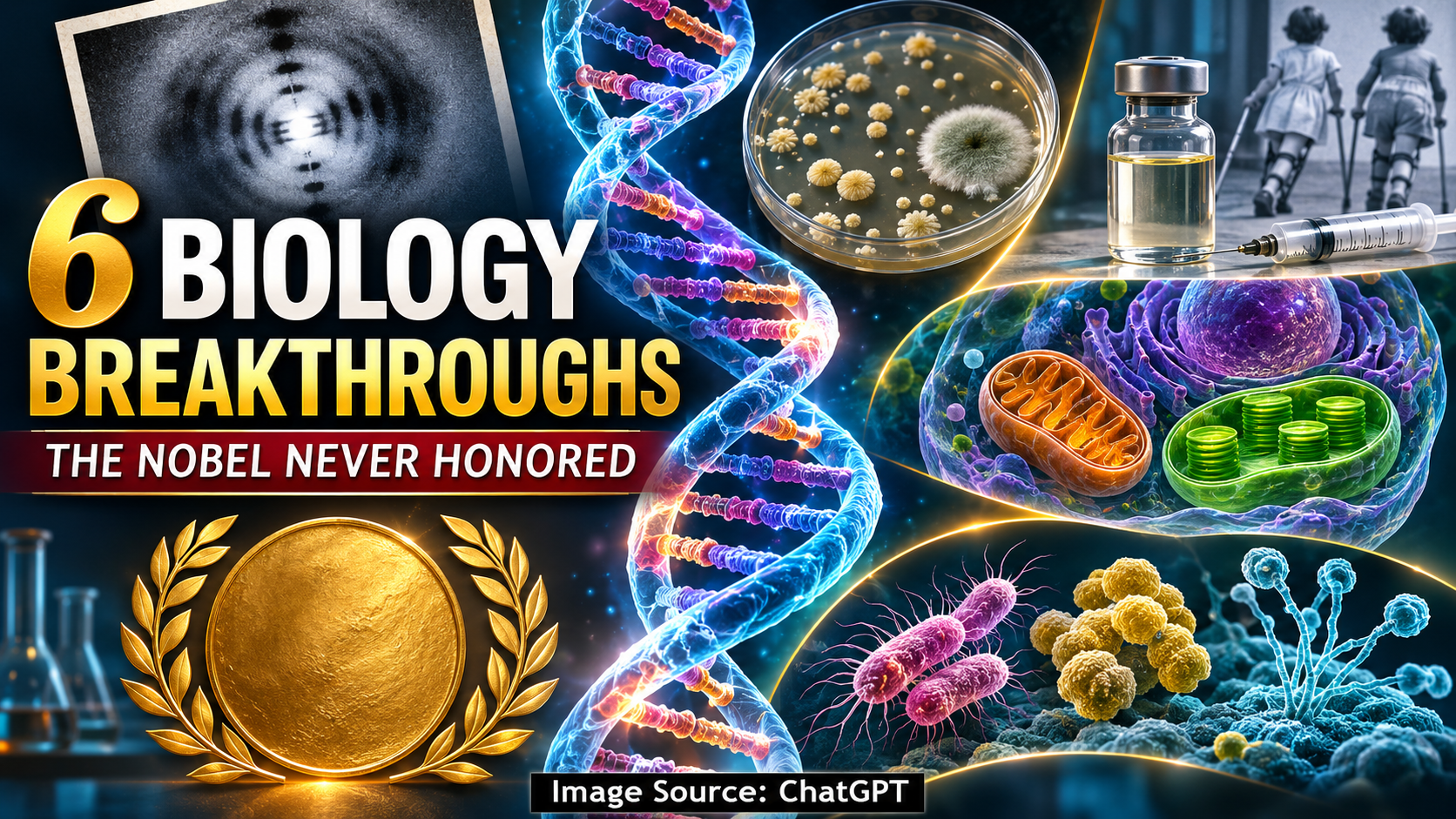
Some of the most important discoveries in human history have been celebrated with Nobel Prizes. Others have transformed entire scientific disciplines without receiving that recognition.
The Nobel Prize is widely considered one of science's most prestigious honors. Yet its history reveals an important distinction: a discovery's scientific importance does not always determine whether the people responsible receive an award.
Scientific progress rarely follows a simple path. Major breakthroughs often involve decades of experiments, competing theories, overlooked contributors, and discoveries whose importance becomes obvious only much later.
In biology, this pattern is especially visible. Researchers have identified the substance carrying hereditary information, explained how complex cells evolved, developed vaccines that saved countless lives, and reconstructed the evolutionary relationships among microorganisms.
Not every achievement earned a Nobel Prize.
Here are six remarkable biological breakthroughs whose principal contributors never received Nobel recognition for their work. The argument that these discoveries deserved a prize is an editorial judgment, but their scientific importance is supported by extensive historical evidence.
Key Highlights
DNA as genetic material: Oswald Avery and colleagues established that DNA carries hereditary information.
DNA structure: Rosalind Franklin's X-ray research helped reveal the double helix.
Bacterial genetics: Esther Lederberg helped develop revolutionary methods for studying genetic mutations.
Polio prevention: Jonas Salk's team created an effective inactivated poliovirus vaccine.
Cellular evolution: Lynn Margulis transformed understanding of how complex cells originated.
The tree of life: Carl Woese and collaborators uncovered Archaea as a distinct evolutionary lineage.
1. Oswald Avery: Discovering That DNA Carries Hereditary Information
Breakthrough year: 1944
Modern genetics depends on one fundamental idea: DNA contains biological instructions that can pass from one generation of cells to another.
Today, the concept seems elementary. In the early twentieth century, however, many scientists believed proteins were more likely to carry genetic information because their chemical structures appeared more complicated.
Oswald Avery, working alongside Colin MacLeod and Maclyn McCarty at the Rockefeller Institute, helped overturn that assumption.
Their research investigated Streptococcus pneumoniae, a bacterium capable of undergoing transformation. Earlier experiments by Frederick Griffith had shown that material from one bacterial strain could produce inherited changes in another strain.
The central question was straightforward but extremely difficult: what substance caused this transformation?
Avery's team purified material from bacteria and used biochemical tests to identify the active component. Their experiments pointed strongly toward deoxyribonucleic acid, or DNA, rather than proteins or other cellular substances.
Their landmark 1944 paper provided compelling evidence that DNA was responsible for transmitting specific inherited characteristics.
Why this discovery mattered
The implications extended far beyond bacterial research.
Once DNA became recognized as the material of heredity, scientists gained a foundation for understanding mutations, inherited diseases, genetic engineering, and eventually genome sequencing.
Without this discovery, the path toward modern molecular biology would have been considerably different.
The findings also challenged scientists to rethink the relationship between chemical molecules and biological identity.
Why was there no Nobel Prize?
Avery never received the award, and neither MacLeod nor McCarty was honored for the discovery.
Historians have suggested several contributing factors, including skepticism about the evidence, doubts over possible protein contamination, and the time required for the scientific community to appreciate the findings.
Avery died in 1955, shortly after DNA's structure became widely accepted.
The lasting lesson: A breakthrough can establish the foundations of an entire field before its significance is fully recognized.
2. Rosalind Franklin: Providing Crucial Evidence for DNA's Double Helix
Breakthrough period: 1951–1953
Few scientific structures are more recognizable than the DNA double helix.
Its familiar twisted-ladder appearance represents one of the defining discoveries of twentieth-century science. Yet the journey toward identifying that structure involved more researchers than the traditional account sometimes acknowledges.
Rosalind Franklin, a highly skilled physical chemist and X-ray crystallographer, made essential contributions while working at King's College London.
Using X-ray diffraction, Franklin and her graduate student Raymond Gosling obtained detailed information about DNA's molecular arrangement.
Among their experimental results was the famous Photograph 51, produced in 1952.
The image displayed a diffraction pattern consistent with a helical molecular structure.
Franklin also conducted careful investigations into DNA's physical properties, including its behavior under different conditions of hydration.
Her work helped distinguish two structural forms of DNA and contributed measurements necessary for understanding the molecule.
How her research transformed biology
In 1953, James Watson and Francis Crick proposed their double-helix model, drawing on multiple sources of experimental evidence, including work from King's College London.
The resulting structure helped explain how genetic information could be stored and copied.
Its consequences spread across medicine, biotechnology, forensic identification, genetic testing, and evolutionary biology.
Franklin's contribution deserves recognition not merely because of a famous photograph but because she produced and interpreted important experimental data.
Her research represented an independent scientific achievement.
Why did she miss the Nobel Prize?
Watson, Crick, and Maurice Wilkins received the 1962 Nobel Prize in Physiology or Medicine.
Franklin had died in 1958, four years before the award.
The Nobel rules governing posthumous awards meant she could not share the 1962 prize.
Therefore, describing her absence simply as a rejection by the Nobel Committee would be misleading.
Nevertheless, the way her scientific contribution was represented for decades generated substantial debate about recognition, collaboration, and the historical treatment of women in research.
The lasting lesson: Scientific discoveries depend on experimental evidence as much as the theoretical models that ultimately become famous.
3. Esther Lederberg: Transforming Bacterial Genetics
Breakthrough period: 1951–1952
Before modern biotechnology, scientists faced a difficult challenge: understanding how bacteria acquired genetic characteristics and how those characteristics passed between generations.
Esther Miriam Lederberg helped create the experimental tools that made such questions easier to investigate.
One of her major accomplishments was discovering bacteriophage lambda, a virus that infects Escherichia coli bacteria.
Unlike viruses that immediately destroy infected cells, lambda can integrate its genetic material into a bacterial host and remain there in a dormant state.
This phenomenon became central to investigations of gene regulation, viral behavior, and bacterial genetics.
Lederberg also played a major role in developing replica plating, a laboratory technique described in a 1952 paper coauthored with Joshua Lederberg.
What made replica plating revolutionary?
Imagine a Petri dish containing hundreds of bacterial colonies.
Researchers want to determine whether some bacteria already possess resistance to a particular condition before exposure.
Replica plating makes it possible to transfer colonies from one culture plate to others while preserving their relative positions.
Scientists can then compare growth patterns under different conditions.
This technique helped demonstrate that certain genetic variants exist before selection occurs, rather than arising solely because an environment requires them.
That insight became an important part of understanding microbial evolution and antibiotic resistance.
Replica plating remains a classic illustration of how a relatively simple laboratory method can answer profound biological questions.
Why did she not receive a Nobel?
Joshua Lederberg received a share of the 1958 Nobel Prize in Physiology or Medicine for discoveries involving bacterial genetic recombination and genetic organization.
Esther Lederberg was not included.
The prize was not specifically awarded for replica plating, so the omission should not be presented as a straightforward case of excluding one coauthor from an award for that experiment.
However, historians have documented the importance of Esther's independent work and how her scientific recognition frequently lagged behind that of prominent collaborators.
The lasting lesson: The people who develop essential experimental tools can influence generations of discoveries without achieving equivalent public recognition.
4. Jonas Salk: Developing a Vaccine That Changed the Fight Against Polio
Breakthrough year: 1955
During the first half of the twentieth century, poliomyelitis was among the most feared infectious diseases.
The poliovirus could attack the nervous system, sometimes causing permanent paralysis or death.
Outbreaks affected communities across the world, particularly children, and created tremendous uncertainty for families.
Jonas Salk and his research team developed an inactivated poliovirus vaccine designed to stimulate immunity without using infectious vaccine virus.
The approach differed from strategies relying on weakened live viruses.
Salk believed that carefully inactivated poliovirus could provide protection while avoiding the risk of infection from a replicating vaccine strain.
A historic vaccine trial
The vaccine underwent extensive clinical evaluation, culminating in a major 1954 field trial involving more than one million children.
On April 12, 1955, the results were publicly announced, establishing the vaccine's effectiveness and leading to its licensing.
Vaccination campaigns subsequently contributed to dramatic declines in polio cases in the United States and elsewhere.
The inactivated vaccine became a major component of polio prevention, while Albert Sabin's later oral vaccine provided another powerful method for controlling transmission.
Together, these developments transformed the global response to the disease.
Why was Salk never awarded the Nobel Prize?
Salk did not receive a Nobel Prize.
Interestingly, three other scientists—John Enders, Thomas Weller, and Frederick Robbins—received the 1954 Nobel Prize in Physiology or Medicine for developing methods to grow poliovirus in tissue cultures.
Their earlier discovery was essential to subsequent vaccine development.
The Nobel Committee therefore recognized a major enabling advance in polio research, although Salk's vaccine itself never earned him the prize.
The absence of an award does not diminish his achievement or the contributions of the many researchers, trial participants, and public-health workers involved.
The impact that matters most
Salk's work illustrates why scientific accomplishment should not be measured solely by professional honors.
A successful vaccine can protect people who will never learn the names of its developers.
Its value is expressed through prevented illness, avoided disability, and healthier communities.
The lasting lesson: Public-health achievements may change the world more visibly than any scientific trophy.
5. Lynn Margulis: Explaining How Complex Cells Evolved
Breakthrough year: 1967
Every human body contains extraordinarily complex cells.
Inside those cells are specialized structures called organelles. Mitochondria help produce usable cellular energy, while chloroplasts allow plants and algae to capture energy from sunlight.
But where did these structures originally come from?
Lynn Margulis helped transform the scientific answer.
In 1967, publishing under the name Lynn Sagan, she presented an influential synthesis of the endosymbiotic hypothesis.
The central idea was that some structures within complex cells originated as independent microorganisms that entered into long-term relationships with other cells.
Over evolutionary time, these relationships became permanent.
Mitochondria and chloroplasts ultimately evolved into essential components of eukaryotic cells.
Why was this idea so important?
The theory challenged an overly simple picture of evolution as a process driven exclusively by competition.
It demonstrated that cooperation and integration between different organisms could produce profound evolutionary innovations.
Modern evidence strongly supports the bacterial ancestry of mitochondria and chloroplasts.
These organelles retain distinctive genetic characteristics, and comparisons of molecular sequences link them to bacterial lineages.
Margulis did not originate every aspect of endosymbiotic thinking. Earlier scientists had proposed related ideas.
Her achievement was revitalizing, developing, and defending the concept while connecting it to a broader explanation of cellular evolution.
Not every proposal she advanced gained acceptance. In particular, her suggestions about the origins of certain cellular structures remain unsupported.
Recognizing that distinction makes her established contributions more compelling, not less.
Why no Nobel recognition?
Margulis never received a Nobel Prize.
Her work helped reshape evolutionary biology, but evolutionary theory and broad conceptual frameworks do not always fit neatly into the categories and discovery-focused traditions of Nobel recognition.
Her scientific legacy survives through research into cell origins, organelle evolution, and relationships between organisms.
The lasting lesson: Evolutionary progress can involve biological partnerships that produce entirely new forms of complexity.
6. Carl Woese: Discovering an Entirely Different Branch of Life
Breakthrough year: 1977
For much of biological history, scientists classified organisms mainly by their visible structures and physical characteristics.
Microorganisms presented a particular challenge because unrelated organisms can appear remarkably similar under a microscope.
Carl Woese helped change biological classification by examining molecular evidence.
Working with collaborators, including George Fox, he compared ribosomal RNA from different microorganisms.
Ribosomal RNA performs an essential cellular function and contains sequence information useful for studying evolutionary relationships.
In 1977, this approach revealed that certain microorganisms previously grouped with bacteria belonged to a deeply distinct evolutionary lineage.
These organisms eventually became known as Archaea.
A new understanding of life's diversity
Woese's discovery challenged the traditional division between organisms with nuclei and those without them.
In 1990, Woese, Otto Kandler, and Mark Wheelis proposed the influential three-domain classification system:
Bacteria
Archaea
Eucarya
This framework fundamentally changed how biology students and researchers understood life's diversity.
Scientists subsequently discovered that archaea inhabit far more environments than initially recognized.
They occur in oceans, soils, sediments, and animal-associated environments, including the human digestive system.
Some play important roles in methane production and global nutrient cycles.
Today, researchers continue refining the evolutionary relationships among these lineages. Some evidence supports models in which eukaryotes emerged from within an archaeal lineage, complicating the traditional three-domain tree.
That ongoing discussion reflects the strength of molecular evolutionary research initiated by Woese and his contemporaries.
Why did Woese never win a Nobel Prize?
Despite his enormous influence on microbiology and evolutionary classification, Woese never received the Nobel Prize.
He earned significant scientific recognition through other awards, but no Nobel honor followed his discovery.
His work represents an especially interesting case because it transformed both a scientific method and a fundamental concept.
Researchers gained a new way to identify microorganisms and a substantially revised understanding of their evolutionary history.
The lasting lesson: Discovering a new major lineage of life can be as revolutionary as discovering a new biological process.
Comparing the Six Breakthroughs
| Discovery | Main Contributor | Major Scientific Impact |
|---|---|---|
| DNA as hereditary material | Oswald Avery and colleagues | Established the chemical foundation of genetics |
| Experimental evidence for DNA structure | Rosalind Franklin and colleagues | Helped explain the double helix |
| Bacterial genetics methods | Esther Lederberg | Advanced studies of mutation and gene regulation |
| Inactivated polio vaccine | Jonas Salk and team | Enabled large-scale protection against polio |
| Endosymbiotic evolution | Lynn Margulis | Explained the bacterial origins of key organelles |
| Discovery of Archaea | Carl Woese and collaborators | Transformed microbial evolution and classification |
Why Do Some Scientific Breakthroughs Never Receive a Nobel Prize?
The Nobel Prize is influential, but it is not a comprehensive ranking of humanity's greatest discoveries.
Several structural features help explain why important contributions can remain unrecognized.
First, the number of recipients is limited. A prize cannot be divided among more than three individuals, even when many scientists contributed to an achievement.
Second, recognition often takes time. Discoveries that initially challenge accepted explanations may require decades of additional research before gaining widespread support.
Third, scientific achievements overlap. A breakthrough may depend on earlier discoveries, specialized instruments, experimental techniques, and contributions from different research teams.
Determining which achievement deserves a particular award can be difficult.
Fourth, not every field aligns neatly with Nobel categories. There is no separate Nobel Prize dedicated exclusively to evolutionary biology, ecology, or biological classification.
Finally, the prohibition on posthumous awards limits recognition once a scientist dies.
These considerations do not prove that every unrecognized scientist was treated unfairly. They demonstrate why Nobel history and scientific history cannot be regarded as identical.
What These Discoveries Teach Us About Scientific Progress
The six breakthroughs share a striking characteristic: each changed how researchers approached a major biological question.
Avery's research clarified what carries inherited information. Franklin helped reveal its physical structure. Lederberg developed methods for investigating genetic behavior.
Salk demonstrated how fundamental virology could protect human health. Margulis expanded the understanding of cellular evolution, while Woese revealed evolutionary relationships hidden within the microbial world.
Each contribution also depended on other scientists, collaborators, earlier experiments, and accumulated knowledge.
That interconnected history matters.
When a discovery becomes associated with a single famous individual, the broader scientific effort can disappear from public memory.
A more accurate understanding recognizes both exceptional individual contributions and the collaborative nature of scientific progress.
Frequently Asked Questions
Did Rosalind Franklin receive a Nobel Prize?
No. Franklin died in 1958, before the 1962 Nobel Prize honoring discoveries about DNA's molecular structure. Her death made her ineligible under the applicable rules.
Was Jonas Salk awarded a Nobel Prize for the polio vaccine?
No. Although his vaccine became an important public-health achievement, Salk never received a Nobel Prize. Related poliovirus research had been honored in 1954.
Does biology have its own Nobel Prize category?
No. Biological discoveries are frequently recognized through the Nobel Prize in Physiology or Medicine or the Nobel Prize in Chemistry.
Can scientists receive Nobel Prizes after death?
Ordinarily, no. Current rules prohibit posthumous awards, with a limited exception when an announced laureate dies before receiving the prize.
Conclusion: Scientific Legacy Is Greater Than Any Award
A Nobel Prize can bring deserved recognition to an extraordinary discovery, but it is not the final measure of scientific importance.
The achievements of Avery, Franklin, Lederberg, Salk, Margulis, and Woese continue to influence research, healthcare, education, and our understanding of life.
Their discoveries also remind us that scientific progress is rarely the work of one person alone.
Some breakthroughs receive immediate celebration. Others encounter skepticism, controversy, or delayed recognition.
What ultimately matters is whether an idea survives careful testing and helps humanity understand the world more accurately.
These six breakthroughs did exactly that.
Their greatest honor may be their enduring presence in the science that followed.