

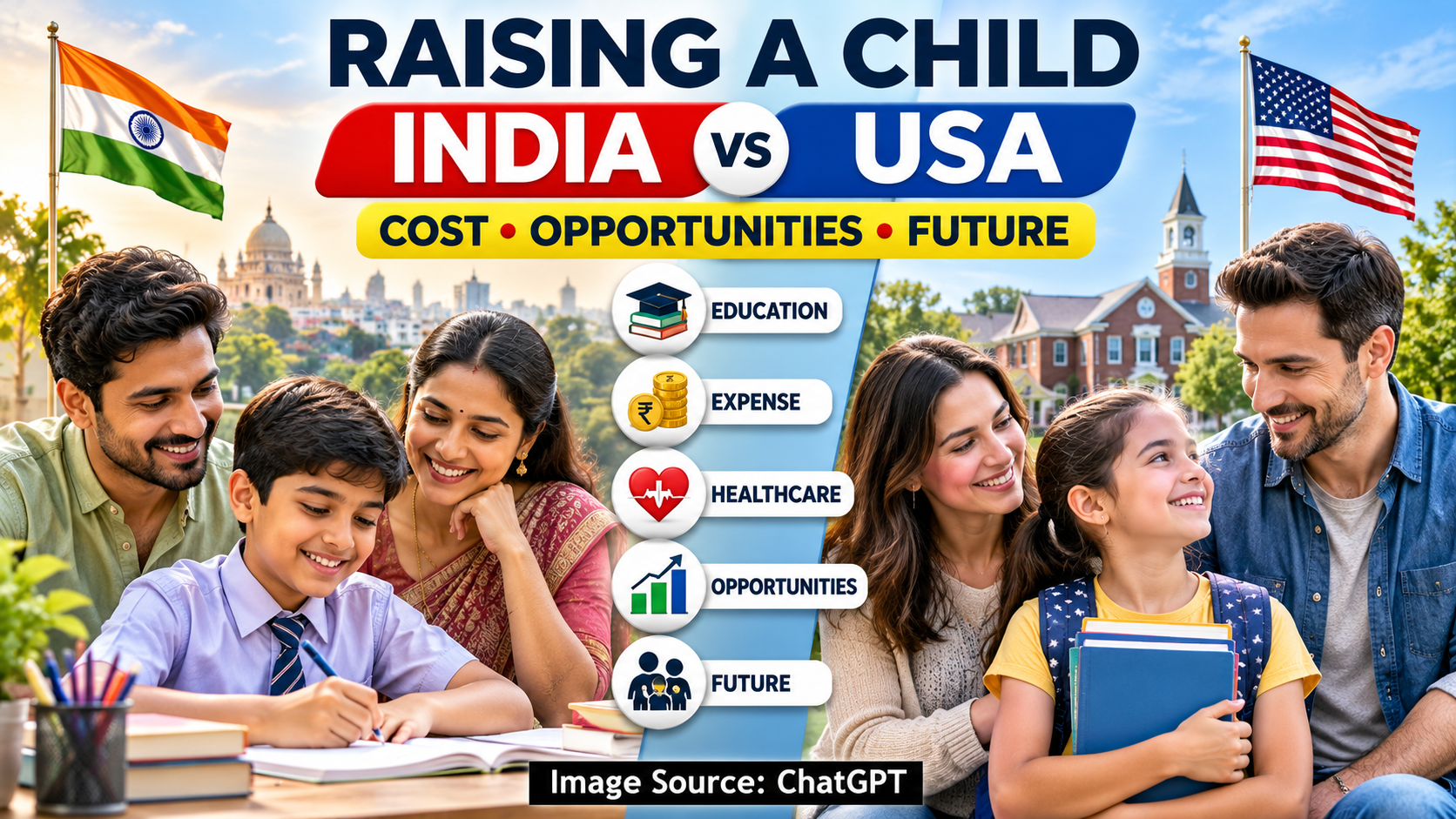
Choosing where to raise a child is one of the most consequential decisions parents can make. India and the United States offer very different combinations of financial affordability, educational opportunities, healthcare, family relationships, and career prospects.
In India, many children grow up surrounded by extended family, familiar traditions, and comparatively affordable everyday services. In the USA, families may benefit from well-resourced public schools, diverse extracurricular opportunities, and access to major international industries.
However, neither country guarantees a better childhood.
A family earning a comfortable salary in India may provide more stability and personal attention than a financially stretched household in an expensive American city. Conversely, a family with good employment benefits in the USA may enjoy educational and professional opportunities unavailable in its previous location.
The meaningful comparison is not simply rupees versus dollars. It involves purchasing power, parental income, the availability of support, and the child's evolving needs.
This guide compares the practical realities of raising a child in both countries, using recent published data and a long-term family-planning perspective.
Key Highlights
Living expenses: Everyday services can be less expensive in India, while American households often face higher housing and childcare bills.
Education: Both countries offer public education, but quality and private-school costs vary considerably.
Healthcare: India provides public and private choices; American medical expenses depend heavily on insurance.
Family relationships: Extended family may be easier to involve in daily childcare in India.
Career opportunities: Both countries offer pathways into technology, healthcare, business, research, and entrepreneurship.
Future security: Savings, educational quality, legal status, and emotional well-being matter more than nationality alone.
1. Understanding the Real Cost of Raising a Child
Child-rearing expenses begin before birth and continue through education, healthcare, food, housing, transportation, and eventually higher education.
India generally provides a lower nominal cost for many domestic services. Families can sometimes access affordable childcare, tutoring, transportation, and household assistance.
But affordability is relative.
A household earning ₹60,000 monthly cannot reasonably be compared with an American household earning $6,000 monthly without examining taxes, housing, insurance, local prices, and savings.
In the USA, salaries in certain professions are substantially higher, but families may spend more on rent, daycare, medical coverage, and transportation.
The important question is: How much disposable income remains after providing a safe, supportive environment for the child?
Parents should assess expenses as a percentage of take-home income, not merely compare converted currencies.
An inexpensive school is not necessarily good value if it lacks qualified teachers. Similarly, an expensive private institution is not automatically superior to a strong public school.
Financial planning begins with identifying what a child genuinely needs rather than what other families purchase.
2. Pregnancy, Childbirth and Medical Expenses
Healthcare is among the first major financial considerations for expecting parents.
Raising a baby in India
India offers government hospitals, community health services, and a large private healthcare sector.
Eligible families can receive maternity-related services through public facilities and applicable government programs.
Private hospitals may provide additional room choices, personalized services, or access to selected specialists, but costs vary significantly.
For parents, hospital delivery charges are only one expense. Prenatal consultations, medical tests, transportation, newborn examinations, and emergency care must also be considered.
Insurance coverage and hospital quality deserve careful examination.
Raising a baby in the USA
The American healthcare system combines private insurance, employer-sponsored coverage, and public programs for eligible families.
A major consideration is the difference between an insurance premium, deductible, copayment, and out-of-pocket maximum.
According to KFF's 2025 Employer Health Benefits Survey, the average annual premium for employer-sponsored family coverage was $26,993. Covered employees contributed $6,850 on average, with employers generally paying the remainder.
This figure represents insurance premiums, not the cost of delivering a baby.
Families should separately examine maternity coverage, hospital networks, pediatric services, and newborn enrollment requirements.
Practical takeaway: Healthcare quality, available specialists, insurance protection, and emergency access are more important than choosing a country based on delivery costs alone.
3. Parental Leave and Time With a Newborn
Money cannot entirely replace the time parents need to recover, bond with a newborn, and establish family routines.
In India, the Maternity Benefit Act provides up to 26 weeks of paid maternity leave for eligible women for their first two surviving children, subject to applicable statutory conditions.
Coverage is not universal across every type of employment. Many workers, especially in informal arrangements, may not receive the same benefits.
In the United States, the federal Family and Medical Leave Act generally provides eligible employees of covered employers up to 12 weeks of unpaid, job-protected leave for qualifying circumstances, including childbirth.
Some American states and employers offer additional paid family leave.
For families comparing two job offers, the number of paid weeks available, whether both parents qualify, and how health coverage continues during leave can materially change the value of employment.
A higher salary may become less attractive if a parent must resume work much earlier than expected.
The best arrangement is one that gives the family financial stability without unnecessarily sacrificing essential recovery and caregiving time.
4. Childcare: One of the Biggest Differences
Childcare can determine whether both parents continue working.
In India, grandparents and other relatives sometimes provide regular care, particularly where multiple generations live nearby.
Families may also use daycare centers, preschools, domestic caregivers, or neighborhood arrangements.
However, informal childcare should not be assumed to be free or automatically available. Grandparents have their own health, work, and personal needs.
In the USA, many households depend on professional daycare facilities, family childcare centers, or paid caregivers.
Child Care Aware of America's 2025 analysis estimated a national average annual childcare price of $13,184.
Actual prices vary by state, child's age, provider type, and required hours. Many families pay considerably more or less.
What parents should compare
A cheaper childcare arrangement is not necessarily better if supervision is unreliable.
Safety practices, caregiver qualifications, hygiene, emergency procedures, developmental activities, and consistency are essential.
Parents should also calculate the consequences of interrupted employment.
If dependable care allows both adults to maintain careers, its long-term economic value may exceed the immediate childcare fee.
Important distinction: The American childcare price is not directly comparable with India's average school expenditure because they measure different services and age groups.
5. School Education: India vs. the USA
Education shapes a child's knowledge, confidence, friendships, and future choices.
India has government schools, government-aided schools, and a wide range of private institutions.
The Right to Education framework provides free and compulsory elementary education for children aged six to fourteen, subject to its provisions.
According to India's 2025 Comprehensive Modular Survey on Education, average household expenditure per enrolled student during the academic year was:
₹2,863 in government schools.
₹25,002 in non-government schools.
These are nationwide survey averages, not quotations from particular schools. Private coaching was surveyed separately.
In the USA, tuition-free public elementary and secondary schools serve eligible children, with schooling generally organized by local districts.
School quality can differ significantly between districts and even between schools in the same region.
Some districts offer extensive facilities, libraries, sports programs, and specialized courses. Others face staffing and funding constraints.
Different academic approaches
Indian school systems frequently emphasize structured curricula, examinations, and academic progression.
American schools may offer more flexibility through elective subjects, school clubs, athletics, creative projects, and student-led activities.
These are broad tendencies, not universal rules.
An excellent Indian school can provide project-based learning and strong extracurricular programs. An American school may also place substantial pressure on grades and standardized testing.
Parents should evaluate actual teaching quality, student safety, class size, learning support, and school culture rather than rely on national stereotypes.
6. Housing, Transportation and Everyday Family Life
A child's environment extends well beyond the classroom.
Families need sufficient living space, a safe neighborhood, access to parks, reliable transportation, and reasonable travel times.
In many Indian cities, public transportation, local markets, and neighborhood services can reduce some everyday expenses.
However, congestion, unreliable infrastructure, long school commutes, and air pollution can affect quality of life in particular locations.
American suburban neighborhoods may offer parks, recreational facilities, and larger homes, but they can also require extensive driving.
A second vehicle, vehicle insurance, maintenance, and commuting expenses may become significant household costs.
Location matters enormously within both countries.
A family living in a walkable Indian neighborhood near grandparents may spend less time arranging transportation and care.
An American family living near a good public school and workplace may enjoy similarly convenient daily routines.
The objective should be to minimize unnecessary travel and create more time for family interaction.
7. Family Support, Culture and Emotional Development
One of India's notable strengths is the opportunity for regular contact with extended family when relatives live nearby.
Grandparents can introduce children to family history, regional languages, festivals, traditional food, and cultural customs.
These relationships may provide emotional security and help working parents manage responsibilities.
Yet extended-family arrangements are not always uncomplicated. Differences over discipline, food, education, and privacy can create tension.
In the United States, nuclear-family households are common, although extended and multigenerational households also exist.
Parents living away from relatives may need to build support through friends, neighbors, schools, community groups, and local activities.
Children growing up in multicultural communities may develop valuable experiences interacting with people from different backgrounds.
Neither arrangement is inherently superior.
What children need most is dependable affection, respectful communication, consistent boundaries, and adults who take their concerns seriously.
An emotionally secure home in India is more beneficial than a wealthy but unstable home abroad. The reverse is equally true.
8. Childhood Freedom, Health and Personal Development
A successful childhood is not measured only through examination scores or financial investment.
Children benefit from physical activity, friendships, play, sleep, creative expression, and appropriate independence.
In India, parents sometimes prioritize academic performance and competitive entrance examinations, particularly during secondary education.
Such preparation can support disciplined study, but excessive coaching or pressure may reduce time for recreation.
In the USA, access to school sports, clubs, arts programs, and community recreation can broaden opportunities.
Participation may nevertheless require substantial parental time, transportation, and fees.
Neither country is immune to screen overuse, bullying, academic stress, unhealthy diets, or social comparison.
Environmental differences also deserve attention. Parents should examine local air quality, traffic conditions, drinking water, pedestrian safety, and healthcare availability.
Rather than assume one nation provides a healthier upbringing, families should investigate the actual neighborhood and school.
The strongest developmental plan balances intellectual growth with emotional confidence, curiosity, and physical well-being.
9. Higher Education: The Biggest Long-Term Financial Decision
College expenses can dramatically alter a family's financial future.
India offers public universities, private universities, technical institutions, professional colleges, and vocational programs.
Highly competitive government institutions may provide relatively affordable pathways, while certain private professional programs can require considerable financial resources.
American higher education includes community colleges, public universities, and private colleges.
According to College Board's 2025–26 data, average published annual tuition and fees were:
$4,150 at public two-year colleges for in-district students.
$11,950 at public four-year colleges for in-state students.
$45,000 at private nonprofit four-year colleges.
These are published prices, excluding many living expenses. Scholarships and grants may significantly reduce actual tuition paid.
Students' residency and eligibility status can also affect tuition and financial aid.
American universities offer extensive research opportunities, but a prestigious degree should not automatically justify financially unsustainable borrowing.
Parents in both countries should discuss academic ability, career interests, scholarships, and alternative pathways before committing to expensive education.
10. Career Scope and Future Earning Potential
The USA offers important opportunities in advanced technology, scientific research, medicine, finance, engineering, and entrepreneurship.
Some careers provide high salaries, access to specialized research facilities, and connections with international employers.
India also has substantial opportunities across information technology, manufacturing, healthcare, education, business services, research, and emerging industries.
A child raised in India is not confined to the Indian labor market.
Similarly, growing up in America does not guarantee admission to an elite university or a high-paying career.
Future earning potential depends on employable skills, educational quality, experience, personal interests, economic conditions, and sometimes immigration authorization.
Parents should avoid choosing a country solely because they expect their child to become a doctor, engineer, or software professional.
The labor market a newborn eventually enters may look very different from today's.
Critical thinking, communication, digital literacy, adaptability, and a willingness to learn will remain valuable across a wide range of possible futures.
11. Legal Status and Long-Term Stability
For Indian families considering relocation to the USA, immigration status may be as important as salary.
Employment authorization, dependent status, permanent residence eligibility, and future education arrangements can influence family decisions.
A child should not be assumed to receive a particular immigration status, citizenship benefit, or tuition classification solely because the family lives in the United States.
Current laws and individual circumstances require verification.
Parents should also consider what happens if the principal visa holder loses employment or must relocate.
India may provide greater residential continuity for Indian citizens who already have established homes, professional networks, and family support.
Conversely, families with secure permanent status in the USA may experience fewer immigration-related uncertainties.
Legal stability should therefore be treated as a core component of financial and emotional security.
12. Comparing Two Practical Family Scenarios
Consider two hypothetical households, each with two working parents and one young child.
Family A lives in an Indian city.
The family rents an apartment, uses a nearby preschool, and occasionally receives help from grandparents.
Its major decisions involve selecting a suitable school, arranging dependable care, managing healthcare expenses, and preparing savings for future education.
Family B lives in an American metropolitan area.
Both adults work full-time, the child attends paid daycare, and the family depends on employer-sponsored medical insurance.
Its budget must account for childcare fees, housing, insurance contributions, transportation, and potential future college expenses.
Neither scenario proves that one country is better.
An accurate comparison requires reviewing household finances.
| Planning Factor | India | USA |
|---|---|---|
| Early childcare | Family support or paid providers | Family support or paid providers |
| Public schooling | Available under applicable laws | Tuition-free public K–12 options |
| Private education | Costs vary substantially | Costs vary substantially |
| Healthcare | Public and private systems | Insurance and public eligibility programs |
| Family support | Potentially easier near relatives | Depends on family and community |
| Higher education | Wide range of public and private costs | Large variation in tuition and aid |
| Career opportunities | Domestic and global pathways | Domestic and global pathways |
The comparison becomes useful only when parents replace these general descriptions with quotations, salaries, and conditions from their intended locations.
13. How Parents Can Build a Better 18-Year Financial Plan
The decision to raise a child in either country should begin with a realistic long-term budget.
First, calculate monthly take-home household income after taxes and mandatory contributions.
Next, identify fixed costs: housing, utilities, insurance, transport, groceries, and existing loan repayments.
Then estimate child-specific expenses by age.
Infants require healthcare, supplies, and caregiving. School-age children need learning materials, activities, transportation, and sometimes academic assistance.
Teenagers may require larger educational budgets, technology, examination fees, or specialized training.
Parents should also create an emergency reserve and consider appropriate health and life insurance protection.
Education savings should be planned without sacrificing retirement security or creating unsustainable debt.
Review the budget every year rather than assuming today's school fees or childcare charges will remain unchanged.
Finally, preserve money and time for family experiences. Children benefit from shared meals, conversations, outdoor activities, and emotionally available parents.
A financially disciplined household that maintains healthy relationships offers advantages no expensive institution can guarantee.
Final Verdict: Which Country Is Better for Raising a Child?
There is no universal winner between India and the USA.
India may be particularly attractive to families seeking proximity to relatives, cultural continuity, and more affordable everyday services.
The USA may appeal to parents who value certain educational pathways, specialized professional opportunities, and access to particular research or recreational facilities.
However, these advantages depend on location, income, employment benefits, schools, and individual circumstances.
A financially secure, emotionally supportive household in India may provide a better childhood than a household struggling with financial pressure in the United States.
The same principle applies in reverse.
Ultimately, the best country to raise a child is the one where parents can consistently provide safety, love, quality education, healthcare, financial stability, and the freedom to develop individual talents.
A child's future should be measured by opportunity and well-being—not simply by the country printed on a passport.