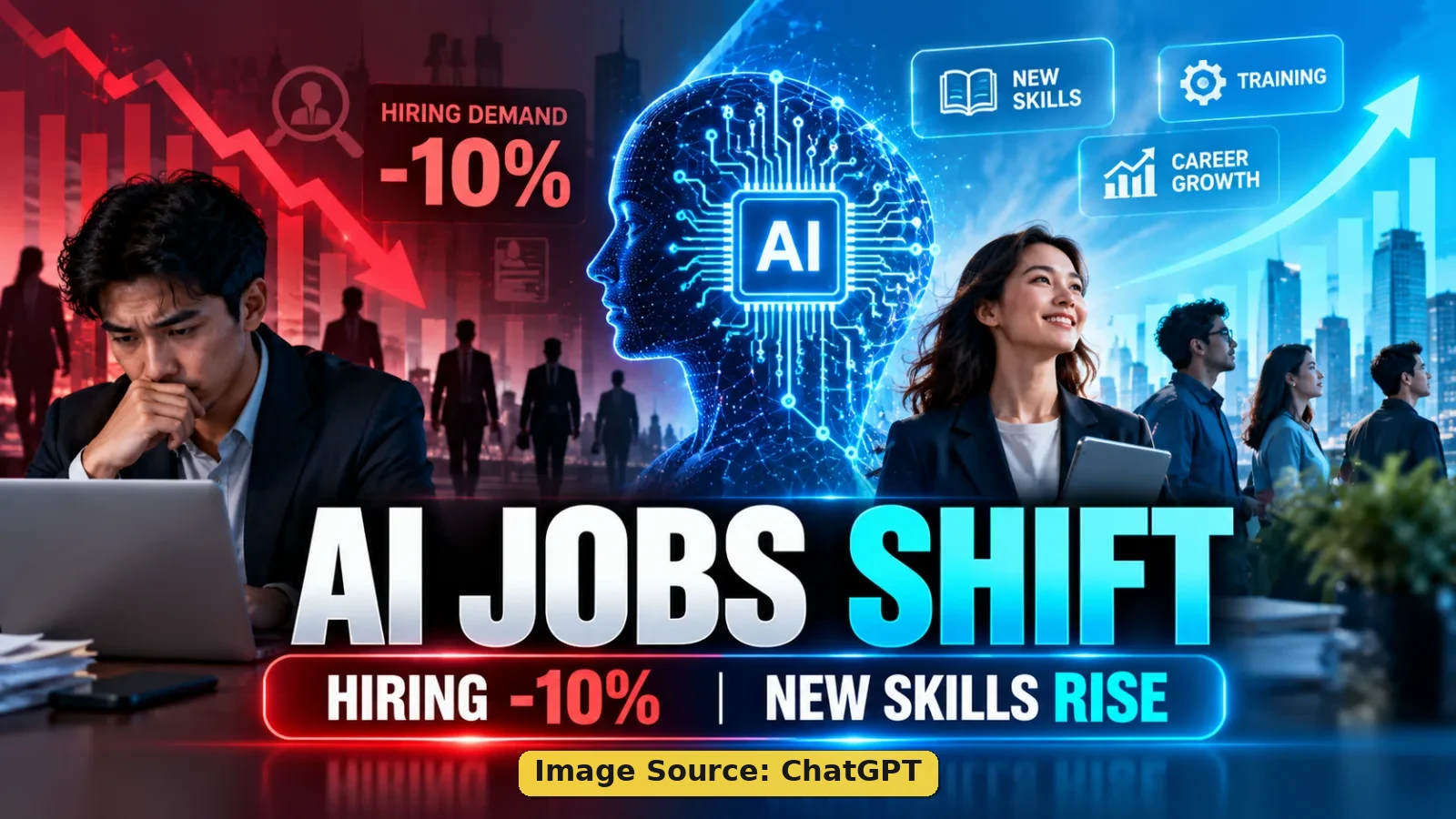
Artificial intelligence is beginning to reshape employment across Asia, with new research from the International Monetary Fund (IMF) revealing that demand for workers in occupations highly exposed to AI has declined by nearly 10% relative to jobs less affected by the technology.
The findings, published in the IMF's October 2026 Regional Economic Outlook: Asia and Pacific, highlight an important change in how businesses recruit employees, organize work and evaluate professional skills.
Researchers examined approximately 40 million online job advertisements across 19 Asian economies, producing one of the region's most comprehensive assessments of how artificial intelligence is influencing hiring.
Although the results raise concerns for workers performing tasks that AI can increasingly automate, they also reveal a more encouraging development: employers are seeking new skills as businesses integrate AI into everyday operations.
Expertise in prompt engineering, AI agents, data management and AI-powered business processes is emerging as an increasingly valuable addition to traditional professional qualifications.
The findings suggest that the employment challenge may be less about the complete disappearance of existing occupations and more about how quickly workers, companies and education systems can adapt.
IMF Study Finds Nearly 10% Decline in Hiring Demand for AI-Exposed Jobs
The IMF examined changes in employer recruitment since the public launch of ChatGPT in November 2022.
Its research compared occupations where artificial intelligence can perform a substantial proportion of existing tasks with occupations where the technology has more limited applications.
The results showed a clear difference.
Hiring demand in more AI-exposed occupations declined by nearly 10% relative to demand in less-exposed occupations.
Importantly, the finding does not mean that 10% of workers across Asia have lost their jobs.
It measures relative changes in demand reflected in online job advertisements, not the total number of workers currently employed.
The distinction matters because companies can reduce recruitment without immediately reducing their existing workforce.
A business may choose not to replace a departing employee, postpone a planned expansion or assign additional responsibilities to its existing staff.
These decisions can lower demand for new hires even when the number of people already employed changes relatively little.
The IMF's findings therefore provide an early signal of employment-market adjustments that could become more visible over time.
How the IMF Measured AI's Impact on Employment
The research covered 19 Asian economies at different levels of economic development.
Rather than relying exclusively on surveys about how companies expect artificial intelligence to affect employment, researchers analyzed actual job advertisements.
The dataset included approximately 40 million postings through April 2026.
The IMF compared hiring trends across occupations with different levels of exposure to AI.
For example, software programming contains tasks that advanced AI systems can increasingly assist with, including code generation and debugging.
By comparison, some responsibilities involving physical work, relationship management or complex interpersonal judgment may be less directly affected by current AI capabilities.
Researchers controlled for differences involving countries, industries, time periods and the suitability of occupations for remote work.
This approach helped distinguish AI-related hiring patterns from broader changes in economic conditions.
However, job advertisements do not capture every form of employment.
Informal hiring, internal promotions and recruitment outside major online platforms can remain underrepresented.
The study provides important evidence of changing employer demand, but it should not be interpreted as a complete measurement of all job creation or displacement.
Why Are Companies Hiring Fewer Workers in AI-Exposed Roles?
The decline in recruitment demand reflects how businesses are reconsidering the relationship between employee productivity and staffing requirements.
Generative AI has expanded rapidly beyond basic text generation.
Modern tools can summarize documents, analyze information, generate computer code, prepare presentations and assist with customer communication.
These capabilities allow certain tasks to be completed more quickly.
Consider a software development team that previously needed additional junior employees to assist with routine coding and documentation.
AI coding assistants may now handle part of that workload, allowing existing developers to concentrate on architecture, testing and more complex problems.
The company may continue developing new software while reducing the need for some additional entry-level recruitment.
Similar changes can occur in marketing, administrative support, data processing and other occupations involving repetitive digital tasks.
However, increased productivity does not always lead to reduced employment.
If AI allows businesses to develop better products, lower prices or serve more customers, those gains may eventually encourage expansion and additional hiring.
The employment outcome depends on whether automation reduces labor requirements faster than productivity improvements generate new business opportunities.
This tension is central to the IMF's analysis.
AI Capabilities Are Improving, but the Hiring Decline Has Stabilized
One of the most interesting findings is that the measured decline in employer demand has not continued to accelerate at the same pace as improvements in AI technology.
During the early period following ChatGPT's introduction, the hiring impact was relatively limited.
As AI systems became capable of more substantial workplace tasks, recruitment demand weakened in exposed occupations.
By 2024 and 2025, the reduction had become more pronounced.
Nevertheless, the IMF reported that the employment-demand effect appeared to stabilize even as AI capabilities continued to improve.
This suggests that employers are not responding to every technological advance by eliminating an equivalent amount of labor.
Instead, businesses may be learning how to combine AI systems with human employees.
Some workers are shifting toward oversight, complex problem-solving and tasks that require contextual judgment.
Others are learning how to use AI tools to complete assignments that previously required considerably more time.
The stabilization offers a reason for cautious optimism, although it does not guarantee that future technological developments will leave hiring unchanged.
New AI Skills Are Creating Different Career Opportunities
While some conventional tasks are becoming easier to automate, companies are developing new requirements for employees who can use artificial intelligence effectively.
The IMF identified growing demand for emerging AI-related skills, particularly in occupations already highly exposed to the technology.
These capabilities include prompt engineering, retrieval-augmented generation and the development of AI agents.
Unlike routine software knowledge, these skills involve understanding how artificial intelligence can be incorporated into real business activities.
For example, a company may need employees who can connect an AI assistant to internal documents while ensuring sensitive information remains protected.
Another organization may require specialists who can evaluate whether an automated system produces reliable answers.
A marketing team may benefit from professionals who combine consumer research and creative judgment with AI-assisted data analysis.
Such responsibilities demonstrate that AI adoption can change the skills required within existing occupations instead of simply creating a separate category of technology jobs.
Five AI Skills That Could Improve Career Prospects
Workers seeking to remain competitive can focus on practical abilities that connect artificial intelligence with real organizational needs.
1. Practical AI Literacy
AI literacy means understanding what current AI systems can do, where they are unreliable and how to use them responsibly.
Employees who understand these limitations can identify useful applications without placing excessive trust in automated results.
This capability is valuable across business administration, marketing, education, finance and customer service.
2. Prompt Engineering
Prompt engineering involves providing clear instructions, relevant context and structured requirements to generative AI systems.
Effective prompting can improve the usefulness of AI-generated reports, summaries, research assistance and software outputs.
However, prompt engineering should be treated as one part of a broader professional skill set rather than a guaranteed standalone career.
3. AI Agent Development
AI agents are systems designed to complete sequences of tasks using models, software tools and predefined workflows.
Businesses may use agents to assist with internal research, document processing or other structured activities.
Building reliable agents requires knowledge of software integration, access controls, testing and error handling.
4. Retrieval-Augmented Generation
Retrieval-augmented generation, commonly called RAG, allows AI systems to use relevant information from external documents or databases when preparing responses.
This is particularly useful when organizations need assistants that can work with internal policies, technical materials or changing business information.
Practical expertise involves document preparation, information retrieval, system evaluation and data security.
5. AI Quality Assurance and Data Governance
Organizations adopting artificial intelligence need processes for checking accuracy, monitoring performance and protecting information.
Workers who understand AI evaluation, privacy requirements and operational risks can contribute to safer implementation.
These responsibilities are particularly important in industries where mistakes may have serious financial or personal consequences.
Why Entry-Level Jobs Face Particular Challenges
The changing job market creates difficult conditions for students and recent graduates.
Many professional careers begin with relatively structured assignments.
Junior software developers may handle basic coding problems. New analysts may organize spreadsheets. Entry-level marketing employees may prepare initial drafts of campaign materials.
AI systems are becoming increasingly capable of assisting with these tasks.
This creates a potential problem for traditional career development.
If companies automate the assignments historically given to beginners, young professionals may find it harder to gain the experience required for more advanced responsibilities.
Earlier IMF research also identified employment risks for younger workers in occupations with high AI exposure and limited opportunities for human-AI complementarity.
The challenge is not necessarily that junior employees have become unnecessary.
Businesses still need people capable of learning organizational processes, understanding customers and developing professional judgment.
However, employers may increasingly expect new recruits to arrive with a combination of conventional qualifications and practical AI skills.
This could make work experience, internships and demonstrable project portfolios more important.
What the Findings Mean for India and Other Asian Economies
Artificial intelligence will not affect every Asian country in the same way.
Advanced economies with extensive digital infrastructure and substantial professional-service sectors may experience faster changes in occupations involving information processing.
Developing economies often have different employment structures, including larger agricultural, manufacturing and informal sectors.
As a result, their exposure to immediate AI-driven automation may be lower.
However, limited exposure does not automatically protect workers from future disruption.
As affordable AI tools spread, businesses across Asia may begin adopting technologies that were previously accessible mainly to large international companies.
For India, the findings are particularly relevant to information technology services, business-process operations and digitally delivered professional services.
AI tools can support programming, documentation, customer communication and analytical tasks frequently performed within these industries.
At the same time, Indian businesses may find opportunities to provide AI integration, software development, cybersecurity and specialized digital services.
The long-term outcome will depend on how effectively companies develop new services and help employees acquire useful skills.
For economies with growing populations of young job seekers, the challenge is especially urgent.
Governments and businesses must create pathways into productive employment even as some traditional entry-level tasks become automated.
AI Could Help Aging Economies Address Labor Shortages
Not every country faces the same employment problem.
Some Asian economies are experiencing declining birth rates and aging populations.
These demographic changes can create shortages of available workers, particularly in occupations requiring specialized knowledge.
AI may help businesses maintain essential services with smaller workforces.
For example, automation could reduce administrative workloads in healthcare organizations, support business operations and allow experienced employees to focus on higher-value responsibilities.
This does not eliminate the need for trained professionals.
Rather, it creates opportunities to use scarce labor more effectively.
The IMF notes that AI could make employment creation more challenging in younger economies while helping aging societies manage workforce shortages.
These contrasting outcomes illustrate why labor-market policies need to reflect local economic conditions instead of applying a single strategy across the region.
Do AI Skills Lead to Higher Salaries?
Separate IMF research published in January 2026 provides evidence that employers are placing greater financial value on emerging skills.
That study found approximately one in ten job advertisements in advanced economies required at least one new skill, compared with roughly one in twenty in emerging-market economies.
In the United States and United Kingdom, advertisements requiring new skills were associated with wage offers about 3% higher on average.
Positions requiring several emerging skills sometimes offered larger premiums.
These findings do not mean that every AI qualification guarantees a salary increase.
Compensation still depends on professional experience, occupation, location and the employer's actual business requirements.
Nevertheless, the research suggests that workers who combine useful technical abilities with established industry knowledge may gain advantages in recruitment and career advancement.
An experienced accountant who can apply AI-assisted analysis appropriately, for example, may offer greater practical value than someone familiar with AI tools but lacking accounting expertise.
The strongest opportunities may come from combining technology with specialized human knowledge.
How Workers Can Prepare for an AI-Driven Job Market
The IMF's findings offer an important practical message: career preparation should focus on adaptability rather than fear.
Workers do not necessarily need to become AI researchers or software engineers to benefit from technological change.
A more realistic starting point is identifying where AI can improve their existing responsibilities.
For someone working in marketing, that might involve learning to analyze campaign results using AI-assisted tools.
For a financial professional, it could mean understanding automated reporting while retaining responsibility for accuracy and regulatory compliance.
A teacher might explore AI-assisted lesson preparation while continuing to exercise independent educational judgment.
Students entering the workforce can strengthen their prospects by developing both technical and interpersonal capabilities.
A practical career-development strategy includes:
Identify changing tasks: Review which activities within your occupation are increasingly supported by AI.
Learn relevant tools: Focus on applications connected to your field rather than attempting to master every new product.
Build practical projects: Create examples demonstrating how you have used AI to solve meaningful problems.
Develop analytical judgment: Learn to evaluate outputs, recognize errors and explain your decisions.
Strengthen human capabilities: Communication, collaboration and industry knowledge remain essential.
Continue learning: Revisit your skills regularly as employers adopt new systems and change job requirements.
These steps cannot eliminate every employment risk, but they can help workers respond more effectively to changing expectations.
Businesses Must Balance Automation With Workforce Development
Artificial intelligence presents opportunities for companies to improve efficiency and reduce repetitive workloads.
However, an exclusive focus on reducing labor costs can create longer-term problems.
Organizations still need people who understand their products, customers, internal systems and regulatory responsibilities.
If companies reduce junior recruitment too aggressively, they may weaken the pipeline of experienced professionals available in the future.
A more sustainable strategy involves redesigning work around cooperation between employees and technology.
Businesses can use automation for routine activities while giving employees opportunities to develop more complex responsibilities.
Training programs can also support workers whose existing tasks are changing.
For example, a customer-service employee may be trained to supervise AI-assisted support, handle difficult cases and identify recurring customer problems.
Such transitions require investment, but they can help businesses preserve valuable organizational knowledge.
The IMF's analysis reinforces the importance of workforce policies that support both technological adoption and professional development.
Governments and Education Systems Face a Major Test
AI-driven employment changes create responsibilities beyond individual workers and private companies.
Schools, universities and vocational institutions must reconsider which capabilities graduates need.
Traditional curricula may require updates to include AI literacy, digital problem-solving and responsible technology use.
However, educational reform should not concentrate solely on technical instruction.
Communication, mathematics, critical thinking and subject-specific knowledge remain important foundations for productive AI use.
Governments may also need stronger retraining systems for workers whose occupations experience declining demand.
Affordable professional education, employment support and cooperation with employers can help people move between jobs and industries.
The IMF has emphasized the importance of stronger social protection and labor-market reforms as economies adjust to technological change.
Successful policies will need to address differences between urban and rural employment, formal and informal work, and advanced and developing economies.
Without broad access to training, the benefits of AI could become concentrated among workers and businesses that already possess substantial resources.
Will Artificial Intelligence Eventually Create More Jobs Than It Replaces?
The IMF's latest findings do not provide a definitive answer.
Artificial intelligence can create opportunities by reducing costs, enabling new services and expanding productivity.
At the same time, it can weaken demand for occupations where existing tasks become easier to automate.
The balance between these effects remains uncertain.
Much will depend on whether businesses use productivity gains to expand output, introduce new products and develop additional services.
Government policy, education, investment and consumer demand will also influence the outcome.
One encouraging finding is that demand for emerging AI skills is expanding even as recruitment weakens in some exposed occupations.
This indicates that technological adoption is changing the composition of labor demand rather than producing a uniform decline across every profession.
However, new opportunities may not automatically appear in the same locations or require the same qualifications as the jobs experiencing reduced demand.
Helping workers make that transition will be one of the central employment challenges of the coming years.
Final Outlook: The Future of Work Depends on Skills and Adaptation
The International Monetary Fund's October 2026 research offers a significant warning about the speed at which artificial intelligence is reshaping employment across Asia.
Hiring demand in occupations more exposed to AI has fallen nearly 10% relative to less-exposed jobs, providing evidence that technological advances are already influencing recruitment decisions.
Yet the findings also contain an important reason for optimism.
The decline appears to have stabilized despite rapid improvements in AI capabilities, while demand for new technological skills continues to expand.
For workers, this means that relying exclusively on established qualifications may become increasingly difficult in some occupations.
For businesses, it creates an opportunity to redesign work around greater productivity while investing in employee development.
For governments, it strengthens the case for accessible education, practical retraining and employment policies that respond to technological change.
Artificial intelligence may transform how millions of people work, but its ultimate effect on employment is not predetermined.
The defining career advantage of the AI era may belong to people who combine human expertise, sound judgment and the ability to work effectively with intelligent technology.
The future job market will reward more than familiarity with the latest AI tools. It will increasingly depend on the ability to apply those tools responsibly, solve meaningful problems and continue developing skills as technology evolves.