Key takeaways
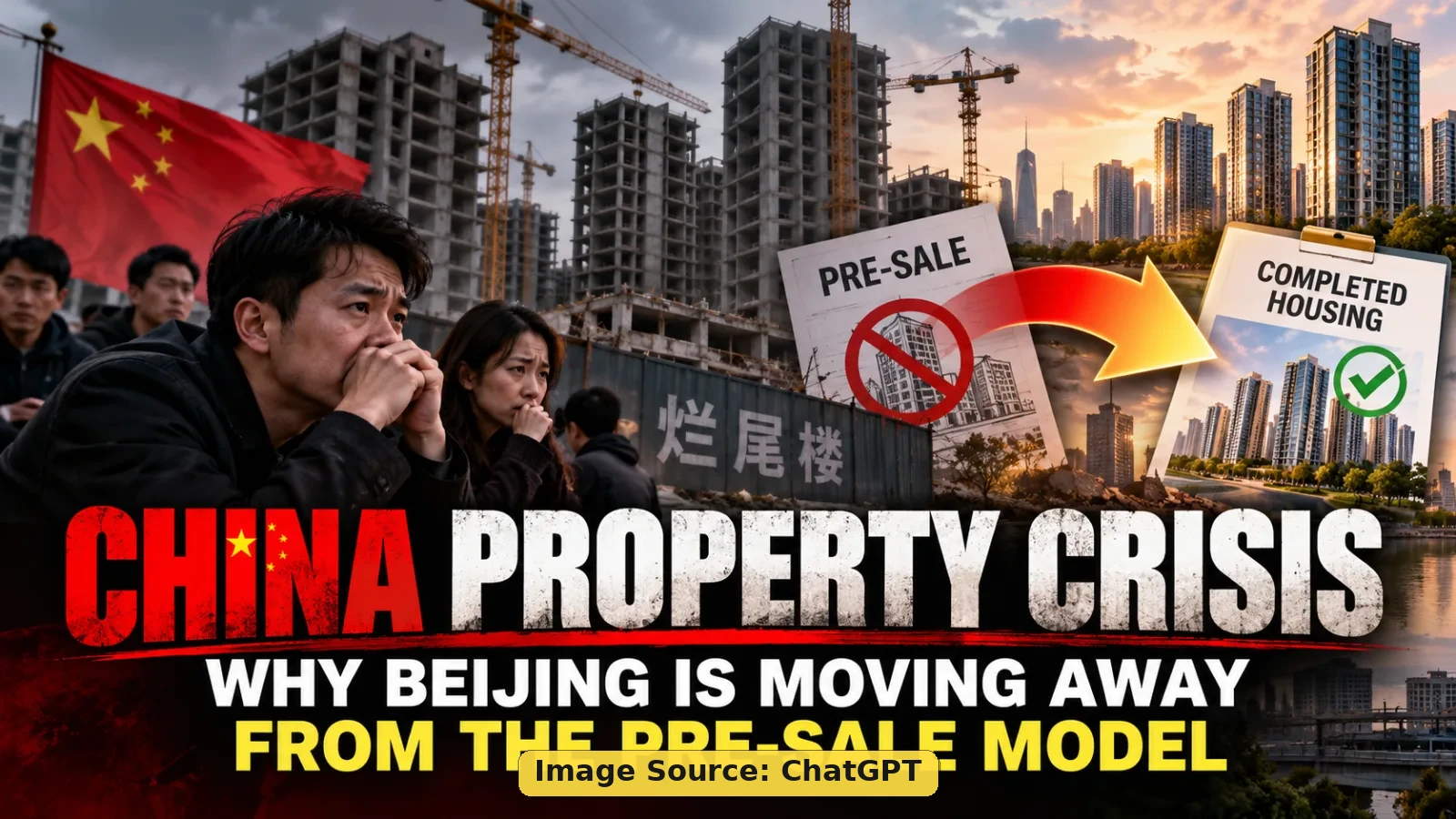
- A coordinated package issued on 28 August 2026 makes finished homes the priority for newly sold land, while pre-sales survive only under tougher conditions.
- Four forces drove the shift: stalled projects, damaged buyer trust, a debt-fuelled developer model, and a market that now has more homes than buyers.
- Early evidence is mixed. Land auctions cooled and resale activity picked up, yet new-home prices are still sliding.
- The core trade-off: buyers gain safety, but developers lose their cheapest source of cash.
Introduction
For roughly thirty years, buying a new apartment in China meant paying for something that existed only as a brochure, a scale model and a promise. Buyers handed over savings, took out mortgages and started repaying banks long before they received keys. Developers used that money to pour foundations, buy more land and launch more projects.
The arrangement powered one of history’s biggest building booms, in a sector that accounted for around a quarter of economic activity at its 2021 peak. It also left millions of households exposed when the boom ended. The reforms announced on 28 August 2026 are Beijing’s clearest admission that the old bargain no longer works. Here is what changed, why, what the first results show, and where the new system could still stumble.
What Beijing actually changed on 28 August 2026
Two sets of documents landed that day. A notice from the housing ministry, the natural resources ministry and the financial regulator redesigned how homes are sold. A separate set of opinions from the central bank and the financial regulator rewired how property is funded. The main elements:
- Finished homes first. Projects on newly transferred land, or on land sold earlier but still lacking a construction planning permit, should prioritise completed-home sales. Projects that already hold permits are encouraged to follow.
- Pre-sale survives, with a higher bar. Developers who still pre-sell may start only after each building’s main structure has topped out. HSBC reads the rules as keeping pre-sale money locked until completion.
- One bank per project. A lead bank (or a syndicate leader) handles each project’s development loan, with terms capped at five years for pre-sale projects and seven for completed-home projects. Loans are meant to flow to projects of any ownership type on equal terms.
- Mortgages follow delivery. Loans for completed homes are released once the sale is registered; for pre-sold homes, only after completion is registered.
- Longer mortgages. The maximum personal mortgage term rises from 30 to 40 years.
- Refundable deposits. Completed-home developers may take small deposits once permits are issued: up to 1% in Beijing, 3% in Shanghai and Shenzhen, and 5% in Guangzhou.
- Old projects, old rules. Land acquired before 28 August generally stays under existing arrangements, after local risk reviews.
The headline is easy to misread. Pre-sale has not been abolished; it has been put on a short leash, and “build first, sell second” is the new default for fresh land.
How pre-sale built modern China
Mainland China wrote pre-sale into law in 1994, borrowing the concept from Hong Kong. In a country short of both housing and capital, it was an elegant fix. Buyers supplied interest-free funding, developers recycled the cash quickly, and cities collected land revenue from each new round of projects. Wu Jing, who directs a real estate research centre at Tsinghua University, has noted that buyers of that era mostly wanted to know whether they could get a home at all; floor plans and renderings were enough.
The model stayed dominant for decades. In 2020, pre-sales made up 87.3% of new-home sales, according to HSBC’s analysis of Wind data. By 2025 the share had slipped to 64.1%, a sign that buyers were already drifting toward finished product.
Why Beijing is walking away: four fault lines
1. Buyers carried risk they could not control
Under pre-sale, a household pays first and waits. If the developer runs out of cash, the buyer keeps the mortgage and loses the home. After Evergrande defaulted in 2021, that risk became real. Nomura estimated in 2022 that developers had delivered only about 60% of the homes they pre-sold between 2013 and 2020. Buyers in dozens of cities stopped paying mortgages on stalled projects, putting loans worth as much as 2 trillion yuan in question, according to Bloomberg. State media later reported millions of stalled homes completed, though some analysts believe the original backlog was far larger, around 20 million units.
2. Pre-sale supercharged leverage
Because buyers’ money arrived before the bricks did, developers could keep borrowing and bidding for land faster than their balance sheets justified. At the press briefing on the package, officials singled out the high-debt, high-leverage, high-turnover playbook and pointed to Evergrande’s collapse. Project-level loans and locked-in funds target that loop directly: one project’s cash can no longer chase the next plot.
3. Trust became the scarcest asset
Households are the weak link in any recovery. Central bank data reported by Yicai show household loans fell by 716.3 billion yuan in the first half of 2026, to 36.29 trillion yuan, a sign that families are paying down debt rather than adding it. Buyers who do shop have shown a preference: completed homes rose from 10.4% of new-home sales by floor area in 2021 to more than 30% by April 2025, Caixin reported. Given a choice, people pay for certainty.
4. The market flipped from shortage to surplus
Pre-sale suited a time when the question was how fast homes could be built. It suits a surplus less well, when the question is which homes are actually good. The National Bureau of Statistics says registered second-hand transactions covered 549.23 million square metres in January–August 2026, outpacing new-home sales for several months running. A new flat sold on a promise now competes with a resale flat the buyer can walk through. The 15th Five-Year Plan, unveiled in March 2026, had already pledged to promote completed-housing sales in an orderly way and to match land supply to inventory and demographic change.
The financing rebuild: what “built-first” requires
Selling finished homes only works if someone funds construction for longer, so the credit rules matter as much as the sales notice.
The lead-bank system aims for closed-loop money: loan proceeds and buyer funds are meant to stay inside the project that raised them. To soften the cash squeeze, cities are also letting developers stage land payments. Beijing wants the balance within two years; Shanghai within one year, with a possible interest-free extension of another year; Guangzhou and Shenzhen use similar “1+1” schedules.
The 40-year mortgage is a double-edged tool. It lowers monthly instalments, which helps younger borrowers who would otherwise hit lenders’ age limits, but it raises total interest paid. Struggling existing borrowers may also extend, provided the extension does not exceed half the original term and the total stays within 40 years. An analyst quoted by Yicai noted that ageing economies such as Japan and South Korea already allow terms of up to 50 years, while the United States, Canada, Australia and Germany stay at 30. Forty years is a ceiling, not a requirement.
What the early data say
Eight weeks of evidence is thin, but it is already instructive.
- Land cooled. Land transaction volume across 70 major cities fell 36% in the week after the announcement, and auction premiums hit a one-month low, Caixin reported. State-backed builders, the main remaining buyers, focused on small, low-density parcels.
- Rules arrived fast. Beijing published detailed rules on 24 September. Shenzhen completed the set for all four first-tier cities on 15 October, 21 days later. Until then many developers simply waited.
- Bidding grew calmer. In Guangzhou’s Pazhou South area, one plot sold on 28 August after more than 200 rounds at a 33.02% premium; a nearby plot sold on 30 September after 41 rounds at 26.5%. Beijing relisted a suspended Chaoyang site, now split in two, for a combined 8.3 billion yuan.
- Resale perked up. Institutional monitoring showed second-hand transactions in 25 cities up 53% year on year during the first six days of the National Day holiday. Holiday data are noisy, so treat that as a signal, not a trend.
- Prices still fall. New-home prices across 70 cities slipped 0.1% month on month in September and 2.8% year on year, the slowest annual decline since December 2025. Seventeen cities posted monthly gains, and Shanghai rose 2.8% year on year. Yet January–September new-home sales by floor area fell 13.8%, and property investment dropped roughly 20%.
Analysts urge patience. Maybank’s Erica Tay argues the reform should not be judged by immediate sales, HSBC describes only marginal demand support, and China Index Academy expects a limited effect on prices.
Winners and losers
- Homebuyers gain delivery certainty and shorter exposure to construction risk. The watch item is price: developers carry higher financing costs and may try to pass them on.
- Strong, state-backed developers can afford longer cash cycles and already dominate land purchases.
- Smaller private developers are squeezed most, because pre-sale cash was their lifeline.
- Local governments rely on land sales for revenue, so cautious bidding hurts budgets.
- Banks gain tighter oversight of each project, but also concentrate exposure in the projects they lead.
Risks and open questions
- A cash gap during the transition. Moving from land purchase to first revenue now takes longer, raising financing costs and testing weaker builders.
- Fiscal and supply-chain spillovers. Fewer land bids shrink local revenue, and slower starts ripple through steel, cement and construction jobs. Property investment already fell 17.2% in 2025.
- An unsolved demand problem. The reform repairs trust on the supply side. It does not raise incomes, job security or price expectations, and new-home prices have been drifting lower since April 2022.
- A patchwork rollout. Deposit caps range from 1% to 5%, and Shenzhen and Shanghai say legacy projects will be “studied separately”. Shenzhen sells only about 30,000 new homes a year, so its adjustment will be gentler than in cities with heavier new-home markets.
- Heavier household debt. Longer mortgages ease monthly strain while quietly increasing lifetime interest.
What to watch next
- The completed-home share of new-home sales
- Land auction premiums and the share of plots left unsold
- Developer cash flow and any new bond defaults
- Detailed rules from the remaining cities
- Take-up of 40-year mortgages and household loan balances
- Property investment and new starts, which show whether builders are re-entering
Frequently asked questions
Is pre-sale banned in China? No. It continues for qualifying projects once the main structure is complete, but completed-home sales are the priority for new land.
Will the reform push home prices up? Not by itself. Analysts expect only a limited price effect; the aim is safer delivery and a sturdier development model.
Does this prevent another Evergrande? It reduces the chance that a developer’s failure becomes a household’s loss, because mortgages start later and funds are ring-fenced. It does not make developers solvent or revive demand.
The bottom line
Beijing is not rescuing the old model; it is replacing it. Pre-sale financed a generation of housing, but it also pushed risk onto the people least able to bear it and let leverage run ahead of demand. The new framework swaps speed for safety: finished homes, ring-fenced money, one accountable bank per project. Whether that stabilises the market depends on whether developers can survive the longer cash cycle and whether households regain the confidence to buy. For now, the reform fixes how homes are sold, not whether enough people want to buy them.