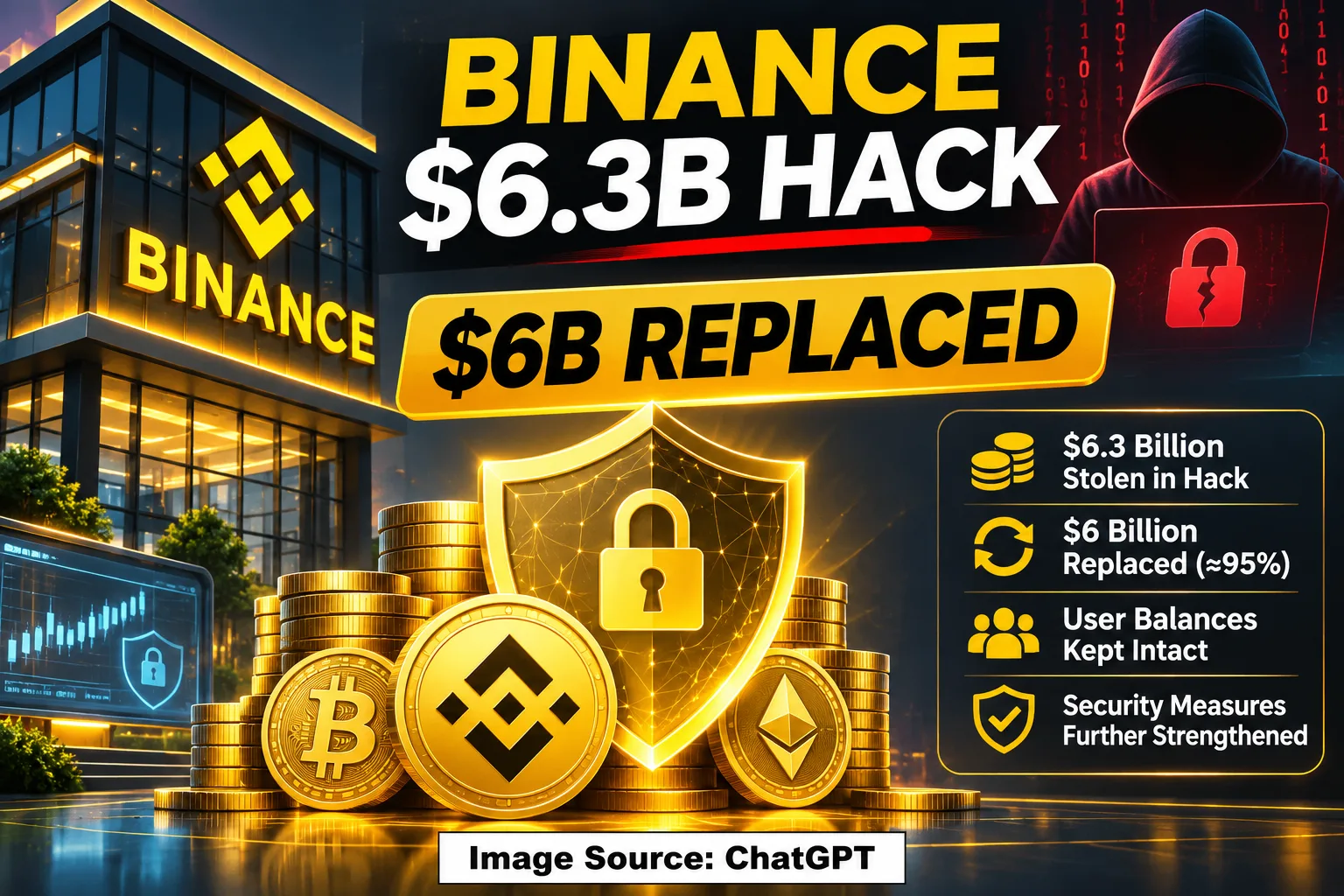
A security breach involving billions of dollars can shake confidence in even the largest cryptocurrency trading platform. For Binance, the events of October 29, 2026, became one of the most significant security emergencies in digital asset history.
Hackers stole cryptocurrency valued at approximately $6.3 billion, forcing Binance to suspend withdrawals while investigating how its systems were compromised. The company subsequently announced that it had replaced approximately $6 billion of the affected assets, using its financial resources rather than waiting for the stolen funds to be recovered.
By November 1, Binance reported that approximately 95% of the affected value had been replenished. It also began restoring withdrawal services in stages.
For customers, however, the financial figures tell only part of the story. Questions remain about the security weaknesses that enabled the attack, how protected balances can be independently verified, and whether exchanges are adequately prepared for increasingly sophisticated cyber threats.
Understanding the difference between replacing stolen assets and recovering them is particularly important. The former can restore an exchange's financial backing; the latter requires identifying, freezing, seizing, or otherwise retrieving cryptocurrency from attackers.
1. What Happened During the $6.3 Billion Binance Hack?
The incident began on October 29, when unauthorized transactions drained cryptocurrency from Binance-controlled hot wallets.
Hot wallets remain connected to online systems, allowing exchanges to process deposits, withdrawals, and trading-related transfers efficiently. That convenience also makes the infrastructure a valuable target for cybercriminals.
According to Binance's initial investigation, attackers may have compromised a laptop used by a DevOps engineer. The intrusion apparently provided access to internal infrastructure capable of submitting unauthorized withdrawal transactions.
Subsequent investigations identified additional potential points of compromise, suggesting the attack involved more than one weakness.
Blockchain investigators observed substantial amounts of cryptocurrency moving out of affected wallets within a short period. Reports indicated that much of the theft occurred within approximately 20 minutes.
Binance responded by suspending withdrawals, initiating security checks, examining affected infrastructure, and coordinating with blockchain monitoring companies and law enforcement.
The company also promised to absorb the financial losses instead of passing them directly to customers.
2. How Much Cryptocurrency Was Stolen, Replaced, and Frozen?
The incident produced several enormous financial figures, but they represent different things.
| Financial Measure | Reported Amount | Meaning |
|---|---|---|
| Estimated cryptocurrency stolen | $6.3 billion | Binance's approximate valuation of the affected assets |
| Assets replaced by Binance | Approximately $6 billion | Company-funded replacement of stolen cryptocurrency |
| Replacement coverage | Approximately 95% | Share of the affected value replenished by November 1 |
| Assets identified or frozen | Approximately $3 billion | Stolen assets targeted by separate tracing and freezing efforts |
| Resources allocated to cover losses | Approximately $6.34 billion | Financial resources Binance said it had set aside |
| Remaining replacement requirement | Approximately 5% | Primarily less-liquid tokens awaiting replenishment |
These amounts should not be added together.
For example, the $3 billion identified or frozen through recovery efforts is separate from the cryptocurrency Binance purchased or allocated to restore its holdings.
Similarly, setting aside $6.34 billion does not mean that amount has been recovered from the hackers.
The distinction matters because an exchange can use its own money to protect customer balances while investigators continue pursuing the original stolen assets.
3. How Binance Replaced Nearly 95% of the Stolen Assets
Binance's recovery response depended heavily on its ability to mobilize substantial financial resources quickly.
The company identified three major funding sources.
Corporate treasury: Binance allocated company-owned funds toward purchasing or replacing the affected cryptocurrency.
Secure Asset Fund for Users (SAFU): This emergency protection reserve was established to help address exceptional incidents affecting platform assets.
Futures Insurance Fund: Binance also identified resources associated with its futures insurance arrangements as part of the financial response.
The company said it intended to restore the SAFU balance to approximately $1 billion after using part of the fund.
Replacing a large amount of cryptocurrency is not necessarily as straightforward as transferring dollars between bank accounts.
An exchange must obtain the appropriate tokens, sometimes in substantial quantities, while considering trading liquidity and market conditions.
Widely traded assets such as Bitcoin and Ethereum generally have deeper markets than smaller cryptocurrencies. Less-liquid tokens can be harder to acquire without significantly affecting their prices.
That helps explain why Binance reported replacing most of the affected assets before completing the remaining portion.
The company said it was continuing purchases through public markets and over-the-counter trading channels.
4. Why Frozen Cryptocurrency Is Not Automatically Recovered Money
Blockchain transactions create publicly observable records, but following a digital asset does not necessarily provide the authority to take it back.
Investigators can track transfers between wallets and identify where stolen assets appear to be moving.
Certain centralized stablecoin issuers can also freeze specific tokens through controls built into their systems.
Following the Binance attack, cryptocurrency companies and industry partners helped identify or freeze approximately $3 billion in affected assets.
However, a frozen asset may still require legal procedures, technical cooperation, and ownership verification before it can be returned.
The challenge becomes greater when attackers convert tokens into cryptocurrencies that cannot be frozen directly by an issuer.
Bitcoin and native Ether, for example, operate differently from centrally issued stablecoins. Recovering them often depends on identifying control of wallets, intercepting transfers through cooperating services, or pursuing enforcement action.
Therefore, statements about frozen funds, recovered assets, and financial replacement should be evaluated separately.
Customers benefit from understanding these distinctions rather than assuming that every reported recovery figure represents cryptocurrency physically returned by hackers.
5. Who Was Behind the Binance Security Breach?
On October 31, the United States Federal Bureau of Investigation attributed the cryptocurrency theft to North Korean state-sponsored cyber actors associated with an operation known as TraderTraitor.
The FBI said investigators had observed stolen assets being converted primarily into Ethereum.
Authorities warned that subsequent transfers through decentralized finance platforms and instant cryptocurrency exchange services could complicate attempts to trace the assets.
Blockchain analytics companies also examined the attack's transaction patterns and reported similarities to earlier incidents associated with North Korean cyber operations.
North Korea has previously denied allegations that its government uses cyber units for financial theft.
While the FBI publicly identified the suspected perpetrators, a complete account of the attack's internal technical sequence was not yet publicly established.
That distinction matters. Attribution of an attack and understanding every vulnerability used to conduct it are separate investigative questions.
For exchanges, the bigger lesson is that security threats may extend beyond conventional password theft or isolated wallet vulnerabilities.
6. How a Compromised Employee Laptop Can Threaten Billions
The suspected entry point is particularly concerning because it illustrates the risks associated with trusted internal systems.
A DevOps engineer may work with software deployment, infrastructure maintenance, automation, and operational tools.
Depending on the organization's security design, these systems may interact with sensitive services or control processes affecting production infrastructure.
If an attacker compromises an authorized device, the intrusion may provide opportunities to access connected systems.
Strong wallet encryption alone cannot eliminate every risk if surrounding services or authorization processes are vulnerable.
A resilient cryptocurrency exchange therefore needs multiple independent protections.
These may include tightly limited employee permissions, isolated transaction-signing systems, independent approval requirements, endpoint monitoring, strict withdrawal controls, and automatic detection of abnormal transfers.
Such safeguards are particularly important when unusual transactions involve enormous values or multiple blockchains.
Binance said its investigation was continuing and that a detailed post-incident report would follow.
Until that investigation is complete, individual technical explanations should be treated as preliminary rather than definitive.
7. Binance Withdrawals: What Customers Should Know
One of the most immediate consequences of the attack was the interruption of cryptocurrency withdrawals.
Customers who could see assets in their exchange accounts could not necessarily transfer them elsewhere during the suspension.
Binance explained that the temporary restrictions allowed security teams to contain the incident, examine infrastructure, and assess whether withdrawal services could operate safely.
On November 1, the company began restoring withdrawals in phases. Bitcoin withdrawals resumed, while additional supported networks and assets were scheduled for progressive restoration.
The initial rollout covered major networks including Bitcoin, Ethereum, BNB Smart Chain, Solana, XRP, Tron, Dogecoin, and others.
Availability could differ by token and network.
For customers, this means a cryptocurrency might appear in an account while a particular withdrawal route remains temporarily unavailable.
It is important to check the actual network status before initiating a transfer.
Users should also remember that selecting an incorrect blockchain network or destination address can lead to permanent losses, regardless of whether an exchange has recovered from a security incident.
8. Are Binance Customer Funds Fully Protected?
Binance repeatedly stated that users would not bear the direct financial impact of the attack.
The company said its replenishment efforts had restored complete backing for ten major assets: BTC, ETH, USDT, BNB, SOL, USDC, XRP, USD1, RLUSD, and ZEC.
It also took a new proof-of-reserves snapshot dated October 31.
Proof of reserves is intended to help customers examine whether reported assets support account balances.
However, a reserve snapshot is not identical to a comprehensive independent financial audit.
Its usefulness depends on the scope of assets and liabilities examined, the reliability of the information, and the ability to verify the underlying evidence.
Binance indicated that its full cryptographic proof associated with the new snapshot was expected by November 3.
Customers should therefore distinguish between a company's announcement that assets are backed and the independent verification of that assertion.
An account balance that appears unchanged is reassuring, but access to withdrawals, custody safeguards, and transparent reporting also matter.
9. What the Hack Means for Different Cryptocurrency Customers
Not every Binance customer faces the same practical challenges following a security breach.
A long-term investor may be primarily concerned about the safety of holdings and the ability to withdraw assets when needed.
An active trader may focus on trading access, market volatility, settlement requirements, and liquidity.
Someone who uses cryptocurrency for international transfers may be especially concerned about payment timing.
Meanwhile, a customer holding smaller digital tokens may experience different service restoration conditions from someone holding Bitcoin.
These differences show why a single recovery percentage cannot fully describe the customer experience.
A platform can report substantial financial replenishment while some customers continue encountering delays, uncertainty, or additional verification requirements.
Users should evaluate the situation according to their actual holdings, intended transactions, and available account information rather than relying exclusively on headline figures.
10. A 60-Day Customer Experience Matrix Following the Binance Hack
The following matrix presents an illustrative 60-day customer monitoring scenario, beginning November 1, 2026. It is not based on completed customer interviews or a real 60-day observation period.
Its purpose is to help users organize their decisions and identify the evidence they should review as Binance's recovery progresses.
| Period | Customer Experience Scenario | Key Action | Important Indicator |
|---|---|---|---|
| Days 1–3 | Customer checks account access and affected withdrawal routes | Verify balances and official service status | Successful access and confirmed network availability |
| Days 4–7 | Customer reviews security settings and withdrawal options | Strengthen account protection and test approved processes | Authentication, alerts, and service reliability |
| Days 8–14 | Customer follows security and reserve disclosures | Examine published financial and technical updates | Independent verification and clarity |
| Days 15–21 | Customer assesses whether normal transactions are practical | Review transfer records and unresolved restrictions | Processing consistency |
| Days 22–30 | Customer reassesses exchange custody exposure | Consider whether holdings are appropriately distributed | Custody concentration and access |
| Days 31–45 | Customer monitors continuing recovery developments | Review investigation findings and platform safeguards | Evidence of remediation |
| Days 46–60 | Customer decides whether the platform meets ongoing needs | Evaluate transparency, security, and reliability | Confidence supported by observable performance |
Key Highlights From the 60-Day Scenario
First week: Prioritize account security and verified access rather than reacting emotionally to market headlines.
First two weeks: Watch for independently verifiable reserve disclosures, technical explanations, and progress in restoring services.
First month: Evaluate whether the exchange consistently provides the features and accessibility customers actually need.
Second month: Focus on whether Binance demonstrates meaningful operational improvements and sustained transparency.
The matrix is a decision-making framework, not a prediction that every customer will encounter these experiences.
A customer who requires immediate access to funds may reach a different conclusion from someone whose assets remain securely stored for long-term purposes.
11. Practical Security Steps Binance Users Can Take
Although the reported attack involved exchange infrastructure, individual customers can still reduce their exposure to account-level threats.
Review account access. Check recent login activity, authorized devices, withdrawal addresses, and connected applications.
Enable strong authentication. Use a passkey or a reputable authenticator application where available. Avoid relying exclusively on SMS authentication when stronger options exist.
Protect your email account. A compromised email account can sometimes become the starting point for unauthorized cryptocurrency account access.
Beware of recovery scams. Attackers frequently exploit major security incidents by creating fake support pages, phishing messages, and fraudulent compensation offers.
Verify official announcements. Access Binance through trusted bookmarks or the official application rather than links sent through unsolicited messages.
Check withdrawal networks carefully. Confirm the destination blockchain, recipient address, and applicable network requirements before sending funds.
Assess custody decisions. Long-term cryptocurrency holders may consider whether personally controlled wallets are appropriate, while recognizing that self-custody introduces responsibilities involving recovery phrases, device security, and irreversible transfers.
Keep transaction records. Download account statements and preserve transaction identifiers when available.
No individual security practice can guarantee protection against every exchange-level failure. The objective is to reduce preventable risks and improve the customer's ability to respond.
12. Why the Binance Hack Matters Beyond One Exchange
The scale of the incident raises questions for the entire cryptocurrency industry.
Centralized exchanges perform several functions simultaneously: asset custody, trading execution, transaction processing, and account administration.
When these activities depend on interconnected operational systems, a serious internal compromise can have consequences far beyond one employee or software component.
The incident also highlights the importance of cooperation between stablecoin issuers, blockchain investigators, trading platforms, and enforcement agencies.
The rapid identification and freezing of affected assets demonstrated one potential advantage of coordinated blockchain monitoring.
At the same time, the difficulty of recovering other cryptocurrencies demonstrated the limits of those mechanisms.
Another significant concern is operational concentration.
Even if an exchange possesses enough financial resources to replace stolen tokens, customers may still face temporary restrictions while technical systems are rebuilt and tested.
Financial resilience and operational resilience therefore need to be evaluated together.
13. Can Binance Rebuild Customer Trust After the Breach?
Replacing billions of dollars in assets is an important financial response, but trust ultimately depends on more than compensation.
Customers need reliable access to their accounts, understandable explanations of security failures, and credible evidence that weaknesses have been corrected.
A detailed post-incident investigation could help answer questions about how attackers moved between internal systems, which controls failed, and how unauthorized transfers avoided prevention mechanisms.
Independent verification is equally important.
Clear information about reserves, liabilities, incident response, and security improvements can help customers assess the situation without relying solely on corporate reassurance.
Restoring services is only one milestone.
The longer-term test will be whether Binance can demonstrate that its infrastructure is more resilient and that similar attacks would be harder to execute.
14. What Should Cryptocurrency Investors Watch Next?
Several developments will be particularly relevant after the initial recovery announcement.
The first is completion of the remaining asset replacement process, especially for less-liquid tokens.
The second is sustained restoration of withdrawal services across supported networks.
The third is publication of reserve verification results, including any limitations or qualifications.
Customers should also watch for the detailed technical report promised by Binance and for independent assessments of its findings.
Further announcements by the FBI, blockchain analytics organizations, or enforcement agencies may clarify how much stolen cryptocurrency can ultimately be recovered.
However, progress in tracking criminal assets should not be confused with a guarantee of repayment or seizure.
For investors, another consideration is broader market confidence. A major exchange incident can influence trading activity, perceived counterparty risk, and short-term price volatility.
Those potential effects should be assessed without assuming that one security event determines the future direction of cryptocurrency prices.
15. Frequently Asked Questions
Did Binance recover the entire $6 billion from hackers?
No. Binance said it replaced approximately $6 billion using its own financial resources. The process of tracing and recovering the original stolen cryptocurrency is separate.
How much was stolen in the Binance hack?
Binance estimated the theft at approximately $6.3 billion. Independent blockchain analysis produced somewhat different estimates, reflecting differences in valuation and methodology.
Have Binance withdrawals resumed?
Binance began reopening withdrawals in phases on November 1, 2026. Bitcoin withdrawals resumed, with other assets and networks following a staged process. Customers should verify current availability for their specific asset.
Will Binance customers lose their cryptocurrency?
Binance has stated that it will absorb the financial impact of the incident instead of passing the losses directly to users. Customers should continue monitoring account access and independently available verification information.
Who was responsible for the attack?
The FBI attributed the theft to North Korean cyber actors known as TraderTraitor. The technical investigation into the full breach sequence was continuing.
Does proof of reserves guarantee an exchange is safe?
No. Proof of reserves provides potentially useful evidence about asset backing, but it does not independently guarantee operational security, future solvency, or protection against every type of financial or technical risk.
Conclusion: A Major Financial Response With Important Questions Remaining
Binance's decision to replace approximately $6 billion following a $6.3 billion cryptocurrency theft represents a significant effort to protect customer balances and restore confidence.
Its phased reopening of withdrawals provides another important milestone.
Nevertheless, financial replenishment does not erase the underlying security incident or mean that the original stolen assets have all been recovered.
The coming weeks will be important for assessing security improvements, reserve transparency, service reliability, and progress in the investigation.
For cryptocurrency users, the central lesson is straightforward: evaluate exchanges not only by their popularity and trading features, but also by their custody practices, financial resilience, transparency, and ability to respond when serious problems occur.